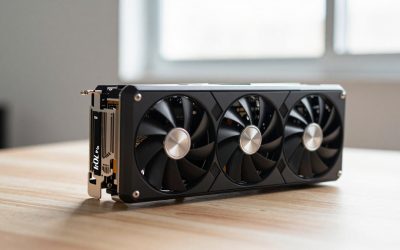
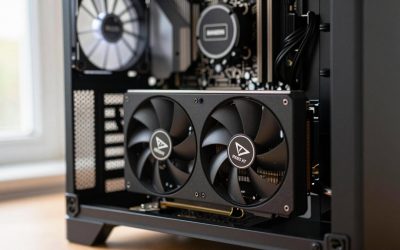
Pick the Arc A770 if you have a modern platform with Resizable BAR and mostly play DirectX 12 or Vulkan games, since it is generally the faster card there and its 16 GB of VRAM ages far better; pick the RTX 2070 if your PC is older, you play a lot of DirectX 11 or older titles, or you want the most mature drivers and DLSS.
The RTX 2070 launched in October 2018 at $499 as NVIDIA’s upper-midrange Turing card. The Arc A770 arrived four years later at $329 as Intel’s first serious desktop gaming GPU. Both are now superseded: NVIDIA’s RTX 50 series and Intel’s Arc B570 and B580 are the current parts. Still, both show up regularly on the used market, and they land close enough in price and performance that the choice comes down to your platform and game library more than raw speed.
As an Amazon Associate we earn from qualifying purchases at no extra cost to you.


Key Specifications
| Specification | GeForce RTX 2070 | Intel Arc A770 |
|---|---|---|
| Architecture | Turing | Xe-HPG (Generation 12.7) |
| Release date | 17 October 2018 | 12 October 2022 |
| Launch price (MSRP) | $499 | $329 |
| Shader units | 2,304 CUDA cores | 4,096 |
| Boost clock | 1,620 MHz | 2,400 MHz |
| Process | 12 nm | 6 nm |
| Board power (TDP) | 175 W | 225 W |
| Memory | 8 GB GDDR6 | 16 GB GDDR6 |
| Memory bus / bandwidth | 256-bit / 448.0 GB/s | 256-bit / 512.0 GB/s |
| L2 cache | 4 MB | 16 MB |
| Interface | PCIe 3.0 x16 | PCIe 4.0 x16 |
| Power connectors | 1x 8-pin | 1x 6-pin + 1x 8-pin |
| Length (reference) | 229 mm | Varies by model |
| Width | 2-slot | 2-slot |
| Outputs | DVI, HDMI 2.0, 2x DP 1.4a, USB-C | 1x HDMI 2.1, 3x DP 2.0 |
On paper the A770 is the more modern card in almost every row: more memory, more bandwidth, a larger L2 cache, newer process node, PCIe 4.0, and DisplayPort 2.0. The catch is that Intel’s architecture depends heavily on driver quality and on Resizable BAR, which older systems may not support.
Gaming Performance Depends on the API
In modern DirectX 12 and Vulkan games, the A770 generally sits ahead of the RTX 2070. TechPowerUp’s RTX 4060 review data had the A770 within about 7 percent of the RTX 4060, and the same review placed the RTX 4060 roughly level with the RTX 2080, a card meaningfully faster than the RTX 2070. Combining those figures points to the A770 being roughly 10-20 percent faster than the RTX 2070 in a modern DX12-heavy test suite.
Older APIs flip the result in some titles. Arc launched with weak DirectX 9 and DirectX 11 performance, and while Intel’s driver updates since 2022 have improved older titles substantially (one PCWorld retest summarized by readers showed overall gains of over 20 percent from launch drivers, mostly in older APIs), the RTX 2070 can still win in a number of DX11 games. Aggregator sites disagree wildly on these two cards, ranging from the 2070 being 20 percent faster to the A770 being nearly 50 percent faster, which mostly reflects which games and driver versions they tested.
Approximate expectations, varying with game, settings, CPU and driver version:
- 1080p high, modern DX12/Vulkan AAA: A770 typically around 60-100 fps, RTX 2070 somewhat lower.
- 1440p high: A770 often in the 45-75 fps range; its larger memory helps hold frame times steadier.
- DX11 and older titles: results vary game by game; the RTX 2070 is more consistent.
Ray Tracing and Upscaling
Intel’s ray tracing units are relatively strong for the A770’s class, and in RT-heavy titles it tends to compare well against first-generation Turing RT cores. Neither card is suited to heavy ray tracing or path tracing, but at 1080p with upscaling both can run light RT effects.
Upscaling options differ:
- RTX 2070: DLSS Super Resolution, including the DLSS 4 transformer model available on all RTX cards. No DLSS Frame Generation, which requires RTX 40 or newer. Can also use FSR and XeSS in games that offer them.
- Arc A770: XeSS running on Intel’s XMX matrix units, which gives better quality and speed than the generic XeSS path on other GPUs. Games implementing XeSS 2 can offer Intel’s frame generation on Arc hardware. FSR also works.
DLSS is still supported in many more games than XeSS, which is a practical advantage for the RTX 2070 even if the A770 has more raw headroom.
The Resizable BAR Requirement
This is the most important compatibility point. Intel states that Arc cards need Resizable BAR enabled for proper performance, and without it frame rates and frame-time consistency drop sharply. Resizable BAR is generally available on AMD Ryzen 3000 and newer (with 400/500-series boards and updated BIOS) and Intel 10th-gen Core and newer. If your system predates that, the RTX 2070 is the safer choice, and its PCIe 3.0 x16 interface is a perfect match for older boards.
Software and Ecosystem Differences
Beyond frame rates, the two cards live in different software ecosystems. The RTX 2070 works with NVIDIA’s mature driver stack, the NVIDIA App, NVIDIA Broadcast for microphone and camera effects, and CUDA-accelerated creative and AI applications. The Arc A770 uses Intel’s Graphics Software, offers AV1 hardware encoding that suits streaming and recording well, and has growing support in video editors and AI tools through oneAPI and OpenVINO. Game-specific profiles and day-one optimizations tend to arrive more consistently for NVIDIA hardware, which is part of why the RTX 2070 feels more predictable across a broad library of games, even when the A770 has more raw headroom.
VRAM: 8 GB vs 16 GB
The A770’s 16 GB is double the RTX 2070’s 8 GB. Rough targets:
- 1080p high: 8 GB is the floor; recent games at ultra can exceed it.
- 1440p high textures: 8 GB is increasingly tight; 12-16 GB avoids texture streaming problems.
- Creative work: 16 GB helps with video editing, and Arc includes AV1 hardware encoding, which the RTX 2070 lacks.
Power, PSU and Case Fit
The A770 is rated at 225 W against 175 W for the RTX 2070, and it uses a 6-pin plus 8-pin layout versus a single 8-pin on the 2070. Arc A-series cards are also known for relatively high idle power draw unless ASPM power-saving settings are enabled in the BIOS and Windows.
PSU worked example (GPU + CPU + about 150 W headroom) with a 105 W CPU:
- RTX 2070: 175 + 105 + 150 = 430 W, so a quality 500-550 W unit is enough.
- Arc A770: 225 + 105 + 150 = 480 W, so a quality 550-650 W unit is appropriate.
The reference RTX 2070 is 229 mm long and two slots wide; A770 dimensions vary by model, so check the specific card against your case’s clearance.
Value and Used Prices
At launch the RTX 2070 cost $499 and the A770 $329. Taking the A770 as roughly 10-20 percent faster in modern games, it delivered about 1.6-1.8 times more performance per launch dollar ($499 / $329 ≈ 1.52, multiplied by 1.1-1.2). Used, the RTX 2070 typically sells for around $120-$170, while the A770 16 GB often lands around $180-$250, depending on condition and model.
Decision Table
| Scenario | Better choice |
|---|---|
| Modern Ryzen or Intel platform with Resizable BAR, new AAA games | Arc A770 |
| Older PC without Resizable BAR support | RTX 2070 |
| Large library of DX9/DX11 games | RTX 2070 |
| 1440p high textures, longer ownership | Arc A770 |
| Streaming or video editing with AV1 | Arc A770 |
| Wants DLSS in the widest range of games | RTX 2070 |
| Can stretch to a new card | Arc B580 or RTX 5060 |
Frequently Asked Questions
Is the Arc A770 faster than the RTX 2070?
In modern DirectX 12 and Vulkan games, the A770 is generally faster, roughly 10-20 percent based on how published reviews position both cards against the RTX 4060 and RTX 2080. In older DirectX 11 and DirectX 9 games, the RTX 2070 can still win. Results also depend on driver version.
Do I need Resizable BAR for the Arc A770?
Intel requires Resizable BAR for Arc cards to perform as intended. Without it, average frame rates and stutter both get noticeably worse. Check your motherboard BIOS for the setting before buying.
Have Intel Arc drivers improved since launch?
Yes, Intel has released many driver updates since 2022, with the largest gains in older DirectX 9 and DirectX 11 games. Compatibility is much better than at launch. Some older titles still run less consistently than on NVIDIA hardware.
Can the RTX 2070 use DLSS frame generation?
No, DLSS Frame Generation requires an RTX 40 or RTX 50 card. The RTX 2070 does support DLSS Super Resolution, including the newer transformer model. It can also use FSR 3 frame generation in games that support it.
What PSU does the Arc A770 need?
The A770 is rated at 225 W and needs a 6-pin and an 8-pin connector. With a 105 W CPU and 150 W headroom the total is about 480 W. A quality 550-650 W unit is a sensible choice.