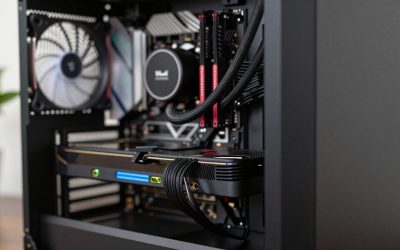
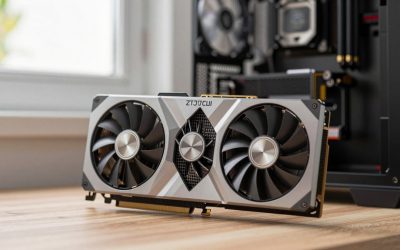
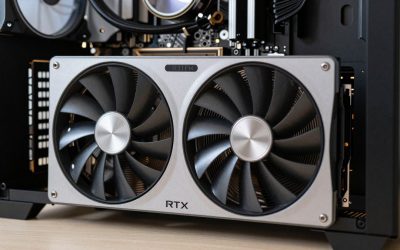
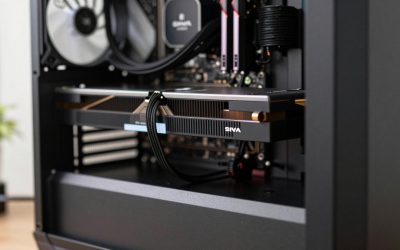
- Top Pick: Gigabyte GeForce RTX 4060 WINDFORCE OC 8G Graphics Card, 2X WINDFORCE Fans, 8GB 128-bit GDDR6, GV-N4060WF2OC-8GD Video Card
- Best Value: GIGABYTE GeForce RTX 4060 Ti WINDFORCE OC 8G Graphics Card, 2X WINDFORCE Fans, 8GB 128-bit GDDR6, GV-N406TWF2OC-8GD Video Card (Renewed)
- Premium Choice: MSI GeForce RTX 4060 Ti Ventus 3X 16G OC Graphics Card -NVIDIA RTX 4060 Ti, 16GB GDDR6 Memory, 18Gbps, PCIe 4.0, DLSS3
For 1080p gaming on a budget the RTX 4060 is the better value, while the RTX 4060 Ti is about 20-25% faster and suits buyers who want higher frame rates at 1080p or occasional 1440p play; since both cards have only 8 GB of VRAM, the Ti’s extra $100 at launch buys speed but not longevity. Both are previous-generation Ada Lovelace cards now that the RTX 50 series is current, so used prices and current alternatives matter as much as the head-to-head.
As an Amazon Associate we earn from qualifying purchases at no extra cost to you.


Spec Comparison
Nvidia launched both cards in May 2023, with the RTX 4060 at $299 and the RTX 4060 Ti 8 GB at $399. They share the same architecture, memory capacity and bus width; the Ti adds more CUDA cores, more L2 cache and slightly faster memory.
| Specification | RTX 4060 | RTX 4060 Ti |
|---|---|---|
| Architecture | Ada Lovelace | Ada Lovelace |
| Release date | 18 May 2023 | 18 May 2023 |
| Launch MSRP | $299 | $399 |
| CUDA cores | 3,072 | 4,352 |
| Boost clock | 2460 MHz | 2535 MHz |
| Process | 5 nm | 5 nm |
| TDP | 115 W | 160 W |
| VRAM | 8 GB GDDR6 | 8 GB GDDR6 |
| Bus width | 128-bit | 128-bit |
| Bandwidth | 272.0 GB/s | 288.0 GB/s |
| L2 cache | 24 MB | 32 MB |
| Interface | PCIe 4.0 x8 | PCIe 4.0 x8 |
| Power connector (reference listing) | 1x 12-pin | 1x 16-pin |
| Length / width | 240 mm / 2-slot | 240 mm / 2-slot |
| Outputs | 1x HDMI 2.1, 3x DisplayPort 1.4a | 1x HDMI 2.1, 3x DisplayPort 1.4a |
The Ti has about 42% more CUDA cores and 33% more L2 cache, yet only 6% more memory bandwidth. That bandwidth ceiling is why its lead shrinks rather than grows at higher resolutions in some games.
How Far Ahead Is the Ti?
TechSpot and Hardware Unboxed’s dedicated RTX 4060 vs RTX 4060 Ti comparison, covering 40 games, found the Ti 22% faster on average at 1080p. Individual results ranged widely: around 23-26% in Call of Duty and Cyberpunk 2077, up to 38-39% in A Plague Tale: Requiem, and smaller in CPU-bound or bandwidth-limited titles. Other outlets reported about 20% at 1080p and up to 25% at 1440p.
- 1080p: RTX 4060 Ti roughly 20-22% faster.
- 1440p: RTX 4060 Ti roughly 20-25% faster, though VRAM limits affect both cards in heavier games.
- Ray tracing: The Ti’s lead is similar at 1080p, and per TechSpot’s Cyberpunk RT data can shrink at 1440p as memory becomes the constraint.
As approximate ranges, current AAA games at 1080p high settings might land around 55-80 FPS on the RTX 4060 and around 65-95 FPS on the 4060 Ti without frame generation. These vary considerably with settings, CPU, game patch and driver version.
DLSS 3 Frame Generation and DLSS 4
Both cards get the full Ada feature set, so there is no feature reason to pick one over the other:
- DLSS 4 Super Resolution with the transformer model for sharper upscaling.
- DLSS Frame Generation (single generated frame), which can substantially raise displayed frame rates in supported games.
- Ray Reconstruction for cleaner ray-traced effects.
- AV1 hardware encoding via the eighth-generation NVENC.
- Not included: DLSS Multi Frame Generation, which is exclusive to RTX 50 series cards.
Frame generation itself uses VRAM, which on 8 GB cards can push memory over budget at 1440p with high textures. Enabling DLSS upscaling at the same time reduces render resolution and helps offset that.
8 GB Is the Shared Weak Point
| Use case | Typical VRAM need | Both 8 GB cards |
|---|---|---|
| Esports titles, any resolution up to 1440p | 3-6 GB | No issue |
| AAA at 1080p medium/high | 6-8 GB | Generally fine |
| AAA at 1080p ultra with RT | 8-10 GB | Lower textures in some titles |
| AAA at 1440p high | 8-12 GB | Frequent texture compromises |
Because both cards have the same 8 GB, the Ti’s extra processing power can end up waiting on memory in the newest games. A 16 GB version of the 4060 Ti exists for that reason, but it carried a higher launch price and is a separate product from the 8 GB card covered here.
Power, Connectors, PCIe Lanes and Case Fit
These are among the most efficient cards of their generation. Using GPU power plus CPU power plus about 150 W headroom:
- RTX 4060: 115 W + 100 W (mainstream CPU) + 150 W = 365 W, so any quality 450-550 W unit is plenty.
- RTX 4060 Ti: 160 W + 100 W + 150 W = 410 W, so a good 500-550 W unit works.
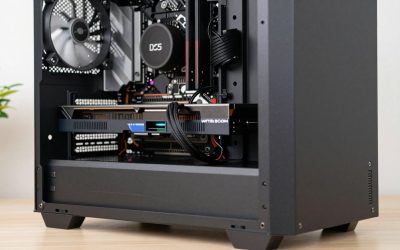
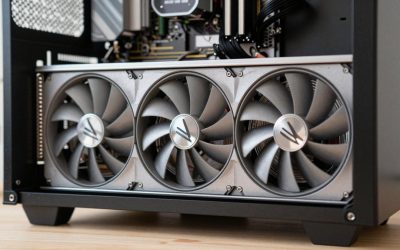
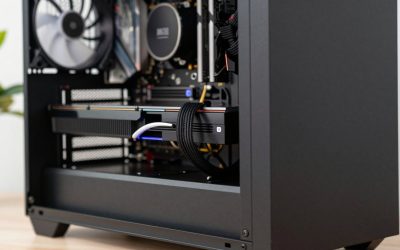
The Founders Edition 4060 Ti uses a 16-pin connector with an adapter, but most partner models of both cards use a single standard 8-pin PCIe plug, which suits older power supplies. At around 240 mm on reference-length designs and two slots thick, both fit nearly any case, including many small-form-factor builds, with compact single-fan versions widely available.
One technical detail matters for older PCs: both cards use a PCIe 4.0 x8 interface. In a PCIe 3.0 motherboard, they run at PCIe 3.0 x8 bandwidth, which costs little in most games but can hurt more when VRAM overflows into system memory, an issue that becomes more likely with 8 GB cards.
Cost per Frame
Using launch prices and a 1080p index of 100 for the RTX 4060 and 122 for the RTX 4060 Ti, based on TechSpot’s 22% average:
- RTX 4060: $299 / 100 = about $2.99 per performance point
- RTX 4060 Ti: $399 / 122 = about $3.27 per performance point
The 4060 is the better value per frame, while the Ti charged a 33% premium for roughly 22% more performance. On the used market in late 2026, an RTX 4060 usually sells for roughly $190-$240 and an RTX 4060 Ti 8 GB for roughly $250-$300. Meanwhile, current-generation cards such as the RTX 5060, RTX 5060 Ti 16 GB, RX 9060 XT 16 GB and Arc B580 deserve a look, particularly models with more than 8 GB of VRAM.
Which One Should You Get?
| Buyer profile | Recommendation |
|---|---|
| 1080p 60-100 Hz, tight budget | RTX 4060 |
| 1080p 144 Hz in demanding games | RTX 4060 Ti |
| Occasional 1440p with DLSS | RTX 4060 Ti |
| Small-form-factor or 450 W PSU | RTX 4060 |
| Older PCIe 3.0 motherboard | Either, but avoid maxed textures |
| Plans to keep the card four or more years | Consider a 12-16 GB alternative instead |
Settings That Get the Most From 8 GB
Because VRAM is the shared limitation, a few settings choices make a big difference on either card:
- Set texture quality one step below maximum in new AAA games; the visual difference is often minor, and it prevents stutter.
- Use DLSS Quality or Balanced at 1440p, which lowers the internal render resolution and reduces memory use.
- Enable DLSS Frame Generation only once the base frame rate is already around 50-60 FPS, since generated frames add latency and their own memory overhead.
- Watch the in-game VRAM meter where available, and treat anything near 7.5 GB as the practical ceiling.
With those adjustments, both cards remain capable 1080p performers, and the 4060 Ti stretches comfortably into lighter 1440p gaming.
Frequently Asked Questions
How much faster is the RTX 4060 Ti than the RTX 4060?
TechSpot and Hardware Unboxed measured the RTX 4060 Ti about 22% faster on average at 1080p across 40 games. Some titles showed gaps near 40%, while CPU-limited games showed much less. At 1440p the lead is roughly similar, around 20-25%.
Do both cards support DLSS 3 frame generation?
Yes. Both RTX 4060 and RTX 4060 Ti support DLSS Frame Generation, DLSS 4 Super Resolution and Ray Reconstruction. Neither supports Multi Frame Generation, which is reserved for RTX 50 series cards.
Is 8 GB of VRAM enough for the RTX 4060 Ti?
At 1080p with sensible texture settings, 8 GB is generally adequate. In newer AAA releases at 1440p or with ultra textures and ray tracing, 8 GB often forces compromises. That limit applies equally to the RTX 4060, so the Ti’s extra speed does not fix it.
Will these cards work in a PCIe 3.0 motherboard?
Yes, both are backward compatible and run at PCIe 3.0 x8. Most games lose only a few percent, but performance can drop more sharply in games that exceed 8 GB of VRAM and spill into system memory. Keeping textures within the VRAM budget minimises the impact.
What power supply do I need?
A quality 450-550 W unit covers the RTX 4060, and a good 500-550 W unit covers the RTX 4060 Ti with a mainstream CPU. Most partner cards use a single 8-pin PCIe connector. The 4060 Ti Founders Edition uses a 16-pin connector with an included adapter.