

- Top Pick: ZOTAC Gaming GeForce RTX™ 3090 Ti AMP Extreme Holo 24GB GDDR6X 384-bit 21 Gbps PCIE 4.0 Gaming Graphics Card, HoloBlack, IceStorm 2.0 Advanced Cooling, Spectra 2.0 RGB Lighting, ZT-A30910B-10P
- Best Value: Nvidia RTX 3090 TI Founders Edition (Renewed) Founder Video Graphics Card
- Premium Choice: ASRock Radeon RX 7700 XT Challenger 12GB OC Graphics Card, AMD RDNA 3 Architecture, 12GB GDDR6, 2584 MHz Boost Clock, 3X DisplayPort 2.1, 1x HDMI 2.1, Dual Fan Cooling
The RTX 3090 Ti is the much faster card, roughly 25-40% ahead at 1440p and often 45-70% at 4K, with far stronger ray tracing and 24 GB of VRAM, so it is the pick for 4K gaming, heavy ray tracing and creative or AI work. The RX 7700 XT is the sensible choice for 1080p and 1440p gamers on a normal budget, because it costs a fraction as much, draws about 200 W less and fits easily in a standard case.
These two cards were never meant to compete. The RTX 3090 Ti launched in January 2022 at $1,999 as the top Ampere card. The RX 7700 XT arrived in August 2023 at $449 as AMD’s mid-range RDNA 3 option. In 2026 both are previous-generation, and the RTX 3090 Ti is a used-only purchase, which is the only reason the comparison comes up: at used prices, the gap between them is far smaller than at launch.
As an Amazon Associate we earn from qualifying purchases at no extra cost to you.
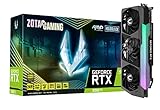


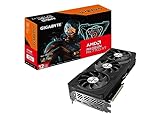
The Spec Sheet
| Specification | GeForce RTX 3090 Ti | Radeon RX 7700 XT |
|---|---|---|
| Architecture | Ampere | RDNA 3.0 |
| Release date | 27 January 2022 | 25 August 2023 |
| Launch MSRP | $1,999 | $449 |
| Shaders | 10752 CUDA cores | 3456 stream processors |
| Boost clock | 1860 MHz | 2544 MHz |
| Process | 8 nm | 5 nm |
| TDP | 450 W | 245 W |
| Memory | 24 GB GDDR6X | 12 GB GDDR6 |
| Memory bus | 384-bit | 192-bit |
| Bandwidth | 1.01 TB/s | 432.0 GB/s |
| Cache | 6 MB L2 | 2 MB L2 + 48 MB L3 |
| Interface | PCIe 4.0 x16 | PCIe 4.0 x16 |
| Power connectors | 1x 16-pin | 2x 8-pin |
| Length / width | 336 mm, 3-slot | 267 mm, 2-slot |
| Outputs | 1x HDMI 2.1, 3x DisplayPort 1.4a | 1x HDMI 2.1a, 2x DisplayPort 2.1, 1x USB-C |
Cross-brand shader counts are not directly comparable, but the memory figures are. The RTX 3090 Ti has twice the VRAM and more than double the bandwidth on a bus twice as wide. That explains why its lead grows as resolution rises. The RX 7700 XT counters with Infinity Cache and much lower power draw.
Raster Performance by Resolution
Direct reviews of this pairing from the major outlets are rare, so the picture comes from combining their placements with multi-game aggregate data. TechPowerUp’s RTX 4080 review placed the RTX 4080 about 16% ahead of the RTX 3090 Ti at 4K, which puts the 3090 Ti firmly in high-end territory. Tom’s Hardware and TechSpot reviews of the RX 7700 XT placed it around RX 6800 level at 1440p, a mid-range position. Multi-game aggregates that compare the two directly show:
- 1080p: Roughly 10-20% in favor of the RTX 3090 Ti, since a high-end card is often CPU-limited at this resolution.
- 1440p: Roughly 25-40% in favor of the RTX 3090 Ti, with some new, demanding releases showing even larger gaps.
- 4K: Roughly 45-70% in favor of the RTX 3090 Ti, as the RX 7700 XT’s 192-bit bus and 12 GB become limits.
As an approximate example, a game running around 70 fps at 1440p high on the RX 7700 XT would typically run roughly 88-98 fps on the RTX 3090 Ti. Numbers vary with settings, CPU, game patch and driver version.
Ray Tracing and Upscaling
Ray tracing widens the gap further. The RTX 3090 Ti’s second-generation RT cores handle heavy ray-traced effects much more efficiently than RDNA 3’s ray accelerators, and in demanding RT and path-traced games the RTX 3090 Ti’s lead commonly exceeds its raster lead. The RX 7700 XT can manage light ray tracing at 1080p or 1440p with FSR, but heavy RT is not its strength.
- RTX 3090 Ti: DLSS Super Resolution including the DLSS 4 transformer model, Ray Reconstruction and Reflex. No DLSS Frame Generation (RTX 40 and newer only), though FSR 3 frame generation works in supported games.
- RX 7700 XT: FSR 3.1 upscaling and frame generation, plus AMD Fluid Motion Frames at the driver level. AMD launched FSR 4 as an RDNA 4 feature, so the RX 7700 XT does not officially support it. It does include AV1 encoding, which the RTX 3090 Ti lacks.
VRAM: 24 GB Versus 12 GB
For gaming, 12 GB is adequate at 1080p and most 1440p settings, while 24 GB is far beyond what current games need even at 4K. The extra memory on the RTX 3090 Ti matters most outside gaming: local AI models, 3D rendering, large video timelines and simulation work. Combined with CUDA support, that makes the RTX 3090 Ti a popular used card for creators and AI hobbyists, which also keeps its used price higher than its gaming performance alone would justify.
Power, PSU and Case Fit: The Big Practical Difference
The RTX 3090 Ti is one of the most power-hungry consumer GPUs ever released. Using GPU TDP plus CPU plus about 150 W headroom:
- RTX 3090 Ti: 450 W + ~125 W + 150 W = ~725 W, so a quality 850 W unit is the realistic minimum, and 1000 W is safer with a high-power CPU.
- RX 7700 XT: 245 W + ~125 W + 150 W = ~520 W, so a good 600-650 W unit is plenty.
The RTX 3090 Ti uses the 16-pin connector. Most cards ship with an adapter that needs three or four 8-pin cables, so check your PSU’s cable count; a native 16-pin cable from an ATX 3.x unit is the cleaner route. The RX 7700 XT uses two standard 8-pin plugs.
Size is the other hurdle. At 336 mm long and 3 slots thick, the RTX 3090 Ti needs a mid-tower or larger with generous GPU clearance, and many partner cards are bigger still and heavy enough to need a support bracket. The RX 7700 XT’s 267 mm, 2-slot design fits most cases. Heat output follows the power numbers: the RTX 3090 Ti dumps roughly 200 W more into your case and room under load.
Decision Table: Which Card for Which Buyer
| Situation | RTX 3090 Ti | RX 7700 XT |
|---|---|---|
| 1080p gaming | Overkill; CPU-limited | Better value |
| 1440p, raster only | Faster, but costs far more | Good value, smooth at high settings |
| 1440p with heavy ray tracing | Clearly better | Light RT only |
| 4K | Clearly better | Needs upscaling and lower settings |
| AI, rendering, CUDA apps | Much better (24 GB, CUDA) | Limited |
| 650 W PSU, compact case | Not suitable | Good fit |
Cost per Performance and Used Prices
At launch MSRPs the comparison is extreme. With the RX 7700 XT as 100 and the RTX 3090 Ti at about 133 at 1440p (the midpoint of the range above), the RX 7700 XT cost about $4.49 per performance point and the RTX 3090 Ti about $15.03. In 2026, used RTX 3090 Ti cards often sell for roughly $650-$850, driven partly by AI demand, while RX 7700 XT cards typically go for roughly $280-$350 used. Even at used prices, the RX 7700 XT delivers more gaming performance per dollar; the RTX 3090 Ti’s value lies in its absolute speed, ray tracing and 24 GB.
For pure gaming, both should be weighed against current cards. The RX 9070 and RTX 5070 launched at $549 and offer modern features such as FSR 4 or Multi Frame Generation, and the RTX 5070 Ti ($749) performs close to the RTX 4080 in most reviews, which puts it ahead of the RTX 3090 Ti. When buying a used RTX 3090 Ti, inspect the 16-pin connector for any heat damage, ask about mining or AI-training use, and check memory temperatures, since GDDR6X on Ampere cards runs hot.
Frequently Asked Questions
How much faster is the RTX 3090 Ti than the RX 7700 XT?
Aggregate data puts the RTX 3090 Ti roughly 25-40% ahead at 1440p and around 45-70% ahead at 4K. At 1080p the gap is smaller, often 10-20%, because of CPU limits. With ray tracing, the RTX 3090 Ti’s lead grows further.
What power supply does the RTX 3090 Ti need?
A quality 850 W unit is the realistic minimum with a typical gaming CPU, and 1000 W gives better headroom with high-end processors. The card uses a 16-pin connector, typically via an adapter that needs several 8-pin cables. The RX 7700 XT runs on a good 600-650 W unit.
Is 24 GB of VRAM useful for gaming?
Not much for current games, which rarely use more than 16 GB even at 4K. It matters for AI models, 3D rendering and video work. For gaming at 1440p, 12 GB is generally sufficient today.
Will an RTX 3090 Ti fit in my case?
The reference figure is 336 mm long and 3 slots thick, and many partner cards are larger. You need a mid-tower or full tower with at least that much GPU clearance. A support bracket is recommended because of the card’s weight.
Is an RTX 5070 Ti better than a used RTX 3090 Ti for gaming?
For gaming, generally yes. The RTX 5070 Ti is faster in most reviews, uses much less power, supports DLSS Multi Frame Generation and comes with a warranty. The RTX 3090 Ti mainly keeps an edge for workloads that need more than 16 GB of memory.
Ready to decide? Our #1 pick for 2026 is the Architecture.
Live price & availability on Amazon.













