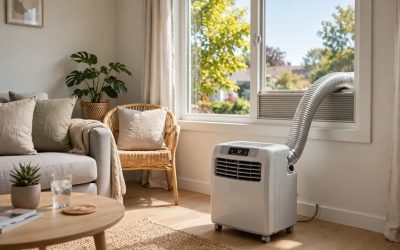
- Top Pick: Midea 6,000 BTU Window Air Conditioner, Electronic Control, 250 Sq Ft, New | 3-In-1 Cool/Fan/Dehumidifier Modes, Easy-To-Use Controls, Remote Control, And Cooling For Bedrooms, Studies and Home Offices
- Best Value: GE Window Air Conditioner 5,000 BTU AC Unit for Small Spaces up to 150 sq ft with Manual Controls & 2 Cooling Modes, Easy Install Kit, White
- Premium Choice: Frigidaire 5,000 BTU Window-Mounted Air Conditioner, Cools Up to 150 Sq. Ft., Quiet Operation, Effortless Temperature Control, 2 Fan Speeds, Auto Restart, White
The best window air conditioners for a gaming room are the LG LW1023IVSM (10,000 BTU dual inverter) for a room with a high-end PC, the LG LW8024IVSM (8,000 BTU dual inverter) for most bedroom-size setups, and the Midea U-Shaped inverter line when you want the quietest operation and an unobstructed window. Window units remain the quietest and most efficient way to cool a gaming room because the compressor sits outside, so your microphone hears the fan and little else.
As an Amazon Associate we earn from qualifying purchases at no extra cost to you.


How we chose these window air conditioners
This is a research-based guide built on published specifications, efficiency ratings and the conclusions of established review publications and independent testing organizations. We screened for what matters to someone who games for hours at a desk:
- Capacity that covers the gear. The unit must handle floor area plus the heat from a PC, monitors and a console.
- Efficiency. CEER (combined energy efficiency ratio) shows how much cooling you get per watt. Above about 14 is excellent for a window unit.
- Noise. Low-fan readings at or below roughly 45 dB are the target for streamers.
- Window fit. Standard double-hung, sliding and casement windows each need different unit shapes.
- Control and features. Wi-Fi, remote and sleep modes should work with a desk setup, not against it.
Step one: calculate the heat load
Hardware turns almost every watt into heat, and one watt equals 3.412 BTU per hour. Here is a worked example for a 220 square foot room with a high-end PC, two monitors and a console in use:
- Floor-area load: 220 sq ft x 20 BTU per sq ft = 4,400 BTU per hour.
- PC at 600 W under load: 600 x 3.412 = about 2,047 BTU per hour.
- Two monitors at 80 W combined: about 273 BTU per hour.
- Console at 150 W: about 512 BTU per hour.
- One person: about 350 BTU per hour.
- Sunny window adjustment (10 percent of floor-area load): about 440 BTU per hour.
- Total: 4,400 + 2,047 + 273 + 512 + 350 + 440 = about 8,020 BTU per hour.
This room needs about 8,000 BTU of real cooling, which lands exactly on an 8,000 BTU window unit. If the PC runs lighter at 300 W, the total drops to near 7,000 BTU and a 6,000 to 8,000 BTU unit with a little margin is appropriate. A window unit delivers its full rating, so unlike portables you can size by the label.
Window AC sizing by room and gaming load
| Room size | Console or laptop only | Mid-range PC | High-end PC + console |
|---|---|---|---|
| Up to 150 sq ft | 5,000 BTU | 6,000 BTU | 6,000 to 8,000 BTU |
| 150 to 250 sq ft | 6,000 BTU | 8,000 BTU | 8,000 BTU |
| 250 to 350 sq ft | 8,000 BTU | 8,000 to 10,000 BTU | 10,000 BTU |
| 350 to 450 sq ft | 10,000 BTU | 10,000 to 12,000 BTU | 12,000 BTU |
| 450 to 800 sq ft | 12,000 BTU | 12,000 to 15,000 BTU | 15,000 BTU |
Why inverter and U-shaped designs matter for gamers
A traditional window unit runs its compressor at full speed until the room hits the setpoint, shuts off, then starts again. That start-up thump and constant cycling is exactly what a microphone catches. A dual inverter compressor changes speed continuously, so after the room reaches temperature it runs quietly at a low speed. A U-shaped design, such as the Midea U-Shaped line, lets the window sash close in the middle of the unit, which reduces vibration and sound transmission through the window and keeps the window usable for light and airflow.
Best window air conditioners: our picks
LG LW1023IVSM (10,000 BTU dual inverter)
10,000 BTU · dual inverter · CEER about 15.35 · about 42 dB on low · Wi-Fi · 350 to 450 sq ft class
Best for: a larger gaming room or a smaller one with a high-end PC and a lot of afternoon sun. Skip if: your room is under about 250 square feet, where it can overcool and cycle.
- Pro: Named best overall in one specifications-based ranking.
- Pro: Very low reported low-fan noise for its capacity.
- Con: Premium tier cost.
- Con: Wide body needs a standard-width window.
LG LW8024IVSM (8,000 BTU dual inverter)
8,000 BTU · dual inverter · about 44 dB reported · Wi-Fi · ENERGY STAR rated · 250 to 350 sq ft class
Best for: most gaming rooms with a typical gaming PC. Skip if: you need a very compact unit for a narrow window.
- Pro: Best-for-most-buyers pick in a major specifications comparison.
- Pro: App control lets you pre-cool before a session.
- Con: Costs more than fixed-speed 8,000 BTU models.
- Con: Heavier to lift into a window.
LG LW8023IVSM (8,000 BTU inverter)
8,000 BTU · inverter · CEER about 15.57 · about 40 dB reported · 250 to 350 sq ft class
Best for: buyers who put electricity use and quiet at the top of the list. Skip if: you want a newer model name or smart-home extras and cannot find this one in stock.
- Pro: Among the most efficient 8,000 BTU window units reported.
- Pro: Very low noise on the low fan.
- Con: Availability can vary as lineups change.
- Con: Similar capacity to the LW8024IVSM, so little reason to pick both.
Midea U-Shaped Inverter (8,000, 10,000 and 12,000 BTU)
8,000 to 12,000 BTU class · inverter · U-shaped body · about 42 dB reported for the 8,000 BTU model · app control
Best for: the quietest operation and a window you can still open and close. Skip if: your window frame cannot take the U-shaped installation kit.
- Pro: Named top overall by a national consumer publication and quietest by another comparison.
- Pro: Sash closes through the middle, which reduces rattling and noise leakage.
- Con: Installation takes more steps than a basic bracket.
- Con: Premium tier cost.
Midea MAW06V1QWT (6,000 BTU)
6,000 BTU · about 39 dB reported · 150 to 250 sq ft class
Best for: small rooms and light to moderate PC loads where silence matters most. Skip if: you run a high-wattage tower for long sessions.
- Pro: Ranked first in the 6,000 BTU class in a specifications comparison.
- Pro: Very low noise.
- Con: Fixed-speed compressor cycling.
- Con: Limited capacity for demanding hardware.
Frigidaire FFRE053WAE (5,000 BTU)
5,000 BTU · mechanical-style control · about 150 sq ft class · entry-level cost
Best for: a tiny console nook or dorm room. Skip if: you have a desktop with a high-wattage graphics card.
- Pro: Entry-level cost and simple operation.
- Pro: Easy to install.
- Con: Small capacity.
- Con: No smart features.
LG LW8016ER (8,000 BTU, basic)
8,000 BTU · plain box design · remote control · about 250 to 350 sq ft class
Best for: budget-conscious buyers with a mid-size room. Skip if: noise from compressor cycling would bother you on a microphone.
- Pro: Named best budget pick by a national consumer publication.
- Pro: Dependable basic layout.
- Con: No Wi-Fi or inverter.
- Con: Cycles on and off.
Toshiba 8,000 BTU Smart Window AC
8,000 BTU · smart control · up to about 350 sq ft class
Best for: gamers who want smart-home voice and app control at mid-range capacity. Skip if: your window is narrow.
- Pro: Top overall pick from a home-improvement publication.
- Pro: Simple smart features.
- Con: Fixed-speed compressor.
- Con: Mid-range cost.
LG LW1522IVSM (15,000 BTU dual inverter)
15,000 BTU · dual inverter · rooms up to about 800 sq ft class · 230 V
Best for: large game rooms or basements with multiple machines. Skip if: your outlet is a standard 120 V receptacle, because this class commonly needs a 230 V circuit.
- Pro: Called the only quiet high-output window option in one comparison.
- Pro: Handles a multi-PC room.
- Con: Needs a dedicated higher-voltage circuit in most cases.
- Con: Large, heavy body requires support.
Comparison table
| Model | Capacity | Compressor | Noise (low fan) | Efficiency | Room class |
|---|---|---|---|---|---|
| LG LW1023IVSM | 10,000 BTU | Dual inverter | about 42 dB | CEER about 15.35 | 350 to 450 sq ft |
| LG LW8024IVSM | 8,000 BTU | Dual inverter | about 44 dB | ENERGY STAR | 250 to 350 sq ft |
| LG LW8023IVSM | 8,000 BTU | Inverter | about 40 dB | CEER about 15.57 | 250 to 350 sq ft |
| Midea U-Shaped | 8,000 to 12,000 BTU | Inverter | about 42 dB (8K) | High | 250 to 550 sq ft |
| Midea MAW06V1QWT | 6,000 BTU | Fixed | about 39 dB | Standard | 150 to 250 sq ft |
| Frigidaire FFRE053WAE | 5,000 BTU | Fixed | mid | Standard | about 150 sq ft |
| LG LW8016ER | 8,000 BTU | Fixed | mid | Standard | 250 to 350 sq ft |
| Toshiba 8,000 Smart | 8,000 BTU | Fixed | low-mid | Standard | up to about 350 sq ft |
| LG LW1522IVSM | 15,000 BTU | Dual inverter | low for class | High | up to about 800 sq ft |
Installing a window unit around a gaming setup
A window unit weighs 40 to 100 pounds, and installation errors are the main source of leaks and noise. Take these steps:
- Measure the window opening width and height before buying and compare them with the unit’s published minimum and maximum.
- Use the support bracket and side panels supplied, and tilt the unit slightly outward so condensation drains outside.
- Seal the gaps with weatherstripping foam, not tape alone, to cut leaks and rattles.
- Keep the unit away from cable runs and the back of your monitors, since cold airflow blowing directly on a person or hot airflow near electronics is both unpleasant and inefficient.
- Check the building or landlord rules on window units before installing.
Electrical safety
An 8,000 BTU unit typically draws roughly 600 to 800 W, and 10,000 to 12,000 BTU units can draw 900 to 1,200 W. On a 15 A, 120 V circuit a continuous load should stay near 1,440 W, so a 10,000 BTU unit plus a 600 W PC and a console can approach the limit. Plug the unit directly into a grounded wall receptacle, never a power strip or a thin extension cord. Larger units such as the 15,000 BTU class may need a 230 V circuit, which should be installed by a licensed electrician.
Humidity and electronics
An air conditioner also pulls moisture from the air, which helps electronics stay out of high humidity. But if the room is cooled very hard with no fresh air, the air gets overly dry. Aim for roughly 40 to 50 percent relative humidity. A cheap hygrometer on the desk tells you more than any setting on the unit.
Who should skip a window unit
Skip a window unit if your window is a casement or crank type, if the building bans them, or if the window is your only fire exit. In those cases a dual-hose portable or a ductless mini-split is the better route.
How to choose between the picks
Use the following simple logic. First, size by the heat-load table above. Second, decide whether noise near a microphone matters. If it does, restrict yourself to the inverter models: LG LW1023IVSM, LG LW8024IVSM, LG LW8023IVSM or the Midea U-Shaped line. If cost is the priority and you can tolerate compressor cycling, the Midea MAW06V1QWT, LG LW8016ER and Frigidaire FFRE053WAE are the sensible choices. Third, check the window. A U-shaped unit needs a window that can be raised to the right height, while a standard unit needs a frame wide enough to hold the side panels.
Running cost logic
Energy use is simple to estimate. Take the unit’s running watts, multiply by hours per day, and divide by 1,000 to get kilowatt-hours. An 8,000 BTU unit drawing about 650 W for 6 hours uses about 3.9 kWh. A higher CEER rating means fewer watts for the same cooling, so a CEER of about 15 compared with about 11 can cut energy use by roughly a quarter for the same BTU output. Over a long gaming summer that gap can pay back much of the price difference of an inverter model.
Maintenance that keeps the unit quiet
- Wash or vacuum the filter every two to four weeks in heavy use.
- Clean the condenser and evaporator fins gently once a season, with the unit unplugged.
- Check that the unit is tilted slightly outward so water drains and does not slosh inside.
- Re-seal gaps and tighten the bracket each year, since loose parts cause rattles that a microphone hears.
- At the end of the season, remove or cover the unit with a weatherproof cover and clear the drain.
Frequently asked questions
What size window air conditioner do I need for a gaming room?
Most gaming rooms of 150 to 350 square feet need 6,000 to 10,000 BTU. Add about 3.4 BTU per watt of PC, monitor and console load.
Are window air conditioners quiet enough for streaming?
Inverter models with low-fan readings around 40 to 44 dB, such as the LG inverter line and Midea U-Shaped models, are usually quiet enough with a directional microphone.
Is an inverter window air conditioner worth the extra cost?
For a gaming room, usually yes. It avoids start-stop compressor noise, holds a steadier temperature and uses less electricity.
Can a window air conditioner damage my PC?
Not directly. Avoid blowing cold air straight onto the PC and keep condensation and drain water well clear of cables and power strips.
Do I need a special outlet for a window air conditioner?
Units up to about 12,000 BTU generally use a standard 120 V outlet. Larger units such as 15,000 BTU models may need a 230 V circuit.
What is CEER?
CEER is the combined energy efficiency ratio, BTU of cooling per watt-hour of electricity. A higher number means lower running costs.
Where should I mount the unit relative to my desk?
Mount it on the side wall away from the microphone, with airflow directed across the room rather than at your seat.
How often should I clean the filter?
Clean it every two to four weeks during heavy use. A clogged filter lowers capacity and makes the fan louder.
Bottom line
For most gamers the LG LW8024IVSM or LG LW1023IVSM gives the best mix of capacity, efficiency and low noise. Choose a Midea U-Shaped inverter when window access and silence matter, the Midea MAW06V1QWT for small quiet rooms, and one of the basic LG or Frigidaire models when cost is the priority.