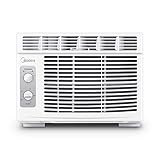
- Top Pick: Midea 5,000 BTU EasyCool Small Window Air Conditioner – Cool up to 150 Sq. Ft. with Easy-to-Use Mechanical Controls and Reusable Filter, Perfect for Small Bedroom, Living Room, Home Office
- Best Value: GE Window Air Conditioner 5,000 BTU AC Unit for Small Spaces up to 150 sq ft with Manual Controls & 2 Cooling Modes, Easy Install Kit, White
- Premium Choice: Portable Air Conditioner Fan, 4-in-1 Mini Air Cooler with 450ML Water Tank, 3 Speeds Portable Fan 7 Colors LED Ambient Light, Mini Evaporative Cooler Desktop Humidifier Fan for Bedroom Office Travel
The best air conditioners for a small gaming room are the Midea MAW06V1QWT (6,000 BTU window unit) for rooms up to roughly 250 square feet, the LG LW8024IVSM (8,000 BTU dual inverter window unit) for 250 to 350 square feet, and the Black+Decker 8,500 BTU portable when you cannot use a window sash. A small room with a gaming PC, a console, two monitors and a player inside it behaves very differently from a plain bedroom, so this guide sizes the cooler around the heat your gear produces, not just the floor area.
As an Amazon Associate we earn from qualifying purchases at no extra cost to you.


How we chose these air conditioners
This is a research-based guide. We compared published specifications, manufacturer rating standards, and the findings of independent testing organizations and major review publications, then filtered for the things a gamer cares about: enough real cooling capacity for a heat-producing desk, low noise near a microphone, a form factor that fits a small window or a cramped floor, and a control scheme that does not fight your setup. Every model below is a current-generation product family sold in the United States. Where a specific figure could not be confirmed, we describe the spec class instead of guessing.
Our criteria, in priority order:
- Rated capacity versus room and heat load. A unit must cover floor area plus the extra watts from the PC, console and displays.
- Noise. Under about 45 dB on the low fan setting is the target if a microphone sits within a few feet. Compressor cycling matters as much as fan noise.
- Efficiency. Inverter compressors ramp up and down instead of switching on and off, which keeps temperature steadier and cuts the loud start-up thump that headsets and microphones pick up.
- Installation fit. Window width, sash type, and whether the unit blocks the only window matter in a small room.
- Controls. Remote, app and voice control are useful when the unit is behind a monitor arm or a desk.
Step one: add up the heat your gaming setup makes
Nearly every watt your hardware pulls from the wall ends up as heat in the room. One watt equals about 3.412 BTU per hour, so you can convert directly. This is the information that most generic air conditioner guides skip, and it is why a unit that is fine for a quiet bedroom can struggle in a gaming room.
Here is a worked example for a typical small room of 120 square feet (about 10 by 12 feet) with one player:
- Base room load: A common rule is about 20 BTU per square foot, so 120 square feet needs about 2,400 BTU per hour before any equipment.
- Gaming PC under load: Assume 450 W at the wall. 450 x 3.412 = about 1,535 BTU per hour.
- Two monitors: Assume 60 W combined. 60 x 3.412 = about 205 BTU per hour.
- Console on standby or in use: Assume 150 W. 150 x 3.412 = about 512 BTU per hour.
- One person: A seated adult gives off roughly 350 BTU per hour.
- Total: 2,400 + 1,535 + 205 + 512 + 350 = about 5,000 BTU per hour.
The room needs roughly 5,000 BTU per hour of real cooling, and a sunny window or a top-floor room can add 10 percent or more. A 5,000 BTU unit would be right at its limit, so a 6,000 BTU unit gives a comfortable margin. If you only run the PC lightly, drop the PC figure toward 200 W (about 680 BTU per hour) and the same room needs closer to 4,100 BTU.
Quick sizing table for gaming rooms
| Room size | Plain-room need | Add for PC + monitors + console | Practical unit size |
|---|---|---|---|
| 100 to 150 sq ft | 2,000 to 3,000 BTU | about 2,000 to 2,500 BTU | 5,000 to 6,000 BTU |
| 150 to 250 sq ft | 3,000 to 5,000 BTU | about 2,000 to 2,500 BTU | 6,000 to 8,000 BTU |
| 250 to 350 sq ft | 5,000 to 7,000 BTU | about 2,000 to 2,500 BTU | 8,000 to 10,000 BTU |
| 350 to 450 sq ft | 7,000 to 9,000 BTU | about 2,000 to 2,500 BTU | 10,000 to 12,000 BTU |
Oversizing is a real problem in a small room. A unit that is far too large cools the air quickly, shuts off, and cycles repeatedly, which is noisy and leaves humidity behind. Stay within one size step of your calculated number.
Window unit or portable for a small room?
Window units are quieter for the cooling you get, cost less to run, and avoid the heat penalty of a portable. A single-hose portable pulls room air to cool its condenser and pushes it outdoors, which creates negative pressure and draws warm air in through gaps. That is why portable units carry two ratings: the headline ASHRAE figure and the lower DOE figure (often labeled SACC) that reflects real cooling. Always compare the DOE or SACC number. Choose a portable only when the window will not take a standard unit, when rules prohibit window units, or when you need to move it between rooms.
Best air conditioners for small rooms: our picks
Midea MAW06V1QWT (6,000 BTU window)
6,000 BTU · window · about 39 dB reported · remote control · small-room class (roughly 150 to 250 sq ft)
Best for: a 120 to 200 square foot gaming room where noise near a microphone is the main worry. Skip if: your PC regularly draws more than 500 W under load or the room gets strong afternoon sun.
- Pro: Among the quietest small window units reported by published comparisons.
- Pro: Sized well for a bedroom-scale gaming desk.
- Con: Limited headroom for a high-end PC plus console.
- Con: Not an inverter design, so the compressor cycles.
LG LW8024IVSM (8,000 BTU dual inverter window)
8,000 BTU · dual inverter compressor · about 44 dB reported · Wi-Fi control · ENERGY STAR rated · 250 to 350 sq ft class
Best for: a room with a serious PC, because the inverter holds temperature without hard on/off cycling. Skip if: your window is narrow, since this class of unit needs a standard-width opening.
- Pro: Smooth, steady cooling with fewer loud compressor starts.
- Pro: App control means you can pre-cool the room before a session.
- Con: Costs more than a basic 8,000 BTU unit.
- Con: Slightly louder than the best 6,000 BTU units.
LG LW6017R (6,000 BTU window)
6,000 BTU · window · rated for spaces up to about 260 sq ft · remote control
Best for: value buyers with a small room and a moderate PC. Skip if: you want Wi-Fi control or inverter operation.
- Pro: Strong value in the 6,000 BTU class.
- Pro: Compact for small sliding windows.
- Con: Fixed-speed compressor.
- Con: Modest headroom for gaming hardware.
Frigidaire FFRE053WAE (5,000 BTU window)
5,000 BTU · window · mechanical-style small-room unit · about 150 sq ft class
Best for: a tight dorm-size room with a console or a laptop. Skip if: you run a high-wattage desktop for hours.
- Pro: Entry-level cost and low power draw.
- Pro: Easy installation in standard windows.
- Con: Runs out of capacity with a 400 W-plus PC.
- Con: Basic controls.
Toshiba 8,000 BTU Smart Window AC
8,000 BTU · window · smart control · about 350 sq ft class
Best for: gamers who want app and voice control and a little extra capacity. Skip if: you need a very small footprint.
- Pro: Highlighted as a top overall window pick in a major home-improvement publication.
- Pro: Smart features suit a gaming setup.
- Con: Larger body than 5,000 and 6,000 BTU units.
- Con: Mid-range cost.
LG LW8016ER (8,000 BTU window)
8,000 BTU · window · plain box design · remote control
Best for: a budget-minded upgrade for a 250 square foot room. Skip if: you want quiet inverter performance.
- Pro: Solid cooling for the cost.
- Pro: Simple, dependable layout.
- Con: No Wi-Fi.
- Con: Fixed-speed noise pattern.
Black+Decker 8,500 BTU portable
8,500 BTU (ASHRAE class) · portable · cooling up to about 350 sq ft per its rating · single exhaust hose · wheels
Best for: renters or rooms with a casement window where a window unit will not fit. Skip if: you can fit a window unit, because the real cooling is lower than the headline number.
- Pro: Moves between rooms and needs no permanent mounting.
- Pro: Easy to store between seasons.
- Con: Single-hose design pulls warm air back in.
- Con: Takes floor space and its hose can snag desk cables.
Hisense HAP0824TWD (8,000 BTU DOE portable)
8,000 BTU DOE/SACC class · portable · about 350 sq ft class
Best for: a portable buyer who wants a rating based on real cooling. Skip if: you are noise-sensitive and can use a window unit instead.
- Pro: Rated on the stricter DOE basis, so the number is honest.
- Pro: Suits a bedroom or home office.
- Con: Portable noise sits near the desk, not outside the window.
- Con: Venting kit takes up window space.
Whynter ARC-122DS (compact dual-hose portable)
12,000 BTU ASHRAE / about 7,000 BTU SACC · dual hose · about 400 sq ft class
Best for: small spaces that need a portable with a smaller footprint and dual-hose efficiency. Skip if: your room is under about 150 square feet, where the capacity is more than you need.
- Pro: Dual-hose design avoids pulling room air out.
- Pro: Smaller, more compact than many dual-hose models.
- Con: Lower real capacity than the label suggests.
- Con: Two hoses add cable clutter.
Comparison table
| Model | Type | Capacity | Room class | Noise | Standout |
|---|---|---|---|---|---|
| Midea MAW06V1QWT | Window | 6,000 BTU | 150 to 250 sq ft | about 39 dB | Quiet |
| LG LW6017R | Window | 6,000 BTU | up to about 260 sq ft | low-mid | Value |
| Frigidaire FFRE053WAE | Window | 5,000 BTU | about 150 sq ft | mid | Entry-level |
| LG LW8024IVSM | Window | 8,000 BTU | 250 to 350 sq ft | about 44 dB | Dual inverter |
| LG LW8016ER | Window | 8,000 BTU | 250 to 350 sq ft | mid | Budget 8K |
| Toshiba 8,000 BTU Smart | Window | 8,000 BTU | up to about 350 sq ft | low-mid | Smart control |
| Black+Decker 8,500 BTU | Portable | 8,500 BTU (ASHRAE) | up to about 350 sq ft | mid-high | No window install |
| Hisense HAP0824TWD | Portable | 8,000 BTU (DOE) | up to about 350 sq ft | mid-high | Honest rating |
| Whynter ARC-122DS | Portable, dual hose | about 7,000 SACC | up to about 400 sq ft | mid-high | Dual hose, compact |
Noise near a microphone
Most air conditioners list noise as a single figure that is measured at a set distance, usually in low-fan conditions. A published reading near 40 to 45 dB is roughly equal to a quiet library, but a condenser or large-diaphragm microphone with high gain can still pick up a steady low rumble. Practical steps matter more than the spec sheet:
- Keep the unit on the opposite wall from your microphone, not behind your monitor.
- Use a dynamic microphone with a tight cardioid pattern and enable noise suppression in your voice software.
- Pre-cool the room before a stream or ranked session and drop the fan to its lowest setting once the room is at temperature.
- Window units keep the compressor outside the window frame, which is why they sound quieter indoors than a portable that keeps the compressor in the room.
Electrical and safety checks for gaming rooms
A 5,000 to 8,000 BTU unit commonly draws roughly 450 to 800 W on a standard 120 V circuit. Add a gaming PC of 450 W and a console, and a single 15 A breaker (about 1,800 W continuous at the 80 percent rule is closer to 1,440 W) can trip. Use the unit on its own receptacle when possible, plug it directly into the wall rather than a power strip or an extension cord, and confirm what else shares that breaker. Do not run an air conditioner from a surge protector strip that is not rated for its load. Drain and dry the unit at the end of the season to reduce mold risk.
Who should skip an air conditioner entirely
If your room is below about 100 square feet and your hardware draws under 250 W, a good fan and better case airflow may be all you need. If you have a PC that is dumping 600 W or more into a tiny room, it can be cheaper to improve the PC cooling and move the tower so its exhaust goes toward a vent or door than to buy a larger AC.
Frequently asked questions
What size air conditioner do I need for a small gaming room?
Most 100 to 150 square foot gaming rooms need 5,000 to 6,000 BTU. Add about 3.4 BTU per watt of gear, so a 450 W PC adds roughly 1,500 BTU per hour.
Calculate the floor-area load at about 20 BTU per square foot, then add the equipment and person heat. Round to the nearest standard size.
Is a window unit or a portable better for gaming?
A window unit is usually better because it is quieter indoors, cools more per watt and keeps the compressor outside. Choose a portable only when a window unit will not fit.
How loud is too loud near a microphone?
Aim for about 45 dB or lower on the low setting and keep the unit far from the microphone. A steady hum can be filtered, but compressor start-ups cannot.
Does a gaming PC really heat up a small room?
Yes. A PC drawing 450 W releases about 1,535 BTU per hour of heat, which is comparable to a small space heater running on low.
That is why a room that feels fine while browsing can become uncomfortable within an hour of playing a demanding game.
Can I plug an air conditioner into the same strip as my PC?
No. Plug it directly into a wall receptacle and keep it off power strips and extension cords. Ideally use a separate circuit from the PC.
What does SACC mean on portable air conditioners?
SACC stands for seasonally adjusted cooling capacity, the DOE rating for portable units. It is lower than the older ASHRAE number and better reflects real cooling.
Will a 5,000 BTU unit cool a room with a gaming PC?
Only in a room around 100 to 120 square feet with a modest PC. For a 400 W-plus desktop and a console, step up to 6,000 or 8,000 BTU.
Should I get an inverter air conditioner for a gaming room?
Yes if you can afford one. Inverter models avoid frequent compressor on/off cycles, hold temperature steadier and are generally more efficient.
Bottom line
Size the unit from heat, not just floor area. For a quiet small room, the Midea MAW06V1QWT is the safest pick; for a room with a real gaming PC, the LG LW8024IVSM gives the headroom and inverter smoothness; and if a window unit is not an option, a portable such as the Black+Decker 8,500 BTU or the dual-hose Whynter ARC-122DS can work with trade-offs in noise and real cooling.