As an Amazon Associate we earn from qualifying purchases

Most people do not want two pairs of headphones on the desk, one for games and another for albums. A single pair for both jobs has to satisfy demands that pull in opposite directions. Gaming needs a low-latency connection, clear positional cues, and a practical way to handle voice chat. Music needs balanced tuning, enough detail to keep familiar recordings engaging, and comfort that holds up after the game ends. Finding the best headphones for gaming and listening to music is therefore about which trade-offs fit a particular setup.
Gaming headsets prioritise latency and microphone clarity. Music headphones prioritise tuning, codecs, and noise cancelling, but many rely on integrated microphones designed for calls. Wired studio headphones deliver straightforward sound and never need charging, yet usually ship with no microphone.
The five picks below cover that range: two wireless gaming headsets with proper microphones, two wireless music headphones with integrated microphones for casual chat, and one wired studio headphone with no microphone. Each section states the microphone provision plainly and separates manufacturer-published specifications, in the Specs list, from commentary.
How to Choose Headphones for Both Gaming and Music
Connection and platform come first
Start with the devices in the room. PC, PlayStation, Xbox, Switch, and phones do not all accept the same wireless connections. Many consoles do not support standard Bluetooth audio for headsets, so a Bluetooth-only headphone may need a cable, dongle, or transmitter for console play. A 2.4 GHz dongle or base station is usually the most reliable wireless route for PC and console gaming. A 3.5 mm cable remains the universal fallback, working with controllers and PCs without pairing or battery concerns. Check the exact variant too, because Xbox and PlayStation versions are not always interchangeable.
Codecs matter for music, latency matters for games
For wireless music, the codec decides how much audio data reaches the headphone. SBC is the universal baseline, AAC is commonly used with Apple devices, and LDAC and aptX codecs can carry more data when both source and headphone support them. Support in the headphone alone does not guarantee that codec will be used.
For gaming, latency usually matters more than codec headroom. Standard Bluetooth can delay dialogue or effects noticeably. Gaming headsets therefore use a low-latency 2.4 GHz link for play and reserve Bluetooth for music. If a music headphone is preferred, use its cable where timing matters. Readers can also see our guide to music gaming headphones for more context.
Be explicit about the microphone
Microphone provision falls into four categories here. A detachable or retractable boom is strongest for regular team chat, placing the capsule near the mouth. Integrated or beamforming earcup microphones are tidier for music and travel and work for calls and casual chat, but rarely equal a boom in a noisy room. An inline cable microphone, when supplied, is a middle ground. Finally, some headphones have no microphone at all: not a flaw for music, but gaming then requires a separate microphone, whose cost should be counted from the start.
Match the pick to the main use case: voice-chat players should start with the gaming headsets, single-player listeners with the music headphones, and listeners willing to add a microphone with the wired studio option.
The Picks
Audeze Maxwell Wireless Gaming Headset
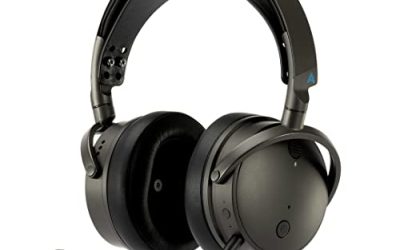
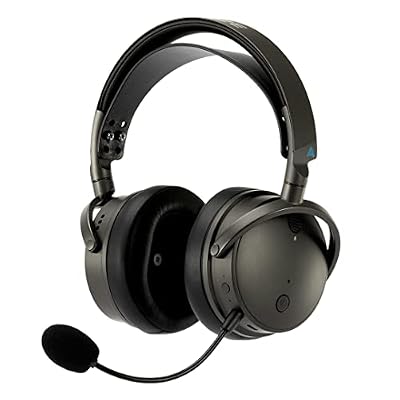
The Audeze Maxwell is the clearest answer here for someone who refuses to treat music as secondary on a gaming headset. Its listing centres on large planar magnetic drivers, more commonly associated with dedicated music headphones, and on high-resolution audio over wireless and USB. That design suits critical listening as well as play, with detail and control rather than an exaggerated low end, so soundtracks, dialogue, and albums sit comfortably in one session.
Connection flexibility is equally strong, with low-latency wireless for gaming, Bluetooth for music, and wired options. Battery life is listed at 80 hours. The listed weight is higher than on most rivals, so fit deserves attention for long sessions.
Microphone provision is a detachable boom microphone, supplemented by integrated beamforming microphones described in the listing. Voice chat is fully covered, and the boom can be removed for music. Provided the correct platform version is selected, this is the most complete package here.
Specs
- Connection: Low-latency wireless via USB dongle, Bluetooth, USB wired, and 3.5 mm wired
- Codecs: LC3plus, LE Audio, and LDAC stated in the listing; high-resolution audio up to 24-bit/96 kHz over wireless or USB
- Driver: 90 mm planar magnetic drivers
- Microphone: Detachable boom, plus integrated beamforming microphones; no separate microphone needed
- Platform compatibility: Xbox, PlayStation, Mac, PC, and Switch for this version, plus mobile
- Battery: 80 hours listed
SteelSeries Arctis Nova Pro Wireless
The SteelSeries Arctis Nova Pro Wireless pairs dynamic drivers with a base station that handles switching, charging, and control. The manufacturer describes premium high-fidelity drivers, spatial audio including Tempest 3D Audio on PlayStation and Microsoft Spatial Sound on Xbox, and a pro-grade parametric equaliser. For music, that equaliser is useful because a single tuning rarely suits both competitive play and album listening.
The base station is the defining feature. Dual USB connections allow two systems to be connected at once and swapped with a button, while a spare battery charges in the station, so a flat battery is a quick swap. Simultaneous Bluetooth allows phone music or calls to be mixed with game audio. Active noise cancelling adds a travel benefit most gaming headsets omit.
Microphone provision is a retractable ClearCast Gen 2 boom that slides into the earcup. Pulled out, it covers team chat; pushed in, the headset behaves like conventional headphones for music. No separate microphone is needed. Confirm the variant matches the console.
Specs
- Connection: 2.4 GHz wireless via dual-USB base station, simultaneous Bluetooth, and 3.5 mm wired cable supplied
- Codecs: No headline Bluetooth codec list in the listing; gaming uses the base-station wireless link
- Driver: 40 mm dynamic drivers, described as premium high-fidelity drivers
- Microphone: Retractable ClearCast Gen 2 boom with AI noise cancelling described in the listing; no separate microphone needed
- Platform compatibility: Xbox, PC, PlayStation 5, PlayStation 4, Switch, and mobile for this version
- Battery: Hot-swappable dual-battery system; 40 hours listed
Sony WH-1000XM5

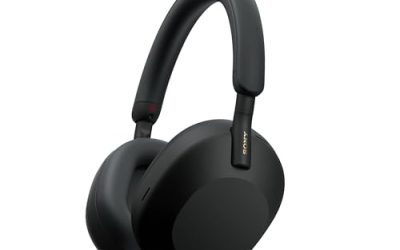
The Sony WH-1000XM5 is a music and travel headphone first, earning its place for players whose gaming is mostly single-player, whose chat needs are casual, or who plan to use a cable at the desk. The listing highlights active noise cancelling driven by two processors and eight microphones, a lightweight design, and up to 30 hours of battery life. Noise cancelling helps in shared homes, offices, and flights, and its codecs suit everyday streaming and higher-quality sources alike.
For gaming, the limits need stating. There is no dedicated low-latency gaming dongle in the listing, and standard Bluetooth is not ideal for fast-paced play or direct connection on every console. The supplied cable changes the picture at a desk or with a controller, removing wireless delay for story games. Used that way, the XM5 works well for solo sessions, while Bluetooth remains the mode for music away from the desk.
Microphone provision is integrated microphones, with no boom. The listing describes hands-free calling, and those microphones handle casual chat when the connection supports a microphone profile, but competitive players should expect a boom headset to be clearer.
Specs
- Connection: Bluetooth wireless and 3.5 mm wired with the supplied connection cable
- Codecs: LDAC, AAC, and SBC in the manufacturer specification; Bluetooth version 5.2 listed
- Driver: 30 mm dynamic driver
- Microphone: Integrated microphones for calls, no boom; a separate microphone is recommended for regular competitive chat
- Platform compatibility: Bluetooth-enabled devices and devices with a 3.5 mm jack, as stated in the listing
- Battery: 30 hours listed
Sennheiser MOMENTUM 4 Wireless
The Sennheiser MOMENTUM 4 Wireless is the other music-first option, and its distinguishing strength is endurance. Battery life is listed at up to 60 hours of music playback via Bluetooth with noise cancelling on, practical for a week mixing work, travel, music, and evening gaming. The manufacturer describes a 42 mm transducer system, adaptive noise cancelling with a transparency mode, and customisable sound through its app, features that also help games sound full in a noisy home.
Gaming use works best with clear expectations. With no gaming dongle, the low-latency route for desk and console play is a wired connection, while Bluetooth suits music and casual gaming. Its codec list is a music advantage on aptX-capable sources, while AAC covers Apple devices and SBC is the fallback.
Microphone provision is integrated MEMS microphones with beamforming, with no boom fitted. That system is intended for clear calls and is adequate for occasional chat, but it is not a substitute for a boom in nightly team play, so regular multiplayer users should choose a gaming headset above or add a separate microphone.
Specs
- Connection: Bluetooth 5.2 wireless, plus wired operation with the supplied audio cable and USB-C charging
- Codecs: SBC, AAC, aptX, and aptX Adaptive, as listed in the manufacturer specification
- Driver: 42 mm dynamic transducer system
- Microphone: Integrated MEMS microphones with beamforming, no boom; a separate microphone is recommended for regular competitive chat
- Platform compatibility: Bluetooth phones, tablets, and computers, plus wired devices; check console requirements
- Battery: Up to 60 hours of Bluetooth playback with noise cancelling on, per the manufacturer
Audio-Technica ATH-M50x

The Audio-Technica ATH-M50x is the wired studio option. There is no battery, pairing, codec, or wireless latency to manage: plugged into a PC, controller, or audio interface, it simply plays. The listing describes 45 mm large-aperture drivers, a circumaural closed-back design for sound isolation, and swivelling earcups. That isolation helps both uses, keeping audio in and reducing room distraction without electronic noise cancelling.
For music, the M50x has a long-standing studio-monitor role, and its detachable coiled and straight cables make it easy to leave one at the desk and carry another. For gaming, positional audio depends on the game and source device rather than headset software, and many players value that predictability. The collapsible design helps storage.
Microphone provision is none. The ATH-M50x has no built-in, boom, or inline microphone, so a separate microphone is needed for voice chat, whether a desk USB microphone or another microphone in the PC or console setup. That requirement is the main cost of this pick and should be decided before ordering.
Specs
- Connection: Wired only, 3.5 mm jack with detachable cables supplied, including coiled and straight cables
- Codecs: Not applicable, because the connection is wired analogue
- Driver: 45 mm dynamic drivers with rare-earth magnets, as described by the manufacturer
- Microphone: None fitted; a separate microphone is needed for voice chat
- Platform compatibility: Laptops, desktops, consoles, phones, and tablets with a compatible headphone jack, as stated in the listing
- Design: Closed-back, circumaural, with 90-degree swivelling earcups and sound isolation listed
Frequently Asked Questions
Can one pair of headphones really work well for both gaming and music?
Yes, provided connection and microphone limits are understood before buying. Gaming headsets with low-latency wireless and a boom cover both uses with fewest compromises, while music headphones work well for solo and casual gaming when a cable is used. Problems arise when a Bluetooth-only headphone is expected to deliver competitive chat and delay-free console audio without a cable, dongle, or separate microphone.
Is Bluetooth good enough for gaming, or is a cable or dongle needed?
It depends on the game and device. Bluetooth is convenient for music and casual play, but a dedicated 2.4 GHz dongle or base station is more reliable for fast-paced gaming and stable chat. A wired connection removes wireless latency entirely. Check whether a console accepts Bluetooth audio directly, because many require a dongle, transmitter, or controller cable instead.
Do all of these headphones have a microphone for voice chat?
No. The Maxwell has a detachable boom and the Arctis Nova Pro Wireless has a retractable boom, so both cover voice chat without extra purchases. The Sony WH-1000XM5 and Sennheiser MOMENTUM 4 Wireless use integrated microphones designed mainly for calls, which handle casual chat but are not boom equivalents. The ATH-M50x has no microphone at all, so a separate microphone is needed for any voice chat.
Which pick is best for mostly single-player gaming and music?
A music-first headphone such as the WH-1000XM5 or MOMENTUM 4 Wireless can be the better fit, because noise cancelling, codecs, and battery life shape more of the experience than boom clarity. Using the cable avoids Bluetooth latency for story games. Players who later move into regular multiplayer should add a separate microphone.
Conclusion
The best choice depends on platform and voice chat. Choose the Maxwell for planar-driver quality with a detachable microphone, or the Arctis Nova Pro Wireless for base-station switching and hot-swappable batteries. Choose the WH-1000XM5 or MOMENTUM 4 Wireless when music comes first and gaming is mainly solo. Choose the ATH-M50x for wired simplicity, planning a separate microphone from the outset.