A 7.1 gaming headset does not hide eight separate speakers inside two earcups. It uses virtual surround processing to fold a multi-channel game mix into a stereo signal that still carries directional cues, so a footstep behind your left shoulder sounds different from one in front of you. Every model here builds that effect with a named, manufacturer-published technology: DTS Headphone:X 2.0, THX Spatial Audio or SteelSeries Sonar. The five picks cover wireless and wired designs for PC, PlayStation and Switch, and each is sold on Amazon US at the time of writing. Read the platform notes carefully: the surround effect is almost always a PC feature delivered through software.
As an Amazon Associate we earn from qualifying purchases
How 7.1 Virtual Surround Works
A game renders its audio in channels: front, centre, side and rear, plus a low-frequency effects channel. Virtual surround software takes that 7.1 mix and applies head-related transfer functions, filters that mimic how your outer ear shapes sound from different directions. The result is a two-channel signal your brain reads as sound coming from around you.
The brand names differ, but the pipeline is similar. DTS Headphone:X 2.0 builds an object-based soundstage on a Windows PC through the maker’s software. THX Spatial Audio, delivered through Razer Synapse, switches between stereo, surround and per-application profiles. SteelSeries Sonar provides a 7.1 virtual surround mode alongside a parametric equaliser. Dolby Atmos for Headphones is a fourth option on some models, although none of the five picks below relies on it.
One distinction matters throughout this guide. The specifications quoted in each product section are the figures the manufacturer publishes: driver size, frequency response, battery rating and platforms. How convincing the soundstage feels is a separate, subjective judgement, so this guide describes what each system is designed to do rather than promising a fixed level of immersion.
What to Check Before You Buy
Platform and connection come first. On PC, surround processing runs through a USB connection and the maker’s software, so every pick here delivers its full feature set on a Windows machine. On PlayStation, a USB dongle usually gives you wireless stereo plus the console’s own spatial audio, while the headset’s PC surround mode stays off. Xbox support is the rarest: none of the five models below is an Xbox design, so Xbox players should look at dedicated 7X-style variants instead. For a wider shortlist by platform, our best gaming headset 7.1 surround roundup groups more options by system.
Check the software requirement. DTS Headphone:X 2.0 on Logitech and HyperX headsets runs through G Hub and NGENUITY respectively, both Windows applications. THX Spatial Audio needs Razer Synapse, and Sonar is part of SteelSeries GG. On a Mac, expect stereo only.
Compare microphones honestly. A detachable boom with software voice processing, such as Logitech’s Blue VO!CE filters, suits streaming and team calls. A retractable mic with AI noise reduction, like the ClearCast Gen 2, is tidier for hybrid use.
Mind the codec and latency basics. None of these headsets uses Bluetooth for its main game link, because standard Bluetooth latency is too high for competitive play. The wireless picks use a 2.4 GHz USB dongle for game audio; Bluetooth, where present, is a second channel for calls and music.
The Five Picks at a Glance
| Product | Surround technology | Connection | Main platforms | Microphone |
|---|---|---|---|---|
| Razer BlackShark V2 Pro (2023) | THX Spatial Audio | 2.4 GHz wireless, Bluetooth | PC, PlayStation, Switch, mobile | Detachable boom |
| Logitech G PRO X Wireless | DTS Headphone:X 2.0 | 2.4 GHz Lightspeed USB | PC, PlayStation | Detachable boom, Blue VO!CE |
| HyperX Cloud Alpha Wireless | DTS Headphone:X Spatial Audio | 2.4 GHz wireless | PC, PS5, PS4, Switch | Detachable boom |
| SteelSeries Arctis Nova 7 Gen 2 | Sonar 7.1 Virtual Surround | 2.4 GHz USB-C, Bluetooth | PC, PS5, PS4, Switch, mobile | Retractable, AI noise cancelling |
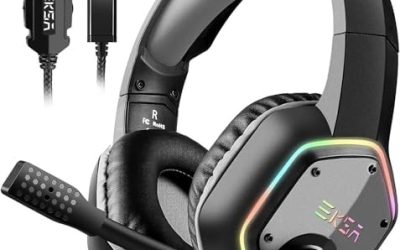
| Razer Kraken V3 HyperSense | THX Spatial Audio | Wired USB | PC | Detachable boom |
Razer BlackShark V2 Pro (2023)

The BlackShark V2 Pro in its 2023 edition is Razer’s esports-focused wireless headset, and its surround system is THX Spatial Audio, switched on and tuned inside Razer Synapse on PC. Synapse also carries pro-tuned FPS audio profiles developed with competitive players. Away from a PC, the headset works over its HyperSpeed 2.4 GHz dongle with PlayStation and Switch, and Bluetooth 5.2 covers phones, although the THX processing stays behind on the computer.
Battery life is the headline published figure: Razer rates the headset for up to 70 hours per charge, with USB-C charging. The detachable HyperClear Super Wideband microphone covers a wider frequency range than the previous generation’s mic, the spec that matters most for shot-callers and streamers. At a published 320 grams with breathable memory-foam cushions, it is built for long sessions, with passive isolation from the closed earcups.
Specs
- Surround sound: THX Spatial Audio via Razer Synapse (PC)
- Connection: Razer HyperSpeed 2.4 GHz wireless, Bluetooth 5.2
- Drivers: 50 mm Razer TriForce Titanium
- Frequency response: 12 Hz – 28 kHz
- Microphone: Detachable Razer HyperClear Super Wideband, unidirectional
- Battery life: Up to 70 hours, USB-C charging
- Weight: 320 g
- Platforms: PC, PlayStation, Nintendo Switch, mobile
Logitech G PRO X Wireless

Logitech’s PRO X Wireless pairs its Lightspeed 2.4 GHz USB connection with DTS Headphone:X 2.0, the object-based surround system Logitech describes as going beyond standard 7.1 by adding distance awareness to directional cues. The surround mode, equaliser and microphone processing all live in G Hub on Windows, so this is a PC-first headset that also connects to PlayStation consoles for stereo play. There is no Bluetooth and no 3.5 mm fallback.
The microphone is the differentiator. The detachable 6 mm boom runs through Blue VO!CE, a filter suite with noise reduction, a compressor and a de-esser, and G Hub stores profiles so your voice settings follow you between games. The 50 mm PRO-G drivers use a hybrid mesh construction, and the frame mixes aluminium forks with a steel-reinforced headband. Logitech rates battery life at more than 20 hours, and the box includes leatherette and cloth ear pads.
Specs
- Surround sound: DTS Headphone:X 2.0 via Logitech G Hub (Windows PC)
- Connection: Lightspeed 2.4 GHz wireless over USB receiver
- Drivers: 50 mm PRO-G, hybrid mesh
- Frequency response: 20 Hz – 20 kHz
- Microphone: Detachable 6 mm boom with Blue VO!CE software filters
- Battery life: 20+ hours
- Weight: 370 g
- Platforms: PC, PlayStation consoles
HyperX Cloud Alpha Wireless

The Cloud Alpha Wireless is the endurance pick of this group. HyperX rates its battery for up to 300 hours of wireless play, a published figure that dwarfs the rest of this list. Its surround system is DTS Headphone:X Spatial Audio, enabled on PC through HyperX NGENUITY software, and the 2.4 GHz USB dongle also covers PS5, PS4 and Switch in stereo.
The hardware underneath is the familiar Cloud formula: 50 mm dual-chamber drivers that separate the bass chamber from the mids and highs, an aluminium frame, and memory-foam ear cushions. The detachable microphone is noise cancelling, with an LED indicator for mute status. There is no Bluetooth and no wired mode, so this is a one-link headset aimed at a desk or console corner rather than travel. For a player who wants to charge a headset a few times a year rather than a few times a month, the trade-offs line up well.
Specs
- Surround sound: DTS Headphone:X Spatial Audio via HyperX NGENUITY (PC)
- Connection: 2.4 GHz wireless over USB dongle
- Drivers: 50 mm HyperX Dual Chamber
- Microphone: Detachable, noise cancelling, LED mute indicator
- Battery life: Up to 300 hours
- Frame: Aluminium, memory-foam ear cushions
- Weight: 335 g with microphone
- Platforms: PC, PS5, PS4, Nintendo Switch
SteelSeries Arctis Nova 7 Wireless Gen 2

The second generation of the Arctis Nova 7 is the flexible traveller of the five. Its USB-C dongle gives low-latency 2.4 GHz wireless on PC, PlayStation and Switch, and Bluetooth runs at the same time rather than instead of it, so game audio and a phone call can be mixed together. Surround duties fall to SteelSeries Sonar on PC, which provides the 7.1 virtual surround mode, a ten-band parametric equaliser and game presets inside the GG software, while the Arctis companion app adds phone control.
SteelSeries rates battery life at more than 50 hours, and a 15-minute fast charge is published as returning about six hours of play. The ClearCast Gen 2 microphone retracts fully into the left earcup, and its AI noise cancelling strips out keyboard and fan noise before your voice reaches the chat. The 40 mm neodymium magnetic drivers are smaller than the 50 mm units in the other picks, keeping the headset compact for handheld use. Note that this is the PC and PlayStation model; Xbox players need the separate Nova 7X line.
Specs
- Surround sound: 7.1 Virtual Surround via SteelSeries Sonar (PC), 360 Spatial Audio
- Connection: 2.4 GHz wireless over USB-C dongle, simultaneous Bluetooth
- Drivers: 40 mm Neodymium Magnetic
- Frequency response: 20 Hz – 22 kHz
- Microphone: Retractable ClearCast Gen 2 with AI noise cancelling
- Battery life: 50+ hours, USB-C fast charge (15 minutes for about 6 hours)
- Model number: 61730
- Platforms: PC, PS5, PS4, Nintendo Switch and Switch 2, mobile
Razer Kraken V3 HyperSense

The Kraken V3 HyperSense is the wired option, and it adds a sense the others do not have: touch. Razer HyperSense converts in-game audio into haptic vibration inside the earcups, so explosions arrive as physical feedback scaled to the sound. It runs over wired USB on PC, which also carries THX Spatial Audio through Razer Synapse, the same surround platform as the BlackShark above.
Because it is wired, there is no battery to manage and no wireless link to drop, which suits a fixed desk setup. The 50 mm TriForce Titanium drivers match the BlackShark’s driver family, the detachable HyperClear cardioid microphone rejects sound from the sides and rear, and the hybrid fabric and leatherette cushions are shaped for glasses wearers. Chroma RGB lighting rings the earcups. The limit is clear from the spec sheet: this PC-only headset stays with the computer rather than following you to a console.
Specs
- Surround sound: THX Spatial Audio via Razer Synapse (PC)
- Connection: Wired USB
- Drivers: 50 mm Razer TriForce Titanium
- Extra feature: Razer HyperSense haptic feedback
- Microphone: Detachable Razer HyperClear Cardioid
- Cushions: Hybrid fabric and leatherette memory foam
- Lighting: Razer Chroma RGB
- Model number: RZ04-03770100-R3U1
- Platforms: PC
Frequently Asked Questions
Is the 7.1 surround in these headsets real or virtual?
It is virtual. Each headset has two drivers, one per ear, and software such as DTS Headphone:X 2.0, THX Spatial Audio or Sonar processes the game’s multi-channel mix into a stereo signal with directional cues. The 7.1 label describes the input format, not the number of speakers in the cups.
Does 7.1 surround work on PS5 and Xbox, or only on PC?
Mostly on PC. The surround modes here run through Windows software, so on PlayStation the same headsets generally deliver wireless stereo plus the console’s own spatial audio. Xbox is the most restrictive platform: none of these five models is an Xbox variant, so check for a dedicated Xbox version before buying for that system.
What is the difference between DTS Headphone:X, THX Spatial Audio and Sonar?
All three are virtual surround engines that differ mainly in tuning and software. DTS Headphone:X 2.0 uses object-based processing and runs through G Hub or NGENUITY depending on the brand. THX Spatial Audio lives inside Razer Synapse and adds per-application profiles. Sonar combines its 7.1 mode with a parametric equaliser and game presets. The goal is the same: clearer direction and distance cues than plain stereo.
Can I use a 7.1 gaming headset for music, films and calls?
Yes. Every surround system here can be switched back to stereo in its software, the better setting for most music. The Bluetooth-equipped picks, the BlackShark V2 Pro (2023) and the Arctis Nova 7 Gen 2, move most easily between game and phone, while the wired Kraken V3 HyperSense stays at a PC desk.
Conclusion
Choosing the best 7 1 gaming headset comes down to where you play and which surround software you live in. The BlackShark V2 Pro (2023) is the competitive all-rounder, with THX Spatial Audio, a wideband microphone and Bluetooth alongside its dongle. The PRO X Wireless suits PC players who care most about voice quality, thanks to Blue VO!CE. The Cloud Alpha Wireless trades extra connections for a 300-hour battery rating and DTS Headphone:X. The Arctis Nova 7 Gen 2 mixes game and phone audio at once, and the wired Kraken V3 HyperSense adds haptic feedback. Match the platform list first, then the microphone, and the surround brand will usually decide itself.