As an Amazon Associate we earn from qualifying purchases.
Plenty of headsets advertise a long feature list and then hide part of it behind a paid plan. An equalizer locked in a premium tier, a spatial audio mode that stops working when a trial ends, or a companion app that asks for a monthly fee can turn a budget purchase into an ongoing cost. This guide takes the opposite approach: every pick below sits in the under-one-hundred-dollar class, and every headline feature works in full the day the box is opened, with no subscription attached.
That condition shapes the shortlist as much as sound quality does. The five headsets here cover wired USB, wired analog, and low-latency wireless designs for PC, PlayStation, Xbox, and Switch. Readers who want the wider budget field first can browse the general roundup of the best gaming headset under 100 before narrowing the choice down to the no-subscription models gathered here.
What “without subscription” actually means
The subscription trap in gaming audio usually appears as software. A headset may ship with a free app whose advanced EQ profiles, surround processing, or microphone noise removal sit in a paid tier. Spatial audio is the most common pressure point: some platforms sell object-based audio as an add-on, and some headset brands bundle only a trial.
Three checks separate a genuinely subscription-free headset from a trial in disguise. First, the spatial audio route should be included, licensed for the life of the product, or supplied free by the platform itself. Windows Sonic is built into Windows and Xbox at no cost, and the PlayStation 5 renders Tempest 3D audio for any wired or wireless headset without a fee. Second, the companion app, where one exists, should expose its EQ and microphone controls in the free version. Third, the core hardware features — microphone, volume control, mute — should never depend on an account or a plan at all. Every headset below passes all three checks according to its manufacturer’s published terms.
Connections, codecs, and microphones
Connection type decides both latency and codec behaviour. Analog 3.5 mm headsets carry no codec at all: the signal is plain stereo, lag is effectively zero, and any spatial processing happens on the host device. USB headsets add an onboard digital path, which is how the HyperX Cloud III delivers its included DTS processing on PC. Wireless is the one area where codecs matter. The Logitech G435 uses a USB receiver for its low-latency LIGHTSPEED link and falls back on standard Bluetooth SBC for phones and handhelds, a sensible split because SBC keeps compatibility broad while the receiver handles gaming duty.
Microphones divide into three designs in this group. Detachable boom microphones, as on the Cloud III, give the clearest voice pickup and can be removed for media use. A retractable boom, as on the Arctis Nova 1, hides inside the earcup when not needed. Fixed cardioid booms and flip-to-mute designs trade a little flexibility for simplicity, while the G435 replaces the boom entirely with dual beamforming microphones built into the earcup.
The picks
HyperX Cloud III

The Cloud III is the most complete package in this group and the clearest example of the no-subscription principle applied to spatial audio. HyperX includes a lifetime activation of DTS Headphone:X through the free NGENUITY software on PC, so the 3D audio mode is licensed once, for good, rather than rented. That processing runs over the USB connection; the same headset also works as a plain analog model through its 3.5 mm cable, which is the route to use on controllers and handhelds.
Published specifications centre on angled 53 mm drivers, a detachable 10 mm microphone with an LED mute indicator, and an aluminium frame with memory foam cushions. HyperX rates the headset at 308 grams, light enough for long sessions without giving up a metal build. Platform support is broad on paper: PC, PlayStation 5 and 4, Xbox Series X|S, Switch, Mac, and mobile devices are all listed. Buyers who play on PC and console from the same desk get the most from it, since the USB path unlocks the DTS mode and EQ while the analog cable covers everything else.
Specs
- Drivers: 53 mm angled dynamic drivers
- Frequency response: 10 Hz – 21 kHz
- Impedance: 64 ohms
- Microphone: detachable 10 mm electret condenser, noise-cancelling, LED mute indicator
- Connections: USB-C, USB-A adapter, 3.5 mm analog
- Spatial audio: DTS Headphone:X, lifetime activation via NGENUITY (PC, USB)
- Weight: 308 g
- Compatibility: PC, PS5, PS4, Xbox Series X|S, Switch, Mac, mobile
SteelSeries Arctis Nova 1

The Arctis Nova 1 keeps its software story simple. Its 360-degree spatial audio and parametric EQ run through SteelSeries Sonar, which is a free download inside the GG app with no paid tier gating the features the headset advertises. On console, the same headset leans on the platforms’ own free spatial formats, since the single 3.5 mm connection works with PlayStation, Xbox, Switch, and PC alike.
SteelSeries publishes a weight of 236 grams, making this the lightest wired model in the roundup, and the ComfortMAX system uses height-adjustable earcups with a stretchy headband to spread pressure. The ClearCast Gen 2 microphone retracts fully into the left earcup and is rated as bidirectional with noise cancelling. The Nova Acoustic System pairs custom high-fidelity drivers with that software layer, and a PC splitter cable is included for desktops with separate audio and microphone jacks. It suits players who move between a PC and a console controller and want one featherweight headset for both.
Specs
- Drivers: 40 mm high-fidelity drivers (Nova Acoustic System)
- Frequency response: 20 Hz – 22 kHz
- Impedance: 36 ohms
- Microphone: ClearCast Gen 2 retractable boom, bidirectional, noise-cancelling
- Connections: 3.5 mm analog, PC splitter cable included
- Spatial audio: 360-degree spatial audio via SteelSeries Sonar (free, PC)
- Weight: 236 g
- Compatibility: PC, PS5, PS4, Xbox, Switch, Mac, mobile
Razer BlackShark V2 X

Razer’s esports-leaning entry takes a different route to surround sound. The BlackShark V2 X is a purely analog headset, and its 7.1 surround on Windows comes from Razer’s surround software, activated with the code included in the box at no extra cost. There is no recurring plan in that arrangement: the activation is a one-time unlock tied to the purchase, and the headset keeps working as a stereo model on every other platform.
The published hardware list includes Razer TriForce 50 mm drivers, a fixed HyperClear cardioid microphone that rejects sound from the sides and back, and memory foam cushions with passive noise isolation. At 240 grams it stays close to the Nova 1 in lightness while adding thicker padding. Razer lists compatibility across PC, Mac, PlayStation, and Switch through the 3.5 mm jack, and the same jack plugs into an Xbox controller. Competitive players on a strict budget are the natural audience, because the tuning prioritises positional clarity over bass weight, according to Razer’s own product description.
Specs
- Drivers: Razer TriForce 50 mm
- Frequency response: 12 Hz – 28 kHz
- Impedance: 32 ohms
- Microphone: fixed HyperClear cardioid boom, unidirectional
- Connections: 3.5 mm analog
- Spatial audio: 7.1 surround via Razer surround software, activation code included (Windows)
- Weight: 240 g
- Compatibility: PC, Mac, PS4, PS5, Switch, mobile, Xbox via controller jack
Logitech G435
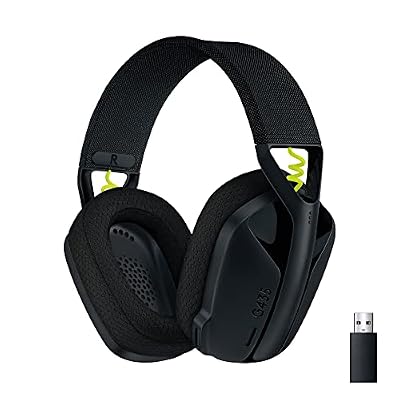
The G435 is the wireless option for buyers who refuse both cables and subscriptions. Its two radios cover the main use cases: LIGHTSPEED over a USB receiver for low-latency play on PC and PlayStation, and Bluetooth for Switch, phones, and tablets. Logitech’s G HUB software, which handles its EQ settings, is free, and the headset carries no feature that asks for a plan. For spatial audio it relies on the host platform, and Logitech lists it as compatible with Dolby Atmos as well as the free object formats built into Windows and PlayStation.
Manufacturer figures put the weight at just 165 grams, the lightest in this group by a wide margin, with 40 mm drivers and a rated battery life of up to 18 hours per charge. There is no boom microphone; dual beamforming microphones in the earcup pick up voice instead, which keeps the silhouette clean for commuting or camera-off calls. The trade-off is voice isolation in loud rooms, where a boom design has the advantage.
Specs
- Drivers: 40 mm
- Frequency response: 20 Hz – 20 kHz
- Impedance: 45 ohms
- Microphone: dual built-in beamforming microphones
- Connections: LIGHTSPEED 2.4 GHz USB receiver, Bluetooth (SBC)
- Battery life: up to 18 hours
- Spatial audio: platform-based, Dolby Atmos compatible, Windows Sonic ready
- Weight: 165 g
- Compatibility: PC, PS4, PS5, Switch, mobile
Turtle Beach Recon 70

The Recon 70 is the purest interpretation of the brief: it has no companion app, no account, and no software layer of any kind, so there is nothing that could ever ask for a subscription. Spatial audio comes entirely from the platform, and Turtle Beach states that the headset supports Sony 3D Audio on PlayStation 5, Windows Sonic, Dolby Atmos, and DTS Headphone:X output from the host device. Windows Sonic and the PlayStation implementation are free, which keeps the whole chain cost-free after purchase.
Published specifications list 40 mm speakers with neodymium magnets, a high-sensitivity microphone that flips up to mute, and synthetic leather cushions on a lightweight frame. The fixed 3.5 mm cable is roughly 1.2 metres long, sized for a controller or a laptop rather than a distant desktop tower. Platform support spans PlayStation 5 and 4, Xbox Series X|S and One, PC, Switch, and mobile devices with a 3.5 mm port. For a spare headset, a younger player’s first headset, or a travel bag, it covers the essentials with zero ongoing commitments.
Specs
- Drivers: 40 mm with neodymium magnets
- Frequency response: 20 Hz – 20 kHz
- Microphone: high-sensitivity boom, flip-to-mute
- Connections: 3.5 mm analog, fixed cable (about 1.2 m)
- Spatial audio: platform-based (PS5 3D Audio, Windows Sonic, Dolby Atmos, DTS Headphone:X)
- Ear cushions: synthetic leather, over-ear
- Compatibility: PS5, PS4, Xbox Series X|S, Xbox One, PC, Switch, mobile
Side-by-side comparison
| Model | Connection | Spatial audio route | Mic design | Weight |
|---|---|---|---|---|
| HyperX Cloud III | USB-C, USB-A, 3.5 mm | DTS Headphone:X, lifetime activation included | Detachable boom | 308 g |
| SteelSeries Arctis Nova 1 | 3.5 mm | Sonar spatial audio, free software | Retractable boom | 236 g |
| Razer BlackShark V2 X | 3.5 mm | 7.1 surround, activation code included | Fixed cardioid boom | 240 g |
| Logitech G435 | LIGHTSPEED USB, Bluetooth | Platform formats, Atmos compatible | Built-in beamforming | 165 g |
| Turtle Beach Recon 70 | 3.5 mm | Platform formats only | Flip-to-mute boom | Lightweight frame |
Frequently asked questions
Do any of these headsets need a paid app to unlock their features?
No. Each model was chosen because its advertised features work without a paid plan. The Cloud III includes a lifetime DTS Headphone:X activation, the Arctis Nova 1 uses the free Sonar software, the BlackShark V2 X activates its surround mode with an included code, and the G435 and Recon 70 rely on free platform audio and free companion software.
Is spatial audio on PlayStation and Xbox really free?
Yes, for the formats these headsets use. Windows Sonic is built into Windows and Xbox consoles at no cost, and the PlayStation 5 includes Tempest 3D audio for supported games with any headset. Optional paid formats exist on those platforms, but none of the five headsets here depends on one.
Which pick is best for playing on both PC and console?
The HyperX Cloud III and SteelSeries Arctis Nova 1 fit that role best on paper. The Cloud III adds a USB path for PC features and an analog cable for controllers, while the Nova 1 uses one 3.5 mm connection everywhere and stays lighter. The G435 is the alternative when wireless matters more than a boom microphone.
Why is there no wireless model with a boom microphone in this list?
At this budget, wireless designs that keep every feature subscription-free tend to drop the boom to save cost and weight, as the G435 does with its beamforming microphones. Buyers who need boom-microphone clarity and wireless at once usually have to step above the under-one-hundred-dollar class.
Conclusion
That filter leaves a strong field: the Cloud III for its included lifetime DTS licence and detachable microphone, the Nova 1 for featherweight wired comfort, the BlackShark V2 X for competitive tuning, the G435 for cable-free flexibility, and the Recon 70 for buyers who want no software in the chain at all. Pick by platform and connection first, and every model here keeps its full feature set without asking for anything more after checkout.