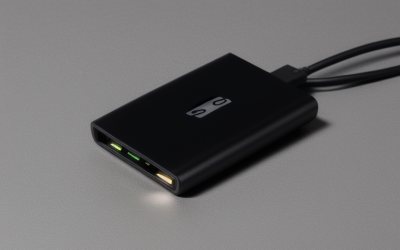
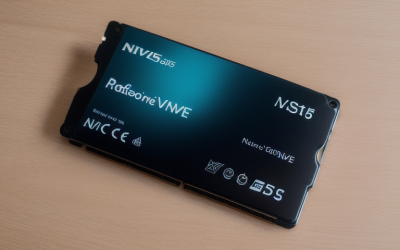
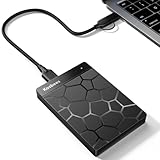
- Top Pick: Kosbees 500 GB External Hard Drives,Portable Hard Drive for Windows,Ultra Slim External HDD Store Compatible with PC, MAC,Laptop,PS4, Xbox one, Xbox 360;Plug and Play Ready
- Best Value: Kosbees 1 TB External Hard Drives,Portable Hard Drive for Windows,Ultra Slim External HDD Store Compatible with PC, MAC,Laptop,PS4, Xbox one, Xbox 360;Plug and Play Ready
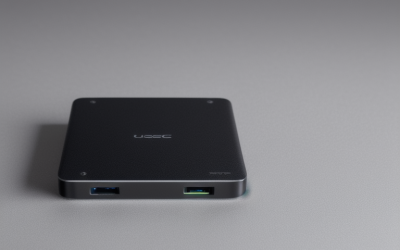
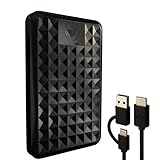
- Premium Choice: ModusTech Facet 500GB External Hard Drive Portable USB-C/USB 3.1 Plug & Play Ultra- Slim HDD Hard Drive for Backup, Gaming, PC, Mac, Laptop, PS4, Xbox, Smart TV (Black)
A gaming laptop runs out of storage faster than almost any other kind of computer. A single modern title can claim well over 100 gigabytes, and the internal drive that shipped with the machine is often shared with the operating system, drivers, and launchers. Adding a hard drive is the fastest fix, but the keyword hides a real fork in the road: a portable drive that plugs into a USB port for extra storage, or an internal drive that replaces what is inside the chassis. Most laptops cannot hold a large desktop-style drive, so portable external storage is where this guide focuses.
This guide is for owners of gaming laptops in 2026 who want somewhere to park installed games, captures, backups, and media without opening the case. Each pick below is compared only on what its listing states: capacity, interface, form factor, and device compatibility. A seventh candidate in the research set, an internal 8TB desktop drive, was left out because a 3.5-inch desktop drive does not fit a laptop bay.
Quick Picks
As an Amazon Associate we earn from qualifying purchases at no extra cost to you.


| Product | Best for | Key spec from the title |
|---|---|---|
| Kosbees 500 GB External Drive | Light overflow and backups | 500 GB, ultra slim, plug and play |
| Kosbees 1 TB External Drive | A bigger library on the same design | 1 TB, PC, Mac, PS4, Xbox compatible |
| ModusTech Facet 500GB | Newer laptops with a USB-C port | USB-C/USB 3.1, ultra-slim |
| OSCOO 1TB Portable SSD | Games that need quicker loading | Up to 2100MB/s, USB 3.2 Gen 2 |
| Unbranded 500GB Portable HDD | The simplest possible backup disk | USB 3.0, 2.5-inch, plug and play |
| ModusTech Facet 1TB | Larger libraries over USB-C | 1TB, USB-C/USB 3.1, smart TV support |
How to Choose
Decide between an HDD and an SSD first
Spinning hard drives usually reach larger capacities than portable solid-state drives but load files more slowly, which shows up as longer waits when a game starts or a level streams in. They also contain moving parts, so a laptop that gets carried to LAN events or classrooms should treat a portable HDD gently and keep it from being knocked while it is spinning. A portable SSD is faster and has no moving parts, but only one pick here, the OSCOO, is described as an SSD. If the drive will hold games you play often, favor the SSD. If it will hold backups, recordings, and a library of rarely played titles, an HDD is the sensible choice.
Match the interface to your laptop
Check which ports your laptop offers. USB 3.0 and USB 3.1 cover common rectangular USB-A ports, while a USB-C connector is increasingly standard on newer machines. A USB 3.2 Gen 2 drive can only reach its top speed on a port that supports the same standard, so a fast drive on a slow port wastes its advantage. Do not assume every USB-C port is equally fast. Look in the laptop manual or the port label for the supported standard, and use the cable that ships with the drive, because a generic substitute cable can limit the connection to older speeds.
Pick capacity based on your library
For a gaming laptop, 500GB fills quickly and 1TB is a sensible minimum for a growing library. Count the games you rotate through, add space for captures and updates, and add a margin of at least one quarter. Remember that a drive’s usable space is less than the number on the box once formatted, and that a nearly full drive slows down and leaves no room for patches. Treat 1TB as the entry point for a laptop that doubles as the main gaming machine, and consider 2TB or a second drive once the library grows past a dozen large titles.
Know what to ignore and where budget drives cut corners
Compatibility lists that name consoles and smart TVs are marketing breadth, not performance. Budget portable drives usually leave out the specifics: no sustained speed figure, no shock-resistance claim, and no stated warranty length. Treat plug-and-play as a convenience, not a quality measure, and look for a stated interface and capacity above all.
The 6 Best Options
Kosbees 500 GB External Hard Drive
An ultra-slim portable hard drive that the listing pitches for Windows, Mac, laptops, PS4, and Xbox One, with plug-and-play setup. At 500 GB it is the smaller of the two Kosbees capacities, so it makes sense as a supplement for a few favorite games or a dedicated backup disk for a laptop with moderate needs.
- Strength: broad compatibility across PC, Mac, and consoles.
- Strength: an ultra-slim body that travels easily with a laptop.
- Trade-off: 500 GB fills quickly with modern game installs.
Skip it if you plan to hold a large library, or if you want an interface version and speed figure printed in the title so you can compare it directly against faster USB drives.
Kosbees 1 TB External Hard Drive
The same ultra-slim design as the 500 GB version, with double the capacity and the same plug-and-play description and device list. For a laptop owner who wants a hard drive to hold a rotating selection of games, 1 TB is the capacity at which the drive begins to feel useful rather than cramped.
- Strength: 1 TB doubles the room of its sibling.
- Strength: Windows, Mac, PS4, and Xbox compatibility is named.
- Trade-off: the title lists no interface version or speed.
Skip it if load times matter more than space, since a spinning drive is not the quick option, or if the laptop has only USB-C ports and you do not own an adapter.
ModusTech Facet 500GB External Hard Drive
This portable HDD names a USB-C and USB 3.1 connection, which matches the ports on many recent laptops without an adapter. The listing positions it for backup, gaming, PC, Mac, PS4, Xbox, and smart TVs, and the black ultra-slim body keeps it easy to carry in a laptop bag.
- Strength: USB-C and USB 3.1 are stated in the title.
- Strength: plug-and-play with a long device list.
- Trade-off: 500GB is a small capacity for a game library.
Skip it if your laptop only has older USB-A ports and you do not own the right cable, or if you need more than a backup disk.
OSCOO 1TB Portable SSD
Although its title says external hard drive, the listing describes an external SSD with speeds up to 2100MB/s over USB 3.2 Gen 2. It is the only solid-state option here and is pitched at gaming, laptops, content creators, and videographers, plus Mac, Windows, and iPhone users. For a gaming laptop that holds the games played every week, the solid-state format is the closest fit to what the keyword is really asking for, and the maximum figure gives a number to compare against.
- Strength: an up to 2100MB/s figure and a USB 3.2 Gen 2 interface are listed.
- Strength: 1TB capacity in a portable SSD format.
- Trade-off: the speed is a maximum that depends on a matching port.
Skip it if you only need cold storage for backups.
500GB Portable External Hard Drive (USB 3.0)
An unbranded 2.5-inch HDD listing with USB 3.0, ultra-slim styling, and plug-and-play use for PC, laptop, desktop, and game consoles, with Windows compatibility named. It is the minimal option, intended for people who want a single-purpose storage box without extras. Because the title spells out the interface and form factor, it is easy to check against a laptop that has a standard USB-A port, and it works as a spare for transferring files between machines.
- Strength: a USB 3.0 interface and 2.5-inch format are both stated.
- Strength: simple compatibility with PCs, laptops, and consoles.
- Trade-off: only Windows compatibility is mentioned.
Skip it if you use a Mac or want a recognizable brand behind the drive.
ModusTech Facet 1TB External Hard Drive
The 1TB version of the Facet, with the same USB-C and USB 3.1 plug-and-play design and the same broad compatibility list. It pairs the more useful capacity with a connector that many newer laptops share, which keeps cable fuss to a minimum. It also doubles as a media library for a smart TV, since the listing names TV use alongside gaming and backup.
- Strength: 1TB with a USB-C and USB 3.1 connection.
- Strength: listed for backup, gaming, PC, Mac, and consoles.
- Trade-off: still a hard drive, with no speed figure given.
Skip it if you want the quickest possible load times, since the OSCOO SSD targets that need.
Which One Fits Your Situation
You want faster game loading from external storage
The OSCOO 1TB is the only solid-state pick here, and its listing gives an interface and speed. Make sure the laptop port can use USB 3.2 Gen 2 speeds.
You need the most space for a growing library
The Kosbees 1 TB and the ModusTech Facet 1TB both reach 1 TB. Choose the Facet if your laptop has USB-C, and the Kosbees if you prefer its wider console list.
You only need a backup disk
The Kosbees 500 GB or the unbranded 500GB drive handle this job without frills. Pair it with a regular backup schedule so saved games and captures stay safe. A backup disk should live in a drawer or bag, not stay plugged in all day, which also helps protect it from accidents.
Your laptop has USB-C and little else
The ModusTech Facet 500GB and 1TB list USB-C directly, so you avoid carrying an adapter. That is a small convenience, but it matters when the laptop is a thin model with only a couple of ports and one of them is already taken by a charger or a headset dongle.
Common Mistakes
- Buying a 3.5-inch internal desktop drive for a laptop that has no bay for it.
- Expecting a spinning drive to load games as quickly as a solid-state drive.
- Pairing a fast USB 3.2 Gen 2 drive with a slow port and assuming the maximum speed.
- Choosing 500GB for a library that already exceeds it.
- Forgetting that the usable space is lower than the labeled capacity.
Related guides
- Combination Smoke And Carbon Monoxide Detectors
- Aio Liquid Coolers For High Performance Gaming
- Graphics Cards For Low Wattage Power Supplies
Frequently Asked Questions
Can I install games on an external hard drive?
Usually yes, though games on a spinning drive can load more slowly than on an internal SSD. Many players keep their current favorites on internal storage and park the rest externally.
Is USB-C faster than USB-A?
Not by itself. The connector shape differs from the speed standard, so look for the USB version, such as 3.1 or 3.2 Gen 2, in the listing.
Why is the OSCOO listed as a hard drive if it is an SSD?
The title uses the phrase external hard drive loosely, while the description names an external SSD with a USB 3.2 Gen 2 interface.
Is 1TB enough for a gaming laptop?
It is a comfortable starting point for a few large games plus captures. If your library is bigger, plan around a larger capacity or more than one drive. Keep the most-played titles on whichever storage loads fastest, and move finished games to the slower disk instead of uninstalling them, so a reinstall never means a fresh download.