Strategy games punish a different part of a laptop than shooters do. A first-person game leans on the graphics chip; a grand strategy or real-time strategy title leans on the processor, because every end-turn calculation, every AI empire and every unit path on a late-game map is CPU work. When that work piles up, a laptop with a headline GPU and a modest processor starts to crawl between turns, while a machine with strong single-core speed, generous memory and a fast SSD keeps the campaign moving. This guide picks gaming laptops currently sold on Amazon US with that balance in mind.
Disclosure: As an Amazon Associate we earn from qualifying purchases.
What strategy games actually ask for
The published requirements of representative titles make the pattern concrete. Firaxis lists Civilization VII’s recommended specification as an Intel Core i5-10400 or AMD Ryzen 5 3600X with 16GB of memory and an RTX 2060-class graphics card, which is a modest bar. Its Ultra tier, aimed at 4K play, jumps to a Core i7-14700F or Ryzen 9 5950X and 32GB of memory — the graphics card rises too, but the striking change is how much processor and memory the top tier demands. That shape repeats across the genre:
- Grand strategy (Civilization, Stellaris, Hearts of Iron, Crusader Kings): turn processing and simulation speed are governed mainly by single-core CPU performance. Late-game slowdowns in these titles are a processor problem, not a graphics problem.
- Total War and other hybrid RTS titles: the campaign map is CPU work, while battles add a real GPU load, so both chips matter — but the processor still decides how the long game feels.
- Memory: 16GB is the published recommended figure for Civ VII; 32GB matches its Ultra tier and leaves headroom for very large maps, heavy mod lists and a browser or guide open on a second screen.
- Storage: a fast NVMe SSD shortens load times and the autosave churn of long sessions. Capacity matters too, because strategy libraries accumulate expansions and mods.
The buying conclusion follows directly: prioritise the fastest single-core processor you can get, take 32GB of memory where the configuration offers it (or a clear upgrade path to it), insist on an NVMe SSD, and treat a mid-range GPU run at a healthy power limit as enough for 1080p and 1440p strategy play.
How to choose a laptop for strategy games
Processor first. Look for HX-class Intel chips or AMD’s high-performance mobile parts, and check the boost clock the maker publishes. A current Core i7 or i9 HX, or a Ryzen 7 or Ryzen 9, sits far above the recommended CPUs named above. If your shortlist leans AMD, our guide to the best gaming laptop AMD Ryzen models works through that side of the field in more depth.
Power limits. The same GPU name can hide very different wattage figures between laptops, and the processor’s sustained power decides whether boost clocks hold through a long turn-processing session. The figures quoted in each pick below are the maker or listing figures for that exact model; where a listing does not publish a GPU wattage, that is stated rather than guessed.
Memory and storage. Prefer 32GB out of the box for grand strategy. If a machine ships with 16GB, it only belongs here when its memory sits in upgradeable slots — and that is stated per model below, only where a source confirms the slot layout. For storage, 1TB is the comfortable starting point for a strategy library.
Display. Strategy interfaces are dense with text and panels, so a 16:10 panel at 2560×1600 shows more map and more UI than a basic 1080p screen. Refresh rate matters less here than in competitive shooters; resolution and size do the real work.
Ports and warranty. An Ethernet port helps large game downloads and patches, USB-C with DisplayPort output makes a second monitor easy for maps and references, and HDMI covers most external displays. On warranty, read the listing terms for the exact configuration: some Amazon configurations are upgraded by the seller before shipping, which can split coverage between the seller and the maker, so confirm who covers the memory and storage before ordering.
The picks
1. MSI Katana 15 HX (B14WGK-016US) — the strongest processor here, 32GB fitted

The Katana 15 HX leads this list because it attacks the strategy bottleneck directly: MSI fits a Core i9-14900HX, a 24-core chip that boosts to 5.8GHz, and pairs it with 32GB of DDR5 memory as sold, so Civ VII’s Ultra-tier memory figure is met without opening the chassis. The RTX 5070 runs at a 115W power limit in MSI’s published specification for this model, which is ample graphics headroom for Total War battles at the panel’s native resolution.
Specs
- CPU: Intel Core i9-14900HX (24 cores, 32 threads, up to 5.8GHz)
- GPU: NVIDIA GeForce RTX 5070 Laptop GPU, 8GB GDDR7, 115W TGP per MSI’s published specification
- RAM: 32GB DDR5-5600
- SSD: 1TB NVMe SSD
- Display: 15.6-inch QHD+ 165Hz, 100% DCI-P3 per the listing
- Ports: USB-C (USB 3.2 Gen 2 with DisplayPort and Power Delivery), USB-A ports, HDMI, RJ45 Ethernet
- Cooling: Cooler Boost 5, dual fans and five heat pipes per MSI
Upgradeability: the published specification for this model lists dual SO-DIMM memory, so the fitted 32GB configuration can be expanded later; treat any storage expansion as unconfirmed until the exact unit’s service information is checked.
2. Lenovo Legion Pro 5i Gen 9 (83DF00A8US) — full-power RTX 4070 and a 2TB drive

Lenovo’s Legion Pro 5i Gen 9 matches the Katana on processor class — the same Core i9-14900HX — and gives its RTX 4070 the full 140W power limit, the highest configuration Lenovo offers for that chip. This Amazon configuration ships with 32GB of DDR5 memory and a 2TB SSD, the largest drive in this guide, which suits a deep strategy library with expansions. The 16-inch 2560×1600 IPS panel runs at 240Hz with full DCI-P3 coverage per Lenovo’s specification, so campaign maps get both room and clarity.
Specs
- CPU: Intel Core i9-14900HX (up to 5.8GHz)
- GPU: NVIDIA GeForce RTX 4070 Laptop GPU, 8GB GDDR6, 140W power limit
- RAM: 32GB DDR5
- SSD: 2TB SSD
- Display: 16-inch WQXGA (2560×1600) IPS, 240Hz, 100% DCI-P3
- Ports: USB-A ports, two USB-C with DisplayPort 1.4, HDMI, RJ45 Ethernet
- Battery: 80Wh
Upgradeability: this model carries two DDR5 SO-DIMM slots and two PCIe 4.0 M.2 slots, so both memory and storage can grow with the library — a layout confirmed for the Gen 9 Legion Pro 5i platform.
3. Lenovo Legion 5 Gen 10 (Ryzen AI 7 350) — OLED screen and 32GB in a smaller chassis

This Legion 5 configuration takes the AMD route: a Ryzen AI 7 350 with eight cores boosting to 5.0GHz, an RTX 5070 and 32GB of DDR5 memory. The 15.1-inch OLED panel at 2560×1600 and 165Hz is the sharpest display in this guide, and OLED contrast flatters the dark campaign maps of space and fantasy strategy titles. The trade-off is storage: 512GB fills quickly once a few large strategy games and their expansions land, so budget for the second drive slot or an external SSD.
Specs
- CPU: AMD Ryzen AI 7 350 (8 cores, 16 threads, up to 5.0GHz)
- GPU: NVIDIA GeForce RTX 5070 Laptop GPU (the listing does not publish a wattage figure)
- RAM: 32GB DDR5
- SSD: 512GB SSD
- Display: 15.1-inch OLED WQXGA (2560×1600), 165Hz
- Ports: USB-C (USB 10Gbps, Power Delivery 3.0, DisplayPort 2.1), USB-C (USB4 40Gbps, DisplayPort 2.1), HDMI, Wi-Fi 7, Bluetooth 5.4
Upgradeability: the listing’s own specification text states memory support up to 64GB of DDR5, so the fitted 32GB is not the ceiling for this configuration.
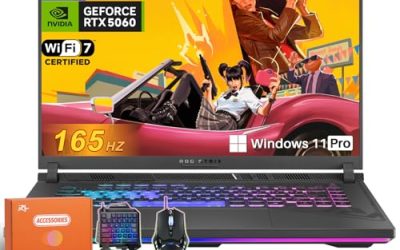
4. ASUS ROG Strix G16 (2025, G615JMR-AS74) — the upgrade-path pick

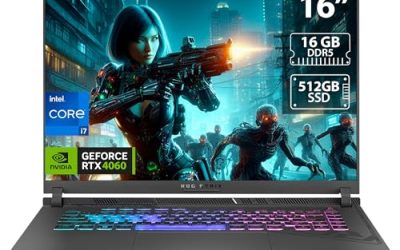
The factory Strix G16 configuration ships with 16GB of memory, which meets Civ VII’s recommended tier rather than its Ultra tier — it earns its place here because the rest of the specification is right and the memory is not fixed. Its Core i7-14650HX is a 16-core HX chip boosting to 5.2GHz, comfortably beyond the recommended processors of the titles above, and the RTX 5060 runs at up to 115W with a MUX switch. Two DDR5 slots mean a move to 32GB is a planned upgrade rather than a new laptop.
Specs
- CPU: Intel Core i7-14650HX (16 cores, 24 threads, up to 5.2GHz)
- GPU: NVIDIA GeForce RTX 5060 Laptop GPU, 8GB GDDR7, up to 115W, MUX switch
- RAM: 16GB DDR5 (two slots)
- SSD: 1TB PCIe 4.0 SSD
- Display: 16-inch FHD+ (1920×1200) 16:10, 165Hz, 3ms
- Wireless: Wi-Fi 7
- Battery: 90Wh
Upgradeability: memory sits in two DDR5 slots, so upgrading from 16GB to 32GB is supported by the design; confirm the exact slot and drive layout of the unit against ASUS’s page for the G615JMR before buying parts.
Verdict
For grand strategy and RTS play, buy the processor and memory first and let the GPU follow. The MSI Katana 15 HX is the most direct answer: the fastest CPU class here, 32GB fitted, and a healthy GPU power limit. The Legion Pro 5i Gen 9 is the pick for players who want the same CPU strength with a bigger screen, a full-power RTX 4070 and the largest SSD. The Legion 5 Gen 10 suits players who value its OLED display and AMD efficiency, and the ROG Strix G16 makes sense for buyers happy to start at 16GB and use its memory slots to reach 32GB when a campaign library grows into it.