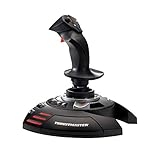
- Top Pick: Thrustmaster T-Flight Hotas X USB Flight Sim Stick & Throttle – PC
- Best Value: Logitech G X56 H.O.T.A.S Throttle and Joystick Flight Simulator Game Controller, 4 Spring Options, +189 Programmable Controls, RGB Lighting, 2x USB, PC – Black
- Premium Choice: Thrustmaster T-Flight Hotas One Flight Stick & Throttle – XBOX & PC
Affiliate disclosure: As an Amazon Associate we earn from qualifying purchases. This post contains affiliate links — if you buy through them we may earn a small commission at no extra cost to you. This never affects our recommendations.
As an Amazon Associate we earn from qualifying purchases at no extra cost to you.




If you have ever tried to dogfight in DCS World or navigate an asteroid field in Elite Dangerous with a mouse and keyboard, you already know the problem. A gamepad gets you further, but it still blunts the nuance that separates survival from mastery. A dedicated flight stick — especially a full HOTAS (Hands On Throttle And Stick) setup — changes everything. The tactile feedback, the physical axis control, and the sheer number of programmable buttons let you fly with both hands without lifting your fingers off the controls.
The market in 2026 has matured considerably. You can spend $99 and get magnetic sensors that would have cost four times as much five years ago, or you can spend $499 on a metal replica so accurate it is used in real military simulation training. This guide cuts through the noise. We compared and evaluated the five strongest options across price points, sensor technology, platform compatibility, and sim-specific ergonomics, then ranked them so you can match the right stick to your use case.
In a hurry? See the top-rated Gaming Flight Stick deals available right now:
🛒 Check Gaming Flight Stick Prices on Amazon →🛒 Best Price Today on Amazon
Prime members get fast, free shipping on everything above, plus member-only deals. New members get a 30-day free trial — cancel anytime.
Start 30-Day Prime Free Trial →See Today’s Amazon DealsQuick Comparison Table
| Product | Axes | Buttons | Twist Rudder | Platform | Material |
|---|---|---|---|---|---|
| Thrustmaster T.16000M FCS HOTAS | 16 | 16 + throttle | Yes | PC | Plastic |
| Logitech X56 HOTAS | 6 + dual throttle | 189 programmable | No | PC | Plastic |
| Thrustmaster HOTAS Warthog | 19 | 55 | No | PC | Metal/Aluminum |
| VKB Gladiator NXT EVO | 3 + expansion | 39 | Optional | PC / Mac | Plastic/Metal hybrid |
| Turtle Beach VelocityOne Flightstick | 3 | 20 | Yes | Xbox / PC | Plastic |
Our Top Picks
1. Thrustmaster T.16000M FCS HOTAS
Thrustmaster T.16000M FCS HOTAS
The T.16000M FCS HOTAS is the gold standard for sim pilots who want genuine precision without crossing into the $300+ tier. At the heart of this stick is Thrustmaster’s H.E.A.R.T. (HallEffect AccuRate Technology) magnetic sensor system — the same contactless technology found in their professional-grade hardware. Because the sensors never physically touch the internals, there is no wear-induced drift over time.
The combined package gives you 16 axes of control across the stick and throttle. The stick itself offers 16 action buttons plus a 4-way hat switch, while the TWCS throttle unit adds a large paddle, dual rotary dials, a mini-stick, and a full-hand throttle slider. Twist rudder is built into the stick handle, which keeps your total desk footprint manageable if you are not ready to add rudder pedals.
The T.16000M ships with profiles for DCS World, Star Citizen, Elite Dangerous, and Microsoft Flight Simulator, reducing configuration time significantly. The grip is ambidextrous — a rare feature at this price — making it accessible to left-handed pilots without buying a dedicated lefty variant.
Pros
- H.E.A.R.T. Hall Effect sensors deliver near-zero dead zone
- 16 total axes covers most complex aircraft configurations
- Ambidextrous grip design
- Twist rudder eliminates need for separate pedals
- Excellent out-of-box game profiles
- Competitive price for the sensor quality
Cons
- Plastic construction feels less premium at the price
- TWCS throttle lacks the detents of higher-end units
- No RGB or aesthetic customization
- Twist rudder is not ideal for helicopter or realistic rudder simulation
2. Logitech X56 HOTAS
The X56 is built for players who map every single function to a physical control. With 189 fully programmable commands spread across the stick and dual-throttle unit, you will rarely need to reach for a keyboard mid-flight. This makes it particularly strong for Star Citizen and Elite Dangerous, where the sheer number of ship functions demands dense button layouts.
The dual-throttle design is the defining hardware feature: each throttle axis moves independently, which maps naturally to twin-engine aircraft and spacecraft with differential thrust. Three spring options ship in the box, letting you tune the tension to match how physical your preferred aircraft handles. RGB lighting on the throttle — in Logitech’s branded style — is a minor touch but appreciated for visibility in dark cockpit setups.

The X56 does not include twist rudder. Logitech expects users at this price to pair it with rudder pedals, which is the correct simulation approach. If you are going pedal-free, the T.16000M is a better fit.
Pros
- 189 programmable commands — the densest input layout at this price
- Dual independent throttle levers for twin-engine and spacecraft control
- Three interchangeable springs for customizable resistance
- RGB lighting on throttle unit
- Large, clearly labeled button clusters reduce eyes-off-stick time
- Strong software with macro and profile support
Cons
- No twist rudder — rudder pedals are effectively required
- Plastic construction with some flex on the stick base
- Heavier software learning curve for new users
- Reported stick drift on some units after extended use
3. Thrustmaster HOTAS Warthog
The Warthog is not a compromise. It is a direct replica of the A-10C Thunderbolt II’s HOTAS controls, built from aircraft-grade aluminum and steel. When you pick it up, the weight alone communicates that this is not a consumer peripheral — it is a simulation instrument. The stick weighs approximately 1 kg and the throttle quadrant weighs around 1.4 kg. They do not move when you push against them.
The 55 action inputs across both units are replicated from the real aircraft’s layout, which means DCS World: A-10C users get a one-to-one physical match with the in-game cockpit. Every switch, every button, every hat has a corresponding control in the sim. For DCS specifically, this removes virtually all need to look at a keyboard. The throttle includes a working friction dial, dual independent throttle handles, and a full-arm rest panel with toggle switches that replicate the actual aircraft console.
The Warthog’s only significant omission is twist rudder — because the real A-10C does not have it. You will need rudder pedals (Thrustmaster’s T-Flight Rudder Pedals or the MFG Crosswind are common pairings). This adds $80–$200 to the total cost but also adds the correct simulation experience.
Pros
- Aircraft-grade aluminum and steel construction — will outlast any plastic alternative
- Exact replica of A-10C HOTAS — unmatched authenticity for DCS pilots
- 55 inputs with zero ambiguity on layout
- Dual independent throttle handles with working friction control
- Hall Effect sensors throughout — no potentiometer drift
- Used in professional military simulation training
Cons
- No twist rudder — separate pedals are mandatory
- $499 before rudder pedals — total investment can exceed $700
- Heavy: not ideal for smaller desks or temporary setups
- Overkill for casual or general-purpose gaming
4. VKB Gladiator NXT EVO
VKB is a specialist manufacturer that has earned a devoted following among serious sim pilots. The Gladiator NXT EVO packs technology that should not exist at $99. The gimbals use contactless 3D Hall Effect sensors on all primary axes, meaning the physical tolerances are tighter than anything in the consumer plastic category. The magnetic center mechanism gives the stick a crisp, defined center return with no wobble and no drift.
The modular design is what sets VKB apart philosophically. The grip is detachable. VKB sells a range of alternative grips — from a compact mini grip to the more complex Kosmosima — and the base accepts any of them without tools. As your collection grows or your preferred genre changes, you swap the grip rather than buying a new stick. The NXT EVO also offers optional twist rudder via configuration, or you can disable it and pair with pedals.
Mac compatibility is genuine, not an afterthought. VKB maintains macOS HID drivers that work correctly, which makes this the only stick on this list that fully supports Apple Silicon Macs for flight sim use.

Pros
- Contactless Hall Effect sensors on all axes at an entry price point
- Magnetic gimbal system — class-leading center return and precision
- Modular grip system — swap grips without tools
- Mac and PC compatible with maintained drivers
- Optional twist rudder
- Excellent build quality for the price tier
Cons
- Stick only — no bundled throttle (throttle sold separately as VKB STECS)
- Smaller button count than HOTAS bundles at similar price
- Less known brand means smaller community for troubleshooting
- VKB’s website and ordering process can be confusing for first-time buyers
5. Turtle Beach VelocityOne Flightstick
Turtle Beach VelocityOne Flightstick
The VelocityOne is the only entry on this list built specifically for Xbox, and it does that job well. Microsoft officially licensed the control layout for Microsoft Flight Simulator on Xbox Series X/S, which means the button labels and menu navigation map directly to the sim’s in-game prompts without remapping. Plug it into your Xbox, launch MSFS, and it just works — no configuration required.
The stick offers 3 axes, a twist rudder, and 20 action buttons including an 8-way hat and a dual-function throttle lever. It is designed for Microsoft Flight Simulator specifically but works across other Xbox flight titles. On PC via USB, it functions as a standard HID device and is recognized by most PC sims, though you lose the Xbox-licensed button labeling advantage.
For Xbox pilots or anyone primarily in MSFS who wants a zero-configuration entry into flight stick ownership, the VelocityOne is the cleanest path. It does not compete with the precision or input density of the PC-focused options above, but it was never designed to.
Pros
- Full Xbox Series X/S compatibility — the only licensed Xbox flight stick on this list
- Official Microsoft Flight Simulator button mapping — plug-and-play on Xbox
- Twist rudder included
- 20 action buttons covers MSFS core functions
- Dual USB and Xbox wireless connection
- Accessible $99 price
Cons
- 3 axes only — significantly fewer than PC-focused alternatives
- Potentiometer sensors, not Hall Effect — may drift over extended use
- Throttle lever feels light and imprecise compared to dedicated throttle units
- Not ideal for DCS, IL-2, or hardcore PC sims that demand axis density
How to Choose the Best Gaming Flight Stick
Joystick vs HOTAS Setup: What You Need
A standalone joystick handles pitch and roll. It is the right choice if you are getting started, have limited desk space, or primarily play casual flight games. A HOTAS setup adds a dedicated throttle unit to your off hand, which means both hands stay on hardware modeled after real aircraft controls. For anything classified as a serious simulator — DCS World, IL-2 Sturmovik, Elite Dangerous, advanced MSFS — a HOTAS setup is the correct choice. The cognitive overhead of keyboard shortcuts breaks immersion and costs reaction time.
Sensor Technology: Potentiometer vs Hall Effect
Potentiometer sensors use physical contact between a wiper and a resistive strip. They work, they are inexpensive, and they degrade. After a few hundred hours of use, expect dead zones and drift that require recalibration. Hall Effect sensors measure a magnetic field with no physical contact. There is nothing to wear down. The VKB Gladiator NXT EVO and Thrustmaster T.16000M FCS both use Hall Effect sensors at or near the $99–$149 price point, which makes potentiometer-only sticks increasingly hard to justify for regular sim use.
Twist Rudder vs Separate Rudder Pedals
Twist rudder rotates the stick handle around its vertical axis to control yaw. It works, it saves desk space, and it is included on the T.16000M FCS and VelocityOne. However, it concentrates three axes of input through one hand, which reduces fine control and introduces cross-axis interference during aggressive maneuvering. Separate rudder pedals use both feet independently, matching how real aircraft operate and dramatically improving precision in combat maneuvering, crosswind landings, and helicopter control. If your budget allows, pedals are worth the investment. If space or budget prevents it, twist rudder is a workable alternative — not an inferior one for casual use.
Platform Compatibility
Every PC stick on this list uses USB HID, which means Windows recognizes them natively. Mac support is the exception: only VKB officially maintains macOS drivers. Xbox support is exclusive to the Turtle Beach VelocityOne. PlayStation has no joystick ecosystem worth considering for simulation in 2026. If you split your time between Xbox and PC, the VelocityOne is your only realistic dual-platform option from this list.
Best Games for Flight Sticks
These titles deliver the most direct return on a flight stick investment:

- DCS World — the definitive military flight sim; the Warthog was built for it
- Microsoft Flight Simulator 2024 — civilian aviation; works brilliantly on both Xbox and PC
- Elite Dangerous — space combat and exploration; benefits enormously from HOTAS density
- Star Citizen — the most axis-hungry title on this list; the X56 was practically designed for it
- IL-2 Sturmovik: Great Battles — WWII prop combat; rewards precise analog rudder control
- Ace Combat 7 — arcade air combat; any stick on this list is overkill in the best way
Final Verdict
The Thrustmaster T.16000M FCS HOTAS is the best all-around choice for most pilots. Hall Effect sensors, 16 axes, twist rudder, and strong out-of-box profiles make it an honest performance buy at $149 without demanding rudder pedals or a second mortgage.
If you live in Star Citizen or Elite Dangerous and need maximum programmable inputs, step up to the Logitech X56. The 189-command layout and dual throttle are purpose-built for complex spacecraft.
The VKB Gladiator NXT EVO wins on sensor precision per dollar. At $99 it outperforms hardware twice its price in gimbal quality, and the modular grip system keeps it relevant as your setup evolves.
The Thrustmaster HOTAS Warthog is the correct answer if you fly DCS seriously and want hardware that will still be on your desk in ten years. The cost is real but so is the quality.
The Turtle Beach VelocityOne serves one audience extremely well: Xbox pilots in Microsoft Flight Simulator. If that describes you, nothing else on this list matches its zero-configuration convenience on console.
Choose the stick that matches where you actually fly, not the most impressive spec sheet. The best flight stick is the one attached to the sim you launch every week.
Related Articles
Looking for more on this topic? Browse the hand-picked guides below — each one applies the same scoring rubric used in this review.
Frequently Asked Questions
What is the best gaming controller flight stick in 2026?
The best gaming controller flight stick depends on your budget and how you plan to use it. The options compared above are our top-rated picks based on real customer ratings, build quality, and overall value — start with the highest-rated model that fits your budget.
How much should I expect to spend on a gaming controller flight stick?
Prices vary by brand and features. Budget options cover the essentials, while mid-range and premium models add durability, performance, and extra features. Compare the prices in the list above to find the best value for your needs.
What should I look for when buying a gaming controller flight stick?
Focus on what matters most for your use case — build quality, compatibility, performance, warranty, and verified customer reviews. Every pick above is selected to balance these factors.
Are budget gaming controller flight stick options worth it?
Yes. For most people a well-reviewed budget or mid-range gaming controller flight stick delivers excellent value. You only need to spend more if you specifically require premium materials or top-tier performance.
How did we choose these gaming controller flight stick picks?
We compare current Amazon ratings, review counts, key features, and price to surface the options with the best real-world value. The list is refreshed as ratings and availability change.