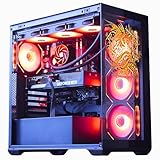
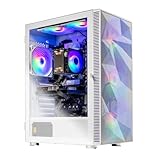
- Top Pick: The Horizon Autherium Dragon RGB I9 RTX Gaming PC || 64GB RAM || 5TB Storage || Core I9 Upto 5.4Ghz || RTX 5070 OC || Windows 11 PRO || 360MM AIO || 2.4GB/s WiFi, VR, Gaming Ready Desktop Computer
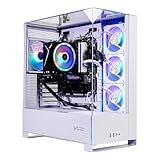
- Best Value: Skytech Gaming Archangel 5 Gaming PC, Intel i5 14400F 2.5GHz, NVIDIA RTX 5060, 1TB NVMe SSD, 16GB DDR5 RAM 6000, 750W Gold PSU, Wi-Fi, Win 11, Desktop
- Premium Choice: msi Codex R2 Gaming Desktop PC | NVIDIA GeForce RTX 5070 12GB | Intel Core i5-14400F | 32GB DDR5 RAM | 1TB NVMe SSD | Air Cooling | Wi-Fi 6E | Windows 11 Home | VR Ready | D14NVP5-613US
Affiliate disclosure: As an Amazon Associate we earn from qualifying purchases. This post contains affiliate links — if you buy through them we may earn a small commission at no extra cost to you. This never affects our recommendations.
- Performance: Gaming PCs Win Decisively
- Pricing: More Complex Than It Looks
- Game Library: PC Has the Most Options
- Convenience: Consoles Win Easily
- Longevity and Upgradability
- Gaming PC vs PS6 vs Xbox Series X 2 — Specs Comparison
- Conclusion — Gaming PC vs Console 2026
- Frequently Asked Questions
- Related Articles
- Related Articles

🛒 Best Price Today on Amazon
Prime members get fast, free shipping on everything above, plus member-only deals. New members get a 30-day free trial — cancel anytime.
Start 30-Day Prime Free Trial →See Today’s Amazon DealsPerformance: Gaming PCs Win Decisively
Raw performance is the clearest gap between PC and console in 2026. A mid-range $1,000–$1,200 gaming PC delivers significantly higher framerates and better image quality than any current console hardware, and that gap only widens as your PC budget moves beyond mid-range. If you’re building from scratch, our best gaming PC budget build for 2026 hits the sweet spot between price and performance, while our step-by-step build guide walks you through assembly even if you’ve never opened a case before.Framerate Advantage
PlayStation 6 and Xbox Series X 2 target 60 fps at 4K in most titles, with select games offering 120 fps modes at lower image quality or reduced resolution. A $1,200 gaming PC built around an RTX 5070 pushes 85–115 fps at 1440p Ultra, or 70–90 fps at native 4K — already comfortably ahead of console output. Step up to a $1,500 build and you’ll see north of 150 fps at 1440p, unlocking high-refresh gameplay that simply doesn’t exist on any console platform. Pair that with the right cooling — like one of the best CPU coolers for RTX 5090 builds if you go higher-end — and the PC keeps those numbers stable through long sessions.Resolution and Image Quality
Consoles lean heavily on dynamic resolution scaling and aggressive reconstruction to hold their target framerates, often rendering well below the resolution they advertise. A PC running native 1440p with DLSS or FSR Quality mode produces a noticeably sharper, more detailed image than any reconstructed console output. At 4K the gap widens further: PC hardware renders at full native resolution with higher-quality texture filtering, better shadow settings, and the option to crank ray tracing well past what consoles allow.Pricing: More Complex Than It Looks
On sticker price alone, consoles win comfortably — a PS6 runs $549 and an Xbox Series X 2 is $599, while a comparable or stronger gaming PC starts around $1,200 and climbs from there. But once you factor in total cost of ownership across a typical four-to-five-year console generation, the picture gets a lot more complicated, and the cheap-to-buy advantage doesn’t always hold up.Console Total Cost of Ownership
Console gamers pay around $69 for most new releases, while the same titles on PC typically launch at around $59 — and they drop hard. Steam sales routinely cut prices 50–75 percent within months of launch. On top of that, online play requires a subscription: PlayStation Plus Premium runs $159 per year and Xbox Game Pass Ultimate costs $204 per year. Across a five-year console lifecycle with a moderate game-buying habit, owners commonly spend an additional $1,500–$2,500 on top of the hardware, which significantly erodes the upfront price advantage.PC Total Cost of Ownership
PC game pricing is consistently 20–40 percent lower at launch and discounts faster and deeper afterward. Steam seasonal sales, free weekly Epic Games Store giveaways, and Humble Bundle deals mean PC players routinely pay far less per title than console gamers do for the exact same games. Online multiplayer is free in most games — no mandatory subscription. Your PC also doubles as a productivity machine, so the cost is spread across work, streaming, and content creation rather than living entirely in your entertainment budget. If you want to maximize that value, picking the right gaming OS can squeeze out extra frames without spending another dollar.Game Library: PC Has the Most Options
Steam alone will pass 100,000 games in 2026, covering everything from AAA blockbusters to indie titles that never see a console release. By comparison, the PS Store sits around 5,000 active titles and the Xbox Store around 3,500. PC libraries also stretch back across every era of gaming history through emulation and preservation projects, while console backward compatibility is limited to recent generations and curated catalogs rather than full historical access.Exclusives
Console exclusives still matter. Sony’s first-party catalog — God of War, Horizon, the Spider-Man series — eventually arrives on PC, but typically with a one-to-two-year delay, so day-one access remains a PlayStation perk. Nintendo’s Switch 2 exclusives stay locked to Nintendo hardware permanently and remain a unique draw for anyone who values Mario, Zelda, and Pokemon. Microsoft has gone the other direction, releasing first-party titles on PC and console simultaneously, which makes Xbox exclusives much less of a deciding factor than they used to be.Mods and User-Generated Content
PC modding has no real console equivalent. Skyrim, Minecraft, Stardew Valley, Cities: Skylines, and thousands of other games support user-created content that extends their useful lifespan by years or even decades past the original release. For any game with an active modding community, the PC version is a fundamentally different — and usually better — experience than the console version of the same base game. Handhelds are catching up too: take a look at our best gaming handheld picks for 2026 if you want PC flexibility in a portable form factor.Convenience: Consoles Win Easily
There’s no honest way around it — consoles are easier to set up and maintain than gaming PCs. Plug it in, sign in, download a game, play. The whole setup takes under an hour for someone with zero technical background. No driver updates, no compatibility issues, no operating system to configure, no parts to research. In 2026, getting started on a console is still the most frictionless path into gaming.Living Room Experience
Consoles are designed for couch gaming on a TV. Replicating that experience on PC takes extra hardware — a long HDMI run, a wireless keyboard and mouse or controller adapter, often a dedicated entertainment-center setup. For households that want gaming as part of a shared TV environment rather than a desk hobby, consoles are the more natural fit. PC is catching up with Big Picture mode and Steam Deck-style handhelds, but pure plug-and-play living-room gaming is still console territory.PC Setup Complexity
Building and maintaining a gaming PC requires more technical engagement than most console gamers want. Driver updates, occasional software conflicts, hardware compatibility research, and the initial assembly are all real time investments without a console equivalent. Even networking matters more — a poorly configured router can cost you frames in competitive play, which is why our guides on the best Wi-Fi routers for gaming and optimal router settings exist. For gamers who treat tinkering as part of the hobby, that complexity is a feature. For people who just want to play, it’s a real barrier and worth being honest about.Longevity and Upgradability
Gaming PCs are upgradable; consoles are fixed-spec hardware. When a new release pushes past your current PC, you can swap in a newer GPU, add RAM, or drop in a faster SSD without replacing the whole system. Console owners wait for the next generation — usually five to seven years — with no mid-cycle upgrade path. That said, console SSD upgrades do exist; if you’re going the PS5 route or holding onto last-gen hardware, our best PS5-compatible SSDs guide covers the options. On the PC side, picking the right case from our mid-tower gaming PC cases roundup and a quality memory kit from our DDR5-6000MHz RAM picks sets up a platform that can grow with you for the better part of a decade.- Performance: PC wins — 2–3x higher framerates than consoles at equivalent GPU power draw.
- Upfront price: Console wins — $549–$599 versus $1,200+ for a comparable PC.
- Total cost of ownership: Roughly even over five years thanks to PC game pricing and free online play.
- Game library: PC wins — 100,000+ titles plus emulation and modding support.
- Convenience: Console wins — plug-and-play with zero technical maintenance.
- Longevity: PC wins — upgradable parts versus fixed-spec console hardware.
Gaming PC vs PS6 vs Xbox Series X 2 — Specs Comparison
| Category | Gaming PC ($1,200) | PlayStation 6 | Xbox Series X 2 |
|---|---|---|---|
| Launch price | $1,200 (build it yourself) | $549 | $599 |
| Target framerate (4K) | 70–90 fps native | 60 fps with reconstruction | 60 fps with reconstruction |
| 1440p performance | 85–115 fps Ultra | Not a native target | Not a native target |
| Game library size | 100,000+ (Steam alone) | ~5,000 (PS Store) | ~3,500 (Xbox Store) |
| Online multiplayer cost | Free (most games) | $159/yr (PS+ Premium) | $204/yr (Game Pass Ultimate) |
| Average new game price | around $59 (frequent 50–75% sales) | Check on Amazon | Check on Amazon |
| Upgradability | Full — GPU, CPU, RAM, storage | SSD only | SSD only |
Conclusion — Gaming PC vs Console 2026
Pick a gaming PC if you want the best raw performance, the largest game library, full customization, and a long-term upgrade path with competitive five-year total cost of ownership. Pick a console if you want simplicity, instant couch gaming, access to platform exclusives, or the lowest possible upfront hardware investment. Both platforms deliver excellent gaming experiences in 2026 — your lifestyle and priorities decide which one fits you better, not any one-size-fits-all answer. The good news: there’s no wrong choice here. There’s only the choice that matches how, where, and what you actually want to play.In a hurry? See the top-rated Gaming PC vs Console deals available right now:
Related: best gaming headsets under $40.
Related: best gaming routers.
Related: best gaming handheld accessories.
🛒 Check Gaming Pc Vs Console Prices on Amazon →Frequently Asked Questions
Are prebuilt gaming PCs worth it in 2026?
Yes for first-time buyers — bundled OS, warranty, and assembly labor often offset the parts markup, especially when GPUs are scarce.
Do prebuilts come with quality components?
Mostly yes from major brands (NZXT, iBUYPOWER, Skytech). Watch for proprietary motherboards or low-watt PSUs in the budget tier.
Can I upgrade a prebuilt later?
Most ATX-based prebuilts upgrade fine. Avoid SFF / proprietary cases — they may block swapping the GPU or PSU later.
Should I custom-build instead?
Build custom if you want exact parts, full warranties on each component, and the cleanest cable management. Buy prebuilt for time-to-game and bundled support.
As an Amazon Associate we earn from qualifying purchases at no extra cost to you.


Related Articles
Looking for more on this topic? Browse the hand-picked guides below — each one applies the same scoring rubric used in this review.