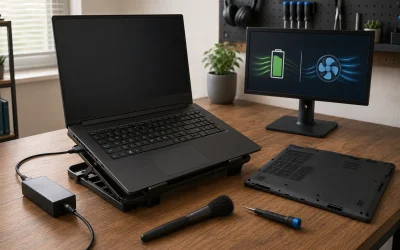
The GPU inside your Acer Nitro 5 is soldered to the motherboard and cannot be swapped for a different chip, but which GPU you actually have depends heavily on the exact model number printed on the bottom of the laptop, since Acer reused the “Nitro 5” name across at least six generations of Intel and AMD platforms with wildly different Nvidia GPUs inside. Below is how to identify yours, what it’s actually capable of once you account for power limits, and where an external GPU can realistically help.
- Find your exact model number first
- GPU by generation: what shipped in which Nitro 5
- Why the wattage matters more than the GPU name
- Does your Nitro 5 have a MUX switch?
- Can you upgrade the GPU? No, but here’s what people mean when they ask
- What an eGPU enclosure can and can’t add
- Decision matrix: what should you actually do?
As an Amazon Associate we earn from qualifying purchases at no extra cost to you.

Find your exact model number first
“Acer Nitro 5” is not one laptop, it’s a product line spanning roughly 2018 to 2026. The model number (something like AN515-58 or AN517-55) tells you the chassis generation, and the GPU is usually listed in the full SKU or on the original purchase receipt. Check the sticker on the bottom panel, or run this in Windows if the laptop boots:
- Press Win + X, choose Device Manager, expand “Display adapters”
- Or open Task Manager > Performance > GPU 0/1 to see the model name and driver version
- Or type
dxdiagin the Run dialog and check the Display tab
This tells you the chip name (e.g., RTX 4060 Laptop GPU), but not the wattage it’s running at, which matters more than the name for real-world FPS.
GPU by generation: what shipped in which Nitro 5
| Nitro 5 generation | Approx. model numbers | GPU options | CPU pairing |
|---|---|---|---|
| 2018-2019 | AN515-52/-53 | GTX 1050, GTX 1050 Ti, GTX 1650 | Intel 8th/9th gen |
| 2020 | AN515-44/-55 | GTX 1650, GTX 1650 Ti, RTX 2060 | Ryzen 4000 or Intel 10th gen |
| 2021 | AN515-45/-57 | RTX 3050, RTX 3050 Ti, RTX 3060 | Ryzen 5000 or Intel 11th gen |
| 2022 | AN515-58 | RTX 3050, RTX 3060, RTX 3070 | Intel 12th gen |
| 2023 | AN515-59, AN16-41 | RTX 4050, RTX 4060, RTX 4070 | Intel 13th gen or Ryzen 7000 |
| 2024-2025 | AN16-51, AN17-51 | RTX 4050, RTX 4060, RTX 4070 (refresh) | Intel 14th gen or Ryzen 8000 |
The overlap matters: an AN515-58 could have an RTX 3050 or an RTX 3070 depending on which SKU you or the original buyer chose. Same shell, very different laptop.
Why the wattage matters more than the GPU name
Nvidia lets laptop makers configure the same GPU chip at different power limits, called TGP (Total Graphics Power), and Acer typically sets Nitro 5 GPUs toward the mid-to-lower end of the allowed range to manage heat in a budget chassis. This is the single biggest reason two laptops with the “same” GPU can perform 15-25% apart.
| GPU | Nvidia’s allowed TGP range | Typical Nitro 5 TGP | Approx. FPS impact vs. max TGP |
|---|---|---|---|
| RTX 3060 Laptop | 60-115W | ~80-105W | Up to ~15% lower than max config |
| RTX 4060 Laptop | 35-115W | ~85-100W | ~10-15% lower than max config |
| RTX 4070 Laptop | 35-115W | ~95-115W | Closer to max, less gap |
You can check your actual configured wattage with a monitoring tool (HWInfo or GPU-Z) while gaming: look at the “GPU Power” reading under sustained load. If it plateaus well below the chip’s maximum rated TGP, that’s the ceiling you’re designing settings around, not the number on the box.
A worked example: is 1080p high or medium the right target?
Take an AN515-57 with an RTX 3060 Laptop GPU running at roughly 90W. In a demanding title like Cyberpunk 2077 at 1080p, that power level typically lands in the 45-55 FPS range at High settings without ray tracing, and drops to the low 30s with ray tracing enabled. Bandwidth isn’t the bottleneck here since 1080p at 60Hz only needs about 12.4 Gbps of pixel throughput, well within any laptop’s display pipeline. The limiter is raw shader and RT core throughput at that power budget. Dropping to Medium settings and disabling ray tracing is usually the difference between a locked 60 FPS and a fluctuating 40s-50s experience, which matters more for feel than the resolution itself.
Does your Nitro 5 have a MUX switch?
This is the setting that changes frame rates more than almost anything else you can toggle, and it’s not listed on any spec sheet. A MUX switch lets the dedicated GPU send frames directly to the display instead of routing through the integrated GPU (Optimus), which removes a small but real overhead, typically 5-15% higher FPS and lower latency in GPU-bound games.
- 2018-2020 models (GTX 1050 through RTX 2060 era): No MUX switch, Optimus only
- 2021-2022 models (RTX 3050/3060/3070): Mixed, check Nvidia Control Panel
- 2023+ models (RTX 4050/4060/4070): Most include Advanced Optimus, which auto-switches without a manual toggle or reboot
To check, open Nvidia Control Panel, go to the 3D Settings tab, and look for “Manage GPU Performance Mode” or similar. If you see an option to force discrete GPU output, you have a MUX switch. If your laptop supports it but it’s not enabled, switching to “Discrete GPU” mode (may require a restart) is free performance with no downside except battery drain on the go, since the integrated GPU is bypassed entirely.
Can you upgrade the GPU? No, but here’s what people mean when they ask
Laptop GPUs in the Nitro 5 are BGA-soldered to the motherboard. There is no MXM module, no socket, nothing a technician can swap even with the right tools and money. Any listing or guide claiming a “GPU upgrade kit” for a soldered laptop chip is describing something that doesn’t exist for this platform. What you can actually change:
- RAM: Most Nitro 5 models have one or two SO-DIMM slots, upgrading to 32GB or 64GB helps CPU-bound scenarios and texture streaming, but doesn’t touch GPU compute
- Storage: Swapping to a faster NVMe SSD reduces load times and stutter from asset streaming, not frame rate ceilings
- Thermal paste/pads: Repasting an older, thermally-throttled unit can recover lost clock speed, sometimes 5-10% in sustained loads, but won’t exceed the GPU’s factory TGP
What an eGPU enclosure can and can’t add
If your Nitro 5 has a Thunderbolt 4 port (mainly the 2022+ Intel-based models; AMD Ryzen versions generally lack Thunderbolt), you can connect an external GPU enclosure housing a desktop card. This is the only real way to add GPU power beyond what’s soldered in, but it comes with specific limits worth knowing before buying one:
- What it helps: Desktop gaming at an external monitor, video editing/rendering, AI workloads needing more VRAM, running games far beyond what the internal GPU could ever manage
- What it doesn’t fix: The internal laptop display in most configurations still routes through the internal GPU or suffers added latency, since Thunderbolt bandwidth (about 32 Gbps usable for data) is a fraction of a native PCIe x16 slot’s bandwidth
- Real-world throughput loss: Expect roughly 15-30% lower performance from a desktop GPU in an eGPU enclosure compared to the same card in a desktop PC, due to the Thunderbolt bottleneck and driver overhead
- Cost: Enclosures alone usually run $200-$350, before adding a desktop GPU, so this only makes financial sense if you already game primarily at a desk with an external monitor
For a Nitro 5 with only USB-C (no Thunderbolt) or a Ryzen model without Thunderbolt support, eGPU enclosures are not a viable option at all, since the bandwidth and protocol support required for external GPU passthrough isn’t present.
Decision matrix: what should you actually do?
| Your situation | Recommended action |
|---|---|
| Pre-2021 model (GTX 1050-1650, RTX 2060) | No MUX switch, no Thunderbolt eGPU path in most cases; consider replacement if gaming is the priority |
| 2021-2022 RTX 3050/3060/3070 without MUX enabled | Check Nvidia Control Panel, enable discrete GPU mode if available before anything else |
| 2023+ RTX 4050/4060/4070 with Thunderbolt 4 | Internal GPU is likely fine for most titles; eGPU only worth it for desk-bound heavier workloads |
| Any model, FPS feels lower than reviews suggest | Check actual GPU wattage under load with HWInfo before assuming something’s wrong |
| Want more GPU power, no Thunderbolt port | No upgrade path exists; only lowering settings or replacing the laptop will help |
The short version: identify your exact SKU, confirm the configured wattage rather than trusting the chip’s name alone, enable a MUX switch or discrete mode if your generation supports it, and treat an eGPU as a desk accessory for Thunderbolt-equipped models rather than a true upgrade path.