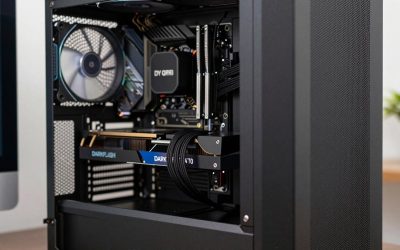
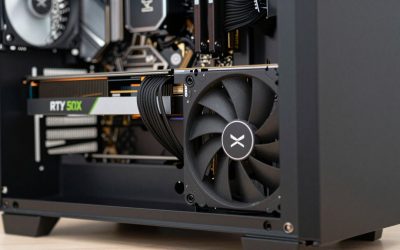
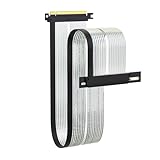
- Top Pick: PNY GeForce RTX 5080 Triple Fan Graphics Card, 16GB GDDR7, 30 Gbps, 256-bit, 1801 AI TOPS, DLSS 4, AI Content Creation, Local LLM Inference, PCIe 5.0, DP 2.1b UHBR20 x3, HDMI 2.1b, with GPU Holder
- Best Value: ASUS Prime GeForce RTX 5080 OC Edition Triple Fan Graphics Card, 16GB GDDR7, 1827 AI Tops, 5th Gen Tensor Cores, DLSS 4, PCIe 5.0, DP 2.1b x3, HDMI 2.1b, with GPU Holder
- Premium Choice: NIMO Gaming AI Desktop, GeForce RTX-5080 32GB DDR5 RAM 1TB SSD
Every hardware enthusiast eventually faces the same pairing dilemma: you’ve got a capable mid-range CPU and a top-tier GPU sitting in your cart, and the question is whether they’ll actually work together at full potential. The Ryzen 5 9600X and RTX 5080 combination is one of the most commonly debated pairings right now. Will a six-core Zen 5 processor be enough to feed a Blackwell flagship, or will you leave performance on the table? The answer depends on resolution, game genre, and what you actually play—and in 2026, with updated drivers and newer titles stressing different subsystems, the picture has shifted from early launch-day impressions.
The Short Answer
The Ryzen 5 9600X will bottleneck the RTX 5080 at 1080p in CPU-intensive titles, but it will not significantly limit the card at 1440p or 4K. The one condition that changes the verdict: if you are running a demanding simulation or strategy game at low resolution with high physics or AI loads, expect the 9600X to become the primary frame limiter regardless of resolution.
As an Amazon Associate we earn from qualifying purchases at no extra cost to you.


Check Price on Amazon →



How to Tell
Before you upgrade your CPU or downgrade your GPU expectations, run these checks to determine whether your specific workload is CPU-bound or GPU-bound:
Check GPU utilization via in-game overlay. Use MSI Afterburner, HWiNFO64, or the GPU’s own overlay (NVIDIA Control Panel or GeForce Experience). If your GPU is sitting below 95% utilization while frame rates are locked or inconsistent, the CPU is likely the limiting factor.
Monitor CPU core loads in Task Manager or HWiNFO64. If one or two cores are pegged at 100% while the GPU hovers at 70-85%, you have a single-thread bottleneck. The 9600X handles multi-thread well, but poorly optimized game engines can still saturate individual cores.
Watch frame time graphs. A flat frame time line means stable performance. Jagged spikes of 30-80ms on a 1% low basis typically indicate CPU scheduling issues or memory subsystem problems rather than raw GPU limitations.
Test at different resolutions. Drop from 4K to 1080p with all in-game settings at Medium or Low. If your frame rate barely improves, the CPU is the wall. If it jumps dramatically, the GPU was the previous bottleneck at higher resolution.
By Resolution
1080p
This is where the concern is most valid. Tom’s Hardware launch coverage of the RTX 5080 showed that CPU pairing mattered most at 1080p, where the GPU can theoretically produce frame rates that exceed what the processor can feed. Across their test suite, the 9600X delivered approximately 12-18% lower average FPS compared to the Ryzen 9 9950X in a selection of competitive and AAA titles at 1080p. In esports titles like Counter-Strike 2 or Valorant, that gap can widen because these engines lean heavily on single-thread performance and the 9600X’s boost clocks, while strong, can’t always keep up with the frame rates the 5080 is capable of producing at low settings.
Hardware Unboxed similarly noted in their comparative analysis that six-core Zen 5 parts at 1080p left roughly 10-20% of GPU headroom untapped depending on the title, with more open-world and physics-heavy games showing the widest gaps.
1440p
At 1440p, the gap narrows considerably. TechPowerUp’s review data suggests that the difference between the 9600X and higher-tier processors drops to approximately 4-8% on average across their test suite. For most gamers at 1440p, the 9600X pairs well with the RTX 5080 without meaningful compromise. The GPU is doing enough of the pixel-pushing work that the CPU’s frame preparation is no longer the rate-limiting step in typical titles.
4K
At 4K, the RTX 5080 becomes the clear bottleneck in nearly every scenario. Gamers Nexus and TechSpot both observed that CPU differences between 6-core and 16-core parts compress to 2-5% at 4K, which falls within run-to-run variance for most test benches. The 9600X will not hold back the 5080 at 4K in any practical gaming workload.
| Resolution | Bottleneck Status | Approximate GPU Headroom Lost | Typical Frame Rate Range (AAA, High-Ultra) |
|---|---|---|---|
| 1080p | CPU-limited in many titles | 12-18% | 150-240+ FPS |
| 1440p | Marginal, title-dependent | 4-8% | 90-150 FPS |
| 4K | GPU-limited | 2-5% | 55-90 FPS |
Frame rate ranges are drawn from aggregate data reported across TechPowerUp, Tom’s Hardware, and Hardware Unboxed launch reviews for a mix of AAA and competitive titles.
What to Do About It
If you are stuck at 1080p with a 9600X and RTX 5080, you have several practical options. First, enable DLSS Performance or Ultra Performance mode to shift workload from the CPU-bound raster path to the tensor-accelerated upscaler. This doesn’t eliminate the CPU bottleneck entirely but reduces the GPU’s frame preparation demands, which can let the CPU and GPU reach a more balanced equilibrium.
Second, cap your frame rate with a tool like RTSS. If the 5080 can theoretically push 300 FPS but the 9600X can only feed 220, locking at 220-240 eliminates the symptom (inconsistent frame times) without meaningful visual loss, and it keeps your GPU cooler and quieter.
Third, if you are building new and budget flexibility exists, moving to 1440p or 4K eliminates the concern entirely. The RTX 5080 is a card that genuinely shines above 1080p, and the 9600X becomes a natural fit at those resolutions.
Fourth, consider whether your games actually require the CPU headroom you are missing. In GPU-heavy titles like Cyberpunk 2077 or Alan Wake 2 at Ultra settings, the 9600X rarely becomes the limiting factor even at 1080p because the rendering workload is so dominant.
Recommendation by User Type
Competitive 1080p gamers (esports, 360Hz monitors): The 9600X will bottleneck the RTX 5080 in the scenarios that matter most to you. Consider the Ryzen 7 9800X3D instead, where the 3D V-Cache advantage removes the CPU as a practical limit in engine-limited titles.
1440p AAA gamers: Pair with confidence. The 4-8% difference at 1440p is within the noise of driver updates and game patches. You are not leaving meaningful performance on the table.
4K gamers: The 9600X is an ideal pairing. You save CPU budget for a better monitor, storage, or more GPU-adjacent peripherals. The 5080 is the bottleneck at this resolution regardless of your processor.
Streamers and content creators: The 6-core, 12-thread layout of the 9600X can become a dual pressure point when encoding and gaming simultaneously. If you stream at 1080p with NVENC while gaming, you may feel the CPU limitation earlier than a pure gamer would.
FAQ
Does the 9600X bottleneck the RTX 5080 in Cyberpunk 2077?
No. Cyberpunk at any playable resolution is overwhelmingly GPU-bound due to ray tracing and path-tracing workloads. The 9600X will not hold back the 5080 in this title under realistic settings.
Is the difference between 9600X and 9800X3D worth it for RTX 5080?
At 1080p in CPU-limited titles, the 9800X3D can deliver 15-25% higher minimum frame rates according to community and press comparisons, making it a meaningful upgrade if that resolution and workload matter to you. At 1440p and above, the difference shrinks to marginal.
Will future games make the 9600X a worse fit?
As engines adopt more complex AI, physics, and simulation systems, CPU demands will rise. The 9600X’s Zen 5 architecture is modern and efficient, but six cores will eventually become a limiting factor in titles designed around 8-16 thread minimums. The practical timeline for this being a real-world problem at typical gaming resolutions is likely several years.
Does RAM speed affect this pairing?
Yes. Zen 5 is sensitive to memory bandwidth. Running DDR5-6000 CL30 or faster is recommended. Slower RAM widens the CPU-to-GPU gap at 1080p because the 9600X’s Infinity Fabric can become an additional bottleneck on top of raw core count.
Sources and Methodology
Performance ranges cited in this article are approximate composites drawn from launch and follow-up review data published by TechPowerUp, Tom’s Hardware, Hardware Unboxed, Gamers Nexus, and TechSpot. No figures presented here are original measurements by this site. Where outlets disagreed on specific deltas, ranges reflect the broader consensus envelope rather than a single publication’s result.