Affiliate disclosure: As an Amazon Associate we earn from qualifying purchases. This post contains affiliate links — if you buy through them we may earn a small commission at no extra cost to you. This never affects our recommendations.
In a hurry? See the top-rated Surge Protector for Gaming PC deals available right now:
🛒 Check Surge Protector For Gaming Pc Prices on Amazon →🛒 Best Price Today on Amazon
Prime members get fast, free shipping on everything above, plus member-only deals. New members get a 30-day free trial — cancel anytime.
Start 30-Day Prime Free Trial →See Today’s Amazon DealsWhy Every Gaming PC Needs a Quality Surge Protector
You spent $500 on a GPU, $300 on a CPU, and hundreds more on RAM, storage, and a quality monitor. A single power spike lasting less than a millisecond can destroy every dollar of it. That is not a scare tactic — it is physics. Voltage surges from lightning strikes, utility switching events, and even your neighbor’s HVAC cycling on can send brief spikes down the line that overwhelm your components’ built-in tolerances.
Here is the misconception most gamers carry: a standard power strip is not a surge protector. A basic strip just multiplies outlets. It passes every volt — clean or dirty — directly to your hardware. A true surge protector adds metal oxide varistors (MOVs) that clamp excess voltage before it reaches your gear.
When shopping, three specs matter most. Joule rating measures how much total surge energy the protector can absorb over its lifetime — higher is better, and anything under 1,000J is marginal for a full gaming setup. Clamping voltage is the threshold at which the MOVs kick in; the UL 1449 standard sets 400V as the highest acceptable clamping voltage, but the best units clamp at 330V or lower. UL 1449 certification is your baseline trust signal — if a product does not carry it, skip it entirely regardless of the marketing copy.
One more distinction worth knowing: a surge protector is passive and offers no protection during a total blackout. A UPS (uninterruptible power supply) adds a battery, letting you save your game and shut down cleanly when the power goes out. For most gamers, a high-quality surge protector is sufficient. If you live in an area with frequent outages, pair it with a UPS.
Quick Comparison Table
| Product | Joule Rating | Outlets | USB-A / USB-C | Cord Length | Price Range |
|---|---|---|---|---|---|
| APC SurgeArrest P11VT3 | 3,020J | 11 | 2A / — | 6 ft | $50–$60 |
| Belkin PF30 Power Strip | 3,996J | 12 | 2A / — | 8 ft | $40–$55 |
| Tripp Lite TLP1008TEL | 2,395J | 10 | — / — | 8 ft | $25–$35 |
| Anker 615 USB Power Strip | 2,500J | 8 | 2A / 1C (30W) | 5 ft | $35–$45 |
| Furman PST-8 Power Station | 1,630J | 8 | — / — | 6 ft | $100–$130 |
Top 5 Best Surge Protectors for Gaming PCs in 2026
1. APC SurgeArrest P11VT3 — Best Overall
The APC SurgeArrest P11VT3 is the go-to recommendation for most gaming setups, and for good reason. Its 3,020-joule rating sits comfortably above the threshold you want for protecting expensive hardware. Beyond raw joule capacity, it covers three entry points that cheaper units ignore: coaxial cable, telephone line, and ethernet port protection. If a spike enters your home through the cable or phone line — which absolutely happens — those paths are shielded too.
The unit features 11 outlets arranged with transformer spacing in mind, so bulky wall-wart adapters do not block adjacent sockets. A protection-active indicator light turns off when the MOVs are depleted and the unit is no longer providing surge protection — a critical safety feature that low-end strips omit entirely. APC also backs it with a $250,000 Connected Equipment Warranty.
Pros:
- 3,020J rating handles full gaming rig plus monitor, speakers, and peripherals
- Coax, ethernet, and phone line protection covers all surge entry points
- Indicator light clearly signals when protection is spent
- Strong brand reputation and equipment warranty
Cons:
- 6 ft cord is shorter than competitors; may require an extension for some desk setups
- No USB-C port — charging modern phones and accessories requires an adapter
- Slightly bulkier form factor than some alternatives
2. Belkin PF30 Power Strip Surge Protector — Best Mid-Range
If joule rating is the headline spec, the Belkin PF30 Power Strip Surge Protector wins outright in this roundup with a 3,996-joule capacity — nearly 1,000 joules more than the APC. Pair that with 12 outlets, an 8-foot cord, and built-in EMI/RFI noise filtering, and you have a compelling package for a desk setup that includes both gaming hardware and audio gear.
EMI/RFI filtering matters more than most gamers realize. Electrical noise on the line manifests as audible hum in speakers and headphone amps, and as display interference on monitors. The Belkin PF30’s filtering stage cleans that noise passively — no action required on your part. The 8-foot cord also gives real flexibility for routing around a desk or reaching a distant wall outlet.
Pros:
- Highest joule rating in this roundup (3,996J) for maximum long-term protection
- 12 outlets accommodate a full gaming station without a second strip
- 8 ft cord provides generous routing flexibility
- EMI/RFI filtering reduces electrical noise for cleaner audio
Cons:
- No USB-C charging port — a notable omission at this price point in 2026
- Lacks dedicated coax or ethernet surge protection
- Design is utilitarian; not the most visually appealing option on a desk
3. Tripp Lite TLP1008TEL — Best Value
Budget shoppers should not have to choose between price and real protection, and the Tripp Lite TLP1008TEL proves that point. At $25–$35, it delivers 2,395 joules — well above the 2,000J floor we recommend for gaming PCs — plus telephone/coaxial line protection and a solid UL 1449 Third Edition certification. That certification matters: it means the unit was independently researched to current standards, not just labeled as compliant.
The 10-outlet layout and 8-foot cord make it genuinely practical for a full setup, even at this price. Tripp Lite is a brand with genuine surge protection credibility (unlike the off-brand strips flooding marketplaces), and the lifetime warranty adds confidence. It does not have USB charging or EMI filtering, but for a gamer who needs reliable protection on a tight budget, nothing in this price range competes.
Pros:
- Excellent value — genuine 2,395J protection at under $35
- UL 1449 Third Edition certified, not just labeled
- 8 ft cord and 10 outlets cover a complete desk setup
- Telephone and coaxial line protection included
Cons:
- No USB charging ports of any kind
- No EMI/RFI noise filtering
- Build quality and aesthetics feel budget-tier compared to Belkin or APC
4. Anker 615 USB Power Strip — Best Modern Design
The Anker 615 USB Power Strip takes a different approach to the category. Where the other picks prioritize maximum outlet count, the Anker 615 focuses on the modern desk with a compact rotating plug, clean rectangular form factor, and — critically — a USB-C 30W Power Delivery port alongside two USB-A ports and 8 AC outlets. Its 2,500-joule rating is more than adequate for the hardware it is realistically sized for.
If your desk doubles as a workspace and you are constantly plugging in a phone, tablet, or USB-C laptop alongside your gaming rig, the integrated 30W USB-C port eliminates a charger block from your outlet count. The rotating plug makes it easier to fit in tight outlet spaces without forcing the strip into an awkward angle. For the price, the build quality feels premium.
Pros:
- USB-C 30W Power Delivery — the only pick in this roundup with USB-C fast charging
- Compact, clean aesthetic that suits a modern battlestation
- Rotating plug provides flexible outlet positioning
- 2,500J rating is solid for a gaming PC and peripherals
Cons:
- 5 ft cord is the shortest in this roundup — potentially limiting for some desk setups
- 8 AC outlets fewer than APC or Belkin options
- No coax, ethernet, or phone line protection
- No EMI/RFI filtering
5. Furman PST-8 Power Station — Best for Audiophile and Studio Setups
The Furman PST-8 Power Station occupies a different tier entirely. Where consumer surge protectors use MOVs to absorb transient energy, the Furman adds a linear filtering network that provides a level of power conditioning typically found in professional recording studios. The result is the cleanest AC power delivery in this roundup — measurably lower noise floor that benefits anyone running high-quality monitors, DACs, or audio interfaces alongside their gaming rig.
At $100–$130, it costs roughly twice the APC, and its 1,630-joule rating is actually lower than the others. The value proposition is not raw joule capacity — it is power quality. If your setup includes studio monitors, a streaming audio interface, or high-end headphone amplifiers, the Furman pays for itself in reduced hum, cleaner signal, and equipment longevity. For a pure gaming setup with no audio hardware, the APC P11VT3 is a smarter buy.
Pros:
- Linear EMI/RFI filtering delivers genuinely clean power — noticeably quieter audio
- 8 widely spaced outlets accommodate large power supply bricks
- Professional-grade build quality designed for extended duty cycles
- Excellent for mixed gaming + audio production or streaming setups
Cons:
- 1,630J rating is the lowest in this roundup — MOV protection is secondary to filtering
- No USB charging ports
- Price is 2–3x higher than mid-range options for features gaming-only setups may not use
- Rack-mountable form factor feels overbuilt if you have a standard desk
How to Choose the Best Surge Protector for a Gaming PC
Joule Rating: Aim for 2,000J Minimum
Joule rating measures the cumulative surge energy the MOVs can absorb before they are spent. Once depleted, the unit still functions as a power strip — it just no longer protects against surges. A 1,000J unit might be depleted by a single large lightning-induced spike. For a gaming PC, target 2,000J at absolute minimum; 3,000J or higher gives you meaningful long-term headroom. Note that joule ratings are not standardized across brands, so treat them as directional rather than exact — a 3,000J unit from a reputable brand (APC, Belkin, Tripp Lite) is more trustworthy than a 6,000J claim from an unknown manufacturer.
Clamping Voltage: Lower is Better
Clamping voltage is the level at which the surge protector begins diverting excess energy away from your outlets. UL 1449 sets a maximum of 400V for certification. Better units clamp at 330V. The lower the number, the less voltage your components are exposed to during a surge event. This spec is often buried in the datasheet — look it up before buying.
UL 1449 Certification: Non-Negotiable
The UL 1449 standard (currently Third Edition) is the independent benchmark for surge protective devices in North America. Products with this certification have been tested for clamping performance, thermal endurance, and failure mode safety. Products without it are not surge protectors in any meaningful sense, regardless of what the packaging says. All five picks in this guide carry UL 1449 certification.
EMI/RFI Filtering: Relevant for Audio and Display Quality
EMI (electromagnetic interference) and RFI (radio frequency interference) are line noise generated by motors, switching power supplies, and other electronics on your circuit. A surge protector with filtering stages attenuates this noise before it reaches your components. For a gaming-only setup this may be imperceptible, but for setups with quality speakers, headphone amplifiers, streaming microphones, or professional monitors, filtering reduces audible hum and visual noise artifacts.
USB Charging Ports: USB-C PD Matters in 2026
Most surge protectors still ship with USB-A ports only. In 2026, USB-C Power Delivery has become the standard charging interface for phones, tablets, wireless headset bases, and even some handheld consoles. If you want to charge modern devices from the same strip as your PC, look for a unit with at least one USB-C port rated at 18W or higher. The Anker 615 is the only pick here with USB-C PD, at 30W.
Surge Protector vs. UPS: When to Upgrade
A surge protector does one job: absorb transient voltage spikes. It provides zero protection during a blackout or brownout — your PC shuts off instantly, risking data corruption or, in worse cases, file system damage. A UPS (uninterruptible power supply) adds battery backup that keeps your system running for several minutes, enough to save your progress and shut down cleanly. If you experience power outages more than once or twice a year, or if you run a home server or NAS alongside your gaming rig, a UPS is worth the additional investment. For most urban and suburban gamers on stable utility power, a high-quality surge protector is the right call.
Budget Guidance
- Under $35: Tripp Lite TLP1008TEL is the only pick we recommend. Avoid unknown brands at this price.
- $35–$55: The Anker 615 (modern features) or Belkin PF30 (maximum joule rating) depending on your priorities.
- $50–$65: APC SurgeArrest P11VT3 for the most complete feature set for a gaming setup.
- $100+: Furman PST-8 only if you have audio equipment that will benefit from power conditioning.
Final Verdict
For the majority of gamers, the APC SurgeArrest P11VT3 is the right answer. The combination of 3,020 joules of protection, 11 outlets, multi-line surge coverage (coax, ethernet, phone), and a protection-status indicator makes it the most complete package for a gaming PC setup. It handles every common failure mode cleanly and carries a credible equipment warranty.
If your primary concern is raw protection capacity, the Belkin PF30 edges ahead with 3,996 joules and adds EMI/RFI filtering — particularly valuable if your setup includes audio equipment.
On a tight budget, the Tripp Lite TLP1008TEL delivers genuine, certified protection at under $35. It skips USB charging and EMI filtering, but it does the core job reliably, which is all that matters at this price.
For a clean modern desk with USB-C charging needs, the Anker 615 USB Power Strip fits the bill — it is the only pick here that handles 30W USB-C PD, and its compact design suits minimalist battlestations.
And if you run studio monitors, a DAC, or audio interface alongside your gaming hardware, the Furman PST-8 justifies its premium with professional-grade power conditioning that the other picks simply cannot match.
Whatever you choose, the most important step is choosing something — a quality surge protector is the cheapest insurance policy you can buy for an expensive gaming PC.
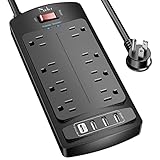
Top-Rated Picks
As an Amazon Associate we earn from qualifying purchases at no extra cost to you.


Frequently Asked Questions
Why does a gaming PC need a surge protector?
A surge protector shields expensive components from voltage spikes caused by storms, grid fluctuations, or appliances. A single surge can damage a PSU, motherboard, or GPU, so protection is cheap insurance.
What joule rating should a surge protector have?
For a gaming PC, look for at least 2000 joules, with higher ratings offering more protection and longer life. The joule rating reflects how much energy the unit can absorb over time.
Surge protector or UPS for a gaming PC?
A surge protector guards against spikes only, while a UPS adds battery backup for outages plus surge protection. A UPS is more complete; a surge protector is the budget minimum.
Do surge protectors wear out?
Yes. They degrade as they absorb surges, so protection weakens over time. Many include an indicator light, and replacing the unit every few years keeps your PC properly protected.
Related Articles
Looking for more on this topic? Browse the hand-picked guides below — each one applies the same scoring rubric used in this review.