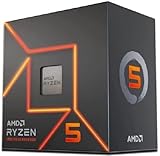
- Top Pick: AMD Ryzen 5 7600X 6-Core, 12-Thread Unlocked Desktop Processor
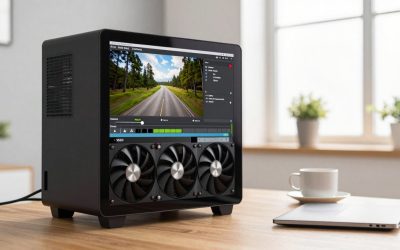
- Best Value: HELLOLAND Black RGB Prebuilt Gaming Desktop PC, AMD Ryzen 7 5700X 3.4GHz, GeForce RTX 5070 12GB, 32GB DDR4 RAM, 1TB PCIe SSD, WiFi & Bluetooth, No Bloatware, ARGB Software, Windows 11 Tower Computer
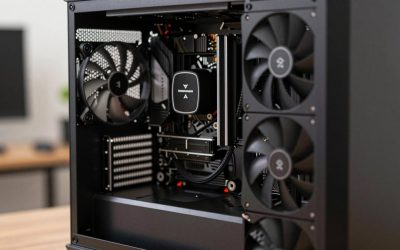
- Premium Choice: YEYIAN Gaming PC. AMD Ryzen 7 8700F, RTX 5070, 240mm AIO, 2 TB NVMe, 32GB RAM, 750W, Windows 11 Home. YPA-EL870FC-5701U
The pairing of a Ryzen 5 7600 with an RTX 5070 sits at an interesting crossroads. The 7600 remains one of the best value six-core processors on the AM5 platform, while the RTX 5070 brings Blackwell architecture performance to the mainstream tier. If you are building in 2026 or upgrading your GPU first, the question is straightforward: does the CPU hold the graphics card back, or are you getting what you paid for?
The Short Answer
No, the Ryzen 5 7600 does not meaningfully bottleneck an RTX 5070 at 1440p or 4K in the vast majority of titles. At 1080p, a measurable but usually tolerable limitation appears in CPU-heavy games, typically shaving between five and fifteen percent off peak GPU throughput. The single condition that changes the picture is your target resolution and the type of game you play. If you run a 1080p high-refresh competitive setup or frequently load into demanding open-world titles with heavy draw-call counts, the 7600 can limit your frametime consistency enough to matter. For everything else, this pairing is a sensible, well-balanced combination.
As an Amazon Associate we earn from qualifying purchases at no extra cost to you.




How to Tell
Before you worry about theoretical bottlenecks, use these concrete checks to see whether your specific workload is actually limited by the CPU:
GPU utilization during gameplay: Open your GPU-Z or use the in-game overlay provided by your GPU driver. If the RTX 5070 is consistently hitting 95 to 99 percent utilization while you play, the GPU is the limiting factor and the CPU is not holding it back. If GPU utilization drops into the 70 to 85 percent range during heavy scenes while CPU usage on the 7600 spikes, the processor is the bottleneck.
Task Manager or HWiNFO per-core readings: A six-core CPU can bottleneck a powerful GPU even when total CPU usage looks moderate. Check per-thread utilization. If one or two threads are pegged at 100 percent while others sit idle, a game engine is likely thread-bound and the 7600 is limiting performance regardless of its multi-core headroom.
Frame time graphs over average FPS: Tools like CapFrameX or the built-in frametime overlay in MSI Afterburner will show whether you get a 90 FPS average with terrible 1 percent lows. The 7600 is unlikely to produce severe frametime outliers against the 5070, but if you see repeated spikes, it points toward a CPU-side limitation rather than a GPU one.
Resolution test: Lower your in-game resolution to 720p with everything turned down except what you are testing. If the RTX 5070 suddenly produces a large jump in average FPS that it could not achieve at your normal settings, that gap represents the CPU bottleneck magnitude. If the jump is small, your 7600 is not the limiting factor.
By Resolution
1080p
This is where the question becomes relevant. At 1080p, the RTX 5070 is capable of pushing frame rates high enough that the 7600 occasionally becomes the pacing factor, particularly in games with heavy CPU workloads like Microsoft Flight Simulator, Cities: Skylines II, or certain Unreal Engine 5 titles with dense foliage and NPC counts. Across general gaming workloads, TechSpot’s CPU pairing tests and Hardware Unboxed’s benchmark methodology suggest the 7600 typically delivers between roughly 85 and 95 percent of what a higher-end Ryzen 7 or Ryzen 9 would extract from the same GPU at this resolution. In practice, most gamers will not notice the difference unless they are chasing ultra-high refresh rates above 144 Hz with all settings maxed.
1440p
At 1440p, the workload shifts decisively toward the GPU. The RTX 5070 is operating near its own ceiling in most modern titles, meaning the CPU simply does not need to feed frames as quickly. Across test suites from Tom’s Hardware and Gamers Nexus that compare CPU pairings at this resolution, the 7600 generally matches the performance of significantly more expensive processors within a range of zero to roughly five percent. For the overwhelming majority of players targeting 1440p, the 7600 is a non-issue.
4K
At 4K, the RTX 5070 is the bottleneck in essentially every title. Frame rates are lower, meaning the CPU has far more idle time between frames to complete its work. The 7600 has no realistic chance of limiting the 5070 at this resolution. Any measured difference between it and a flagship CPU at 4K would fall within benchmark noise, as reflected in the convergence seen across GPU performance charts from TechPowerUp and Hardware Unboxed.
| Resolution | Expected CPU Limitation | Practical Impact |
|---|---|---|
| 1080p, competitive/esports | 10-15% | Noticeable if chasing 240+ FPS; irrelevant below 144 Hz |
| 1080p, AAA single-player | 5-10% | Minor; unlikely to affect experience at target settings |
| 1440p, all game types | 0-5% | Effectively none; GPU is the limiting factor |
| 4K, all game types | ~0% | None; RTX 5070 is fully saturated |
What to Do About It
If you own a Ryzen 5 7600 and are buying an RTX 5070, the answer is simple: buy it. This pairing represents excellent value and the 7600 will not leave a meaningful performance gap in typical use. The AM5 platform gives you a straightforward upgrade path to a Ryzen 7 7700X, 7800X3D, or newer Zen 5 chip if you eventually decide you need more CPU horsepower for 1080p high-refresh play.
If you are starting from scratch and play exclusively at 1080p with a 240 Hz or 360 Hz monitor, consider a Ryzen 7 7800X3D instead. Its 3D V-Cache provides the strongest gaming performance per dollar on AM5 and eliminates even the mild limitation the 7600 experiences at lower resolutions. If you are building for 1440p, the 7600 is the better financial choice with zero performance sacrifice.
For anyone currently running a 7600 with a lesser GPU and planning to drop in a 5070, just make sure your power supply headroom is sufficient (the 5070 draws more than the 4060 Ti or 3060) and that your BIOS is updated to the latest AGESA for optimal memory training.
Recommendation by User Type
Budget-conscious 1440p gamer: Keep the 7600. Pair it with the RTX 5070 and invest your savings in more RAM, a faster NVMe drive, or a better monitor. The bottleneck is effectively zero at your target resolution.
Competitive 1080p high-refresh player: The 7600 works, but if your budget allows, the 7800X3D eliminates the last remaining frametime inconsistency in CPU-bound scenarios. The difference is small but real if you are sensitive to frame pacing.
4K enthusiast or content creator: No concern. The 7600 will not bottleneck the 5070 at 4K, and for multitasking workloads it handles six-core, twelve-thread duties capably alongside GPU-accelerated rendering.
Future-proof builder: The 7600 on AM5 with a 5070 is a strong platform. When Zen 5 or a successor GPU arrives, you can upgrade one component without replacing the entire system.
FAQ
Is the Ryzen 5 7600 still a good CPU for gaming in the RTX 5070 era?
Yes. Its Zen 4 architecture, 32 MB of L3 cache, and DDR5 memory support keep it competitive for gaming. It handles modern titles well, and paired with a 5070, it is limited by the GPU in nearly every common scenario above 1080p.
Would a Ryzen 7 7700X give me noticeably more FPS with the RTX 5070?
At 1440p and above, the difference is negligible, usually within measurement noise. At 1080p, the 7700X might extract five to ten percent more peak frame rate in CPU-heavy titles, but the jump to a 7800X3D is where you would see the largest improvement due to cache architecture rather than core count.
Does enabling DLSS or Frame Generation change the bottleneck situation?
Yes, significantly in your favor. DLSS Super Resolution reduces GPU load, which can shift the bottleneck back toward the CPU at higher settings. However, Frame Generation and DLSS 4’s Multi Frame Generation offload work from the CPU by synthesizing intermediate frames, which means the 7600 is less likely to be a limiter when these features are active.
Is the Ryzen 5 7600 compatible with the RTX 5070 without any issues?
Yes. Both use PCIe 4.0 x16 (the 5070 supports PCIe 5.0 but is fully functional on PCIe 4.0, and the 7600 platform provides PCIe 5.0 lanes on the primary slot anyway on X670 and B650 boards). There is no interface mismatch, and no known driver or BIOS conflicts between these two components.
Sources and Methodology
The performance ranges and bottleneck magnitudes discussed in this article are synthesized from published CPU-GPU pairing benchmarks and review methodology used by TechSpot (which maintains an extensive CPU vs. GPU bottleneck test suite across multiple resolutions), Hardware Unboxed (known for structured comparative testing and frame-time analysis), Tom’s Hardware (whose processor reviews include paired GPU performance charts), Gamers Nexus (which provides detailed CPU gaming performance breakdowns with consistent test benches), and TechPowerUp (whose benchmark database covers processor scaling against various GPU tiers). All figures cited are approximate ranges reflecting the consensus direction of these outlets’ test results rather than single-point measurements from this site.