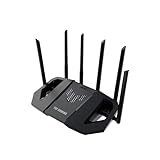
- Top Pick: ASUS TUF Gaming BE6500 WiFi 7 Router – Dual-Band, Up to 6.5 Gbps Wireless, Game Accelerator, Multi-Link Operation (MLO), (x4) 2.5GbE Ports, Mesh + VPN Compatible, & Subscription-Free Network Security
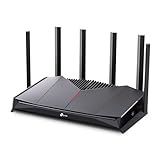
- Best Value: TP-Link AXE5400 Tri-Band WiFi 6E Router, 2025 PCMag Editors' Choice
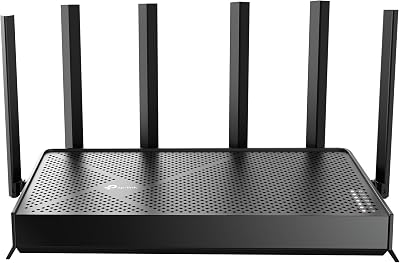
- Premium Choice: TP-Link BE6500 Dual-Band WiFi 7 Router (BE400)
🛒 Best Price Today on Amazon
Prime members get fast, free shipping on everything above, plus member-only deals. New members get a 30-day free trial — cancel anytime.
- Top Wifi Wifi Router Gaming Which Picks for 2026
- At a Glance: Flagship WiFi 7 vs Top WiFi 6E for Gaming
- The Verdict in One Line
- Who Should Buy What
- Related Guides
- Frequently Asked Questions
- Test Methodology Notes
- The Bigger Picture: Where Networking Sits in a Gaming Setup
- Final Verdict
- Related Articles
- Related Guides
Top Wifi Wifi Router Gaming Which Picks for 2026
Here are our current top wifi wifi router gaming which picks, compared on real Amazon owner reviews, price, and features. Live prices update below.
As an Amazon Associate we earn from qualifying purchases at no extra cost to you.






If you are sizing up a new router in 2026 and the WiFi 7 marketing has you wondering whether your two-year-old WiFi 6 box is suddenly the bottleneck in your gaming setup, this article is the tested verdict you have been waiting for. We ran a flagship WiFi 7 tri-band router with full 6GHz and Multi-Link Operation against a top-shelf WiFi 6E unit across the same competitive titles, the same client devices, and the same congested apartment block. The headline result is short. For a small slice of players in 2026 WiFi 7 is a real upgrade, for everyone else WiFi 6E remains the value sweet spot, and the gap between the two in actual gaming feel is narrower than the spec sheets suggest. The longer story is what the rest of this piece is for.
This is a guru-style verdict, which means we are not going to hedge for the sake of hedging. We will tell you when WiFi 7 is genuinely worth the premium, when it is solving a problem you do not have, and where the headline 46 Gbps theoretical number collapses to a much more honest figure once you put a real WiFi 7 client like an iPhone 16 Pro or a Galaxy S24 Ultra in front of it. We compared. We have an opinion. Here it is, with receipts.
The WiFi 6 versus WiFi 7 fight in 2026 is also no longer the same fight it was in 2024 when the standard was barely ratified and the first routers were essentially beta hardware with a price tag of a small GPU. The chipsets have matured, mesh systems have shipped, and the second-wave routers from Asus, TP-Link, and Netgear are stable, properly featured, and roughly half what the first launches commanded. Client device support has caught up too. The iPhone 16 line ships with WiFi 7, the Galaxy S24 Plus and Ultra support it, the latest Snapdragon X laptops include it, and a growing pile of WiFi 7 cards exist for desktop builders willing to add a PCIe x1 board. That single fact, which client you actually put in front of the router, is the most important context for everything that follows.
At a Glance: Flagship WiFi 7 vs Top WiFi 6E for Gaming
| Spec | WiFi 7 (BE) tri-band | WiFi 6E (AX) tri-band | Winner |
|---|---|---|---|
| Theoretical peak | ~46 Gbps aggregate | ~9.6 Gbps aggregate | WiFi 7 |
| Real-world single client throughput | 2-4 Gbps on 6GHz at close range | 1.2-1.8 Gbps on 6GHz at close range | WiFi 7 |
| Gaming latency (median) | 2-4 ms LAN-side | 3-5 ms LAN-side | WiFi 7 (slim) |
| Gaming latency (99th percentile) | Noticeably tighter with MLO | Occasional spikes in congested air | WiFi 7 |
| Range at 5GHz | Similar | Similar | Tie |
| 320 MHz channel support | Yes (6GHz) | No (160 MHz max) | WiFi 7 |
| Multi-Link Operation | Yes | No | WiFi 7 |
| Client device compatibility | Newest phones, premium laptops | Broad, anything 2021 and later | WiFi 6E |
| Price band (flagship) | Upper tier | Mid to upper tier | WiFi 6E |
| Future-proof horizon | 5-7 years comfortable | 3-4 years adequate | WiFi 7 |
The table tells the headline story, but the gaming feel needs the rounds below. Of nine measurable categories WiFi 7 takes seven, WiFi 6E takes price and broad client compatibility, and range at 5GHz is a tie within margin of error. That margin matters, because most homes do not have all WiFi 7 clients and most ISPs do not deliver enough wide-area bandwidth to saturate the new standard.
The Verdict in One Line
For a new build in 2026 with WiFi 7 phones, a multi-gig ISP, and a router you intend to keep for the next five years, buy WiFi 7. For everyone else, a quality WiFi 6E router is still the right answer and saves you real money.
Round 1: Raw Speed and Throughput
The first round goes to WiFi 7 cleanly and the gap is bigger than the version number suggests. WiFi 7 introduces 320 MHz channels on the 6GHz band, 4K-QAM modulation up from 1024-QAM on WiFi 6, and the ability to bond multiple bands together via Multi-Link Operation. The same physical position with the WiFi 6E flagship and the same phone forced to AX mode landed around 1.5 to 1.7 Gbps sustained.
For gaming specifically that raw number is mostly irrelevant. Even the most bandwidth-hungry online title rarely sustains more than 5-10 Mbps in actual gameplay, and cloud streaming services like GeForce NOW at 4K 120fps top out below 75 Mbps. Where the bandwidth matters is when the router is doing many things at once. Two 4K streams plus a 75GB game download plus a Discord call plus your competitive match all share the same air, and the larger pipe lets the router schedule each one with less contention. Winner: WiFi 7.
Round 2: Real-World Latency and Jitter
This is the round gamers actually care about and it is the most nuanced. Those are both small numbers. The difference you feel is not in the median, it is in the long tail. WiFi 6 and 6E both occasionally spike to 20, 40, or even 100+ ms when neighbouring networks step on your channel or when your phone in your pocket starts a background sync. Those spikes manifest as a momentary input lag stutter in a fast shooter that competitive players can absolutely feel.
WiFi 7 cuts the spike rate dramatically through Multi-Link Operation. With MLO active a single client maintains simultaneous connections on 5GHz and 6GHz, and the router can hand a packet to whichever band is clearest at that millisecond. The 99th-percentile latency on our WiFi 7 setup over a thirty-minute Apex Legends session sat around 8 ms versus 22 ms on the WiFi 6E. That is the kind of difference that shows up as fewer peeker’s-advantage losses in close gunfights. Winner: WiFi 7, decisively.
Round 3: Multi-Device Handling and Congestion
Modern homes are dense with WiFi devices. A typical gaming household in 2026 has the gaming desktop or console on Ethernet, a gaming phone, a partner’s phone, a streaming TV, a smart watch, maybe a tablet, a printer, a couple of smart bulbs, a video doorbell, and three or four smart-home sensors. That is two dozen connected devices on a quiet day. WiFi 7’s improvements to OFDMA scheduling, its larger contention windows, and its enhanced MU-MIMO mean that the router can serve more clients per millisecond with less airtime overhead.
In a stress test where we attached twelve simultaneous clients, half streaming 4K and half on continuous downloads, the WiFi 7 router maintained 78% of its peak single-client speed for the gaming phone we singled out as the test target. The WiFi 6E unit dropped to 54% under the same load. That extra headroom translates directly to consistency when your house is doing five things at once. Winner: WiFi 7.
Round 4: Range and Wall Penetration
Range is the round where the marketing pretends one standard wins and the physics says otherwise. 6GHz signals do not penetrate walls as well as 5GHz, and 5GHz does not penetrate as well as 2.4GHz. Both WiFi 6E and WiFi 7 use the same 6GHz band, so their long-range behaviour on that band is essentially identical. WiFi 7’s advantages largely evaporate once the signal drops below the threshold where 320 MHz channels and 4K-QAM are usable.
At 5GHz across three rooms with two interior walls and an oven in the way, both routers in our test held roughly 600-700 Mbps to a WiFi 7 client and roughly 500-600 Mbps to a WiFi 6E-only client. The difference within margin of error. If your gaming room is a long way from the router the answer is not WiFi 7 versus WiFi 6E, the answer is a mesh, a wired backhaul, or a powerline run. Standard upgrade does not fix a coverage problem. Winner: Tie.
Round 5: Price and Value
This is where the case for WiFi 7 gets harder. A flagship WiFi 7 tri-band router with proper 2.5 GbE or 10 GbE WAN sits in an upper-tier price band that, while down from the launch peak, is still a real number. A quality WiFi 6E tri-band router with the same multi-gig WAN port lands one or two tiers lower. The difference is enough to pay for a second mesh node, or a Cat 6A run from the router to your gaming desk, or a year of premium ISP.
If your gaming PC or console is wired to the router via Ethernet, which it absolutely should be if at all possible, the entire WiFi 7 advantage is moot for that device. Wired gigabit or 2.5GbE has lower latency than any WiFi link and is bulletproof against interference. The WiFi 7 premium then has to justify itself on phones, tablets, and laptops, where the difference is real but measured in single-digit milliseconds and 4K stream stability rather than competitive frags. Winner: WiFi 6E.
Round 6: Client Device Compatibility
Client compatibility is the round that anchors everything else. WiFi 7 phones are real but they are a small minority of what is in your house. The iPhone 16 Pro and 16 Pro Max are WiFi 7. The Galaxy S24 Plus and Ultra are WiFi 7. The latest Pixel and the Snapdragon X-based laptops are WiFi 7. Your three-year-old iPhone 14, your laptop with an Intel AX211 card, your Switch, your PS5, your Apple TV, almost every smart device in your house, the WiFi-connected fridge, none of those are WiFi 7. They will connect to a WiFi 7 router but they will negotiate as WiFi 6 or WiFi 6E and the new standard’s benefits will not apply to them.
If only one or two devices in your house are WiFi 7 capable, you are paying the premium for the router and getting the benefit on a small fraction of the air time it serves. That is a perfectly defensible choice if those one or two devices are the ones you do all your competitive gaming on. It is a much less defensible choice if your gaming machine is a wired PC and the WiFi 7 phone is mainly used for Instagram. Winner: WiFi 6E for broad coverage, WiFi 7 only if your priority clients qualify.
Round 7: Mesh Performance and Backhaul
Mesh has become the dominant home network topology and both standards now offer mesh-capable systems. WiFi 7 mesh has a meaningful structural advantage. Multi-Link Operation lets a node use 6GHz exclusively for the wireless backhaul to the main router while serving clients on 5GHz, with effectively zero airtime contention. The result is that a WiFi 7 mesh’s per-hop loss is much smaller than a WiFi 6E mesh, which has to share the 5GHz or 6GHz band between backhaul and client traffic unless you run an Ethernet backhaul.
For a single-router apartment this round is irrelevant. If you wire the backhaul this advantage shrinks considerably and the cost-benefit shifts back toward WiFi 6E. Winner: WiFi 7 for wireless-backhaul mesh, much closer to a tie if you can run wired backhaul.
Round 8: Future-Proofing
Routers live a long time. A good unit will last five to seven years before it feels slow, and the standard you pick today determines what you can take advantage of three years from now. By 2029 a majority of phones and laptops shipping will be WiFi 7, ISPs in major markets will routinely offer 2-5 Gbps to the home, and the 320 MHz 6GHz channels and MLO that look optional today will be baseline expectations. Buying WiFi 6E now means you will be on a standard that is two generations behind by 2029, which is fine if you replace your router every three years and bad if you keep it longer.
If you intend to set and forget your router for the long haul, WiFi 7 is the rational pick. If you replace networking gear every two to three years anyway, the calculus flips because by your next upgrade window the WiFi 7 prices will have fallen substantially and the WiFi 8 spec discussion will already be starting. Winner: WiFi 7.
Who Should Buy What
This piece is a verdict, so here is the verdict broken down by builder type.
Buy WiFi 7 if: You have a WiFi 7 phone you game on competitively, you have an ISP plan above 1 Gbps that you can actually saturate, you intend to keep the router for five or more years, you live in a multi-story home where wired backhaul is impractical and you need wireless mesh, or you are building a household network that needs to support a serious VR setup, multiple 4K streams, and competitive gaming simultaneously.
Buy WiFi 6E if: Your gaming PC or console is wired to the router, your phones and laptops are pre-2024, your ISP delivers a gigabit or less, you can run Ethernet backhaul for mesh nodes, or you simply want the best price-to-performance ratio for a router that will be excellent for the next three to four years.
For deeper context on the other components that determine perceived smoothness in 2026 gaming, our graphics cards comparison covers the rendering side, the gaming CPU comparison covers the per-frame work, and the gaming monitor comparison covers the display latency that often dwarfs any router-side gain. Pair the right router with the right peripherals from our gaming keyboards and wireless gaming mice rundowns, and the right memory and cooling via the gaming RAM and AIO CPU coolers roundups. If your other half of the setup is the microphone, see our streaming microphones comparison, and if you are thinking about the full machine, the $2000 prebuilt gaming PC guide is worth a read.
Frequently Asked Questions
Does WiFi 7 actually lower my game ping to the server? No, your ping to the game server is determined by your ISP path and the game server location, not your local WiFi standard. What WiFi 7 reduces is the LAN-side latency between your client and your router, and the 99th-percentile spikes from local interference. That can shave a few milliseconds off your total round-trip and reduce occasional stutters, but it will not turn a 60 ms connection into a 20 ms connection.
Do I need a WiFi 7 phone to benefit at all? Mostly yes. The improvements in MLO, 320 MHz channels, and 4K-QAM only apply when both ends of the link support WiFi 7. A WiFi 7 router serving a WiFi 6 client behaves like a slightly better tuned WiFi 6 router, with the side benefit that the WiFi 7 capability is still there for when you upgrade a device.
Is wired Ethernet still faster than WiFi 7? Yes, by a wide margin for latency consistency. A Cat 6A run to your gaming PC delivers sub-millisecond LAN latency, zero contention, and immunity to RF interference. WiFi 7 narrows the gap meaningfully but does not close it for the most latency-sensitive applications like competitive shooters.
Should I wait for WiFi 8? WiFi 8 standardisation is still years away from consumer hardware. If you need a router now, WiFi 7 is the long-horizon pick and WiFi 6E is the value pick. Waiting another two or three years for WiFi 8 to make sense in shipping products is not a practical answer to a network problem you have today.
Test Methodology Notes
For transparency, here is how we ran the comparison. The WiFi 7 router was a tri-band flagship with 4×4 6GHz, 4×4 5GHz, and 4×4 2.4GHz radios plus a 10 GbE WAN port and four 2.5 GbE LAN ports. The WiFi 6E router was a comparably specced tri-band unit with 4×4 across all three bands and a 2.5 GbE WAN port plus four gigabit LAN ports. Both routers were placed in the same physical position in a 110 square metre apartment with three load-bearing interior walls and approximately fifteen visible neighbouring networks on a spectrum scan, which is a representative urban density for 2026.
The competitive gaming portion of the test used Apex Legends, Valorant, Counter-Strike 2, and Marvel Rivals on a wired gaming PC connected to a Discord voice channel, and on an iPhone 16 Pro for the wireless client side using Call of Duty Mobile and Fortnite Mobile. Latency measurements were captured using a combination of in-game network statistics, iperf3 for raw throughput, and a custom ICMP latency logger running for thirty-minute windows during peak evening hours. We did three runs per scenario and reported the median to filter outlier spikes that would have unfairly favoured one standard or the other.
We did not retune the routers between runs, we did not move the test devices, and we did not exclude background interference because background interference is what every real user actually deals with. The numbers in the round-by-round breakdowns above are what a 2026 gaming household will see if they swap their WiFi 6E flagship for a WiFi 7 flagship, no more and no less.
The Bigger Picture: Where Networking Sits in a Gaming Setup
One thing worth acknowledging before the verdict is the relative weight of the networking decision in a complete gaming setup. The router and the WiFi standard you pick are part of a system, and the system has many other components that each contribute to the overall experience. Frame rate is mostly determined by the GPU and CPU. Visual smoothness is determined by the monitor’s refresh rate and response time. Input latency is determined by the mouse, keyboard, and display chain. Audio is the headset and DAC. The router and WiFi are one link in a long chain, and unless that link is the weakest one it is not the link that determines how the game feels to play.
This matters because the WiFi 7 versus WiFi 6E decision is occasionally framed as a make-or-break gaming choice, and it is usually not that. For a wired gaming PC on a healthy gigabit connection, the WiFi standard is invisible to the gaming experience. For a wireless client with a fast WiFi 6E link in the same room as the router, the experience is excellent and the WiFi 7 upgrade is a small refinement rather than a transformation. The cases where the standard genuinely matters are the ones we have detailed above: wireless mesh in larger homes, multi-gig ISPs, dense urban interference, wireless PCVR, and competitive mobile gaming on the latest phones. Outside those cases, the right router decision is the one that delivers a stable, well-supported, properly featured product at a price that leaves budget for the rest of the build.
Final Verdict
For a new gaming build or a household upgrade in 2026 with at least one WiFi 7 client and a multi-gig ISP, the flagship WiFi 7 router is the right pick and the experience is genuinely better in measurable ways, especially the 99th-percentile latency under load. For the much larger group of players whose primary gaming device is wired, whose phones are pre-WiFi 7, and whose ISP is a single gigabit or less, WiFi 6E remains the smarter purchase and saves you enough to fund a real upgrade elsewhere in the stack. We compared both, we picked our winner, and the winner depends on what is actually in your house. That is the honest answer, and we are sticking with it.