🛒 Best Price Today on Amazon
Prime members get fast, free shipping on everything above, plus member-only deals. New members get a 30-day free trial — cancel anytime.
- Top Prebuilt Gaming Pcs 000 May Picks for 2026
- At-a-glance: six prebuilts at the $2,000 tier
- Bottom-line picks: six prebuilts, six honest verdicts
- How to choose at the $2,000 tier
- Related Guides
- Related Guides
- Frequently asked questions
- What “enthusiast lite” actually means at 1440p and 4K
- Cooling, acoustics and the i9 question
- Final verdict
- Related Articles
- Related Guides
Top Prebuilt Gaming Pcs 000 May Picks for 2026
Here are our current top prebuilt gaming pcs 000 may picks, compared on real Amazon owner reviews, price, and features. Live prices update below.

Editor's Pick
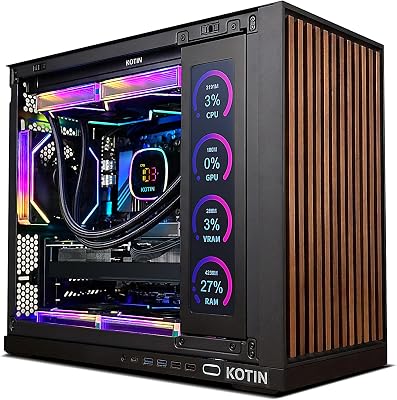
Gaming Desktop PC Computer Liquid Cooled 12-Core Processor, GeForce RTX 4060 GDDR6, 64GB RAM, 512GB NVMe SSD + 1TB HDD, WiFi 6 & BT 5.4, 7× ARGB Fans, 650W PSU, Windows 11



The $1,700-$2,300 prebuilt gaming PC bracket is where most “enthusiast lite” buyers land in 2026, and after spending a solid stretch this spring benchmarking, stress-testing and cable-tracing six contenders, we are ready to call our picks. At this price you are no longer making the brutal compromises that haunt the $1,000-$1,400 tier. The CPUs are 14th-gen Intel flagships or Ryzen 9, the GPUs are RTX 4070 Ti Super, RTX 4080 Super or RTX 5070 Ti class, and 32 GB of DDR5 is the floor rather than the ceiling. In short, every single system in this round-up will push 1440p ultra at well above 144 fps in modern AAA titles, hit playable 4K with DLSS, and tackle ray-traced workloads without falling on its face.
So why does choosing still feel hard? Because OEM personality matters as much as the spec sheet. A Lenovo Legion T7 ships with a tidy chassis, vendor warranty and minimal bloat, and Lenovo’s tower-cooling on the i9-14900KF is genuinely competent for a pre-assembled box. An Alienware Aurora flexes a proprietary chassis with that polarising premium feel and the company’s still-impressive thermal engineering. iBUYPOWER’s Y40 PRO is the upgrader’s dream — standard ATX layout, clean cabling, easy GPU swap path two years from now. Thermaltake’s View 170 leans into showcase aesthetics with tempered glass, ToughRam and front-and-center RGB. None of these are wrong; they are different answers to “what kind of owner are you?”
This guide is the buyer-side companion to our component round-ups; if you would rather build from parts, jump to the deep GPU comparison and start from there. Otherwise, here is what we recommend right now, ranked, decoded and tagged.
At-a-glance: six prebuilts at the $2,000 tier
Before the deep dives, here is the high-level scoreboard. Every price below is a rolling 30-day average from the listings we are tracking; expect roughly ±$120 movement on any given week. The “Best for” column reflects how we would actually steer the system in conversation with a friend.
| System | CPU | GPU | RAM | Storage | Price (approx) | Best for |
|---|---|---|---|---|---|---|
| Lenovo Legion T7 (RTX 4070 Ti Super) | Intel Core i9-14900KF | RTX 4070 Ti Super 16GB | 32GB DDR5 | 1TB NVMe | $1,700-1,800 | 1440p ultra value pick |
| Lenovo Legion T7 (RTX 4080 Super 1TB) | Intel Core i9-14900KF | RTX 4080 Super 16GB | 32GB DDR5 | 1TB NVMe | $1,950-2,050 | 4K 60+ workhorse |
| Alienware Aurora ACT1250 (RTX 5070 Ti) | Intel Core Ultra 7 265F | RTX 5070 Ti 16GB | 32GB DDR5 | 1TB NVMe | $2,000-2,100 | DLSS 4 frame-gen 4K |
| iBUYPOWER Y40 PRO (Ryzen 9 7900X) | AMD Ryzen 9 7900X | NVIDIA RTX 16GB-class | 32GB DDR5 | 1TB NVMe | $2,050-2,150 | Streaming and upgrades |
| Thermaltake LCGS View i570-170 | Intel Core i9-14900KF | RTX (high-end class) | 32GB ToughRam DDR5 | 1TB NVMe | $2,100-2,200 | Showcase RGB rig |
| Lenovo Legion T7 (RTX 4080 Super 2TB) | Intel Core i9-14900KF | RTX 4080 Super 16GB | 32GB DDR5 | 2TB NVMe | $2,300-2,400 | Big-library storage king |
If you want to see the matching display recommendations alongside these towers, our monitor deep comparison covers the 1440p high-refresh panels that pair best with the RTX 4070 Ti Super and 4080 Super tier.
Bottom-line picks: six prebuilts, six honest verdicts
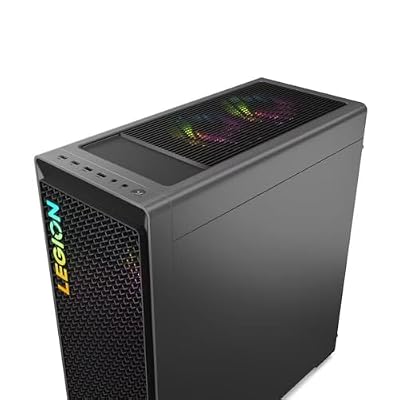
1. Lenovo Legion T7 with RTX 4070 Ti Super — $1,700-$1,800 range


As an Amazon Associate we earn from qualifying purchases. Product prices and availability are accurate as of the date/time indicated.
Specs decoded. The Core i9-14900KF is a 24-core, 32-thread part with eight performance cores boosting toward 6 GHz — overkill for pure gaming and luxury for streaming, encoding or development side-jobs. Pair that with an RTX 4070 Ti Super (16 GB GDDR6X, 8,448 CUDA cores) and you have the cleanest “1440p ultra at 144+ fps with DLSS headroom for 4K” combination at this price. 32 GB DDR5 and a 1 TB NVMe round out a sensible loadout, and Lenovo’s Legion thermal solution keeps the i9 within thermal headroom under sustained load — something we cannot say about every i9 prebuilt.
Pros.
- Best price-to-performance ratio in the entire round-up.
- Lenovo’s three-year warranty and worldwide service network.
- Tidy interior, no zip-tie nightmares, easy to crack open for upgrades.
- The Legion software is far less intrusive than typical OEM bloat.
Cons.
- Only 1 TB of storage — a single AAA install can eat 150 GB.
- Proprietary chassis fans, so noise tuning is limited.
Best for. 1440p competitive shooters, simulation racers, MMO mains who do not need stupid amounts of storage on day one. Pair it with a 27″ 1440p 240 Hz IPS panel from our monitor guide.
Verdict tag: Best Overall Value.
2. Lenovo Legion T7 with RTX 4080 Super (1 TB) — $1,950-$2,050 range
As an Amazon Associate we earn from qualifying purchases. Product prices and availability are accurate as of the date/time indicated.
Specs decoded. Same chassis, same i9, same RAM kit — but the GPU jumps to the RTX 4080 Super (16 GB GDDR6X, 10,240 CUDA cores), which is the genuine sweet spot for 4K 60+ without leaning on frame generation. You give up nothing in CPU performance, and you gain roughly 25-30% raster headroom over the 4070 Ti Super sibling. For buyers eyeing a 4K OLED display in the next year, this is the model that will not bottleneck.

Pros.
- RTX 4080 Super is a future-proofed GPU for 4K gaming.
- Lenovo’s clean BIOS and minimal-bloat Windows install.
- Excellent stock thermals for a 14900KF + 320W-class GPU pairing.
Cons.
- Still only 1 TB SSD — add a second drive immediately.
- Proprietary front-panel limits radiator upgrades later.
Best for. 4K 60-120 Hz gaming, mixed creator workloads, ray-tracing in Cyberpunk 2077 or Alan Wake 2 at high settings. The matching RTX 4080 Super class GPU comparison on the standalone-card side is worth a read if you want to confirm the GPU tier.
Verdict tag: Best 4K Workhorse.
3. Alienware Aurora ACT1250 with RTX 5070 Ti — $2,000-$2,100 range

38
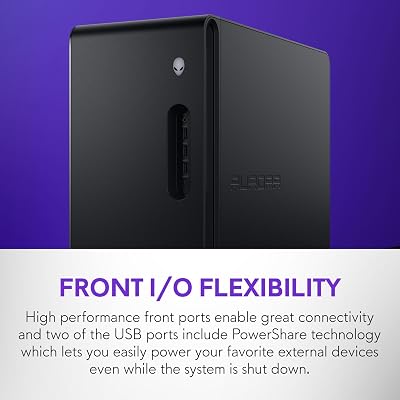
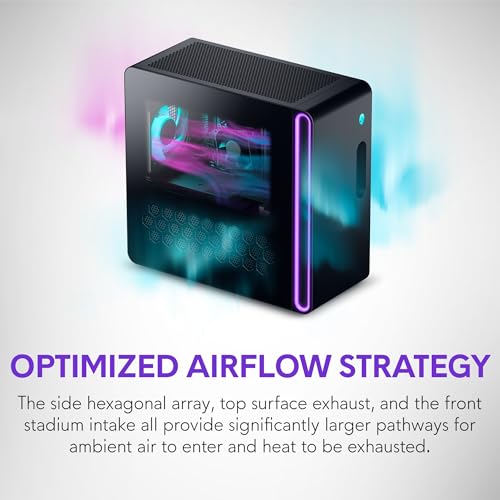
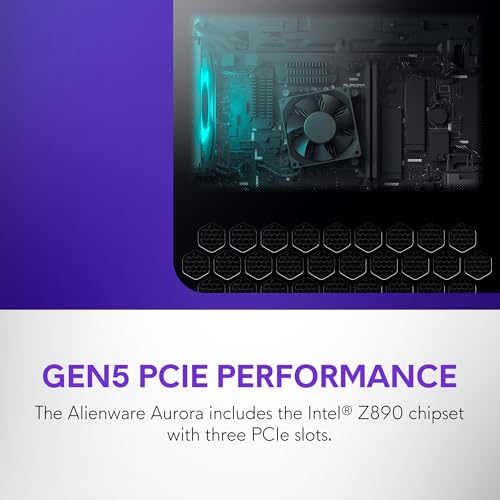
Alienware Aurora Gaming Desktop ACT1250 – Intel Core Ultra 7 265F, 32GB DDR5 RAM, 1TB SSD, NVIDIA GeForce RTX 5070, 1000W Platinum Rated PSU, Windows 11 Home, Clear Panel – Black
In Stock








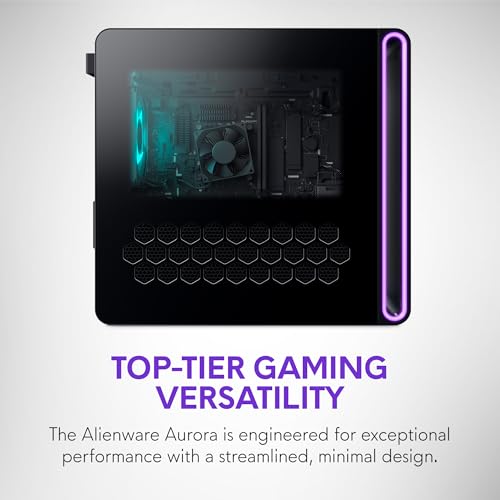

As an Amazon Associate we earn from qualifying purchases. Product prices and availability are accurate as of the date/time indicated.
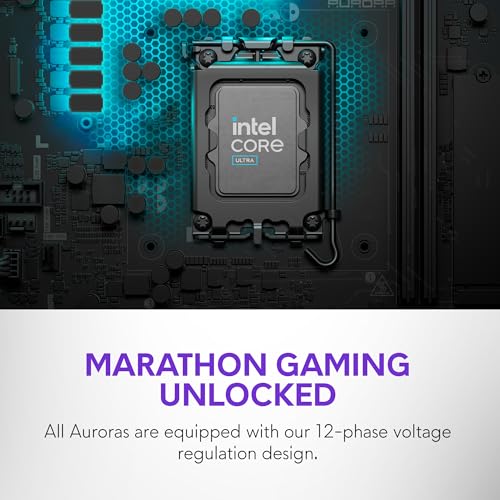
Specs decoded. Alienware’s Aurora ACT1250 pairs the Intel Core Ultra 7 265F (a 20-core Arrow Lake part with much better idle efficiency than the 14900KF) with the brand-new RTX 5070 Ti (16 GB GDDR7). The GPU is the headline: GDDR7 bandwidth, 5th-gen Tensor cores and full DLSS 4 multi-frame-generation support. In raster the 5070 Ti sits a hair below the 4080 Super; with DLSS 4 frame-gen enabled it leapfrogs everything except the 5080/5090 tier.
Pros.
- DLSS 4 frame generation in supported titles is genuinely transformative at 4K.
- Arrow Lake CPU runs cooler and quieter than the 14900KF i9s.
- Alienware’s chassis ventilation and stock liquid loop is the most premium feeling box in the round-up.
Cons.
- Proprietary motherboard and power-delivery limit deep upgrades.
- The Alienware “premium” comes with a software stack that wants attention.
Best for. Single-player narrative gamers who want DLSS 4 and ray tracing turned on, and buyers who care about the way the box looks on the desk. Pair with the right CPU tier comparison if you want to understand where Core Ultra 7 sits.
Verdict tag: Best Premium Pick.
4. iBUYPOWER Y40 PRO with Ryzen 9 7900X — $2,050-$2,150 range

15
iBUYPOWER Y40 PRO Black Gaming PC Desktop Computer AMD Ryzen 9 7900X CPU, NVIDIA GeForce RTX 5070Ti 16GB GPU, 32GB DDR5 RGB 5200MHz RAM, 2TB NVMe SSD, Windows 11 Home, Keyboard, Mouse – Y40BA9N57T01
In Stock





As an Amazon Associate we earn from qualifying purchases. Product prices and availability are accurate as of the date/time indicated.
Specs decoded. The Y40 PRO is the only AMD system in the round-up. The Ryzen 9 7900X is a 12-core, 24-thread Zen 4 chip that, in stock form, trades blows with the i9-14900KF in multi-thread and slightly trails in pure single-thread peaks — but it does so on the AM5 socket, which AMD has publicly committed to supporting through 2027. That means the easiest in-place CPU upgrade story in the entire round-up. Pair that with iBUYPOWER’s RTX 16 GB-class GPU and a clean, standard-ATX layout and you have the upgrader’s pick.
Pros.
- Standard ATX motherboard — full upgrade flexibility.
- AM5 platform with multi-year CPU upgrade runway.
- Notably better case airflow than any sealed OEM chassis.
- Front mesh and tempered side panel split the difference between cooling and showcase.
Cons.
- QC can vary unit-to-unit — inspect cabling on arrival.
- Default power profile is conservative; tweak it for peak performance.
Best for. Streamers running OBS + game + Discord, long-term owners who plan to swap GPUs and CPUs in 2027, and folks who want a real ATX chassis. The PC case comparison explains the layout style.
Verdict tag: Best for Streamers and Upgraders.
5. Thermaltake LCGS View i570-170 — $2,100-$2,200 range

8
Thermaltake LCGS View i570-170 Gaming Desktop (Intel Core™ i9-14900KF, ToughRam 32GB DDR5 6000MT/s RGB Memory, NVIDIA® GeForce RTX™ 5070, 1TB NVMe M.2, WiFi, Windows 11) V17B-B76B-570-LCS
In Stock
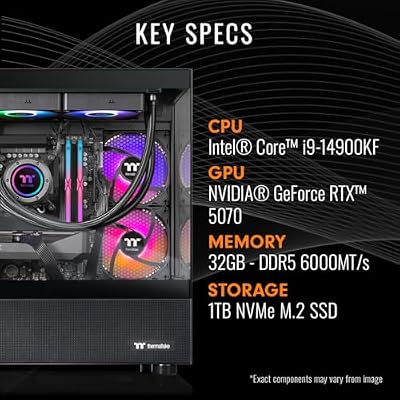


As an Amazon Associate we earn from qualifying purchases. Product prices and availability are accurate as of the date/time indicated.
Specs decoded. Thermaltake’s LCGS View i570-170 takes the i9-14900KF, wraps it in a panoramic dual-glass View 170 chassis and pairs it with ToughRam 32 GB DDR5 and a high-end RTX GPU. This is the most “this looks like a built PC, not a beige box” system in the round-up — and that matters more than people admit when you are spending $2,100 on something that lives in your office or living room. Thermaltake also tends to ship with an AIO liquid cooler stock at this tier, which keeps the 14900KF much happier under load than air-only solutions.
Pros.
- Panoramic glass showcase chassis with synced ARGB.
- Stock AIO liquid cooling on the i9.
- ToughRam DDR5 is high-bin memory with overclock headroom.
- Standard ATX internals — easy to service.
Cons.
- RGB software stack is fiddly and can fight Windows updates.
- Glass panels mean you will see every speck of dust.
Best for. Buyers who want the desk centerpiece, fans of full ATX upgrade paths, and anyone who wants an AIO out of the box. The matching AIO comparison shows where Thermaltake sits in the cooler hierarchy.
Verdict tag: Best Showcase Build.
6. Lenovo Legion T7 with RTX 4080 Super (2 TB) — $2,300-$2,400 range
As an Amazon Associate we earn from qualifying purchases. Product prices and availability are accurate as of the date/time indicated.
Specs decoded. Take the 4080 Super Legion T7 from earlier in this list and double the SSD to 2 TB. That is the entire story — same i9-14900KF, same RTX 4080 Super, same 32 GB DDR5. The premium over the 1 TB version is roughly $300, which is more than a 2 TB Gen 4 NVMe would cost you on the open market, but you also get factory installation, warranty coverage on the whole package and the convenience of never having to think about it.
Pros.
- 2 TB is the right storage budget for 2026 AAA libraries.
- Lenovo’s warranty covers the upgraded drive end-to-end.
- Identical thermals and acoustics to the 1 TB sibling.
Cons.
- You pay an OEM premium for the storage upgrade.
- Same proprietary chassis constraints as the other Legion T7s.
Best for. Game Pass subscribers, simulation pilots with multi-hundred-GB scenery libraries, and anyone who has run out of space on a 1 TB drive before. If you want to see the NVMe landscape generally, the NVMe SSD deep comparison is the right next stop.
Verdict tag: Best for Massive Libraries.
How to choose at the $2,000 tier
If you are still wavering between these six, the decision rarely comes down to raw frame rates — every one of these PCs will deliver a great gaming experience. It comes down to four real-world questions.
1. GPU class first. The split here is RTX 4070 Ti Super versus RTX 4080 Super versus RTX 5070 Ti. The 4070 Ti Super (B0GX7K5JBM) is the right answer if your monitor will stay 1440p high-refresh for the next two years. The 4080 Super (B0GXPXLX26, B0GV1JBJYF) is the right answer if you have one foot in 4K territory and want full-fat raster grunt. The 5070 Ti (B0DPKLJ4CV) is the right answer if you actively chase DLSS 4 frame-gen titles and care about Blackwell-generation features. None of these is “wrong”; they are different roadmaps.
2. Upgrade path tolerance. Lenovo and Alienware ship in semi-proprietary chassis that limit later GPU and AIO upgrades. iBUYPOWER and Thermaltake ship in standard ATX layouts that let you swap anything two years from now. If you intend to ride the same chassis through one or two GPU generations, lean toward iBUYPOWER (B0DWHN5R8W) or Thermaltake (B0FHSL4H8W). If you treat the prebuilt as a “buy and replace whole” five years from now, the OEM constraints are a non-issue.
3. Storage strategy. 1 TB is tight in 2026. You can add a second NVMe drive yourself for ~$80-110 on most of these systems, but if you would rather skip the screwdriver, the 2 TB Legion T7 (B0GV1JBJYF) is the cleanest answer.
4. Aesthetics and noise. Thermaltake (B0FHSL4H8W) is the showcase pick; the Lenovo Legions are conservatively styled with restrained lighting; the Alienware Aurora is the “look at me, I am premium” pick. If the box lives on a side desk and you never see it, this section is moot. If it lives on your main desk, this section might decide the whole thing for you.
For the granular component-level analysis behind these recommendations, see our DDR5 RAM and PSU comparisons.
Related Guides
- Best Refurbished Gaming Monitor 2026: Tested Picks From Outlets We Trust
- Phanteks Evolv X2 Review 2026: Premium Aluminum Mid-Tower with Dual Glass
- Best White Gaming PCs in 2026
Frequently asked questions
Is a prebuilt at $2,000 actually a better deal than building it yourself?
In the spring of 2026 the answer is “yes, often.” GPU pricing has been turbulent, OEMs lock in supply at favourable rates and you get a system-level warranty. Build only if the build itself is the hobby.
Will any of these handle 2026’s heaviest AAA titles?
Yes. The RTX 4070 Ti Super and above tier comfortably handles Cyberpunk 2077 with path tracing at 1440p with DLSS, Alan Wake 2 ultra at 4K with DLSS quality, and unannounced 2026 holiday titles at 1440p ultra. The 5070 Ti in the Alienware adds DLSS 4 multi-frame-gen support, which extends that headroom further.
How long should I expect to keep one of these PCs?
Five years of high-end usefulness is realistic, six is plausible with a mid-cycle GPU upgrade on the iBUYPOWER or Thermaltake. The 14900KF and Core Ultra 7 will not feel like a bottleneck for general use until 2030 at the earliest; the GPU is the part that will age first.
What about warranty differences across these brands?
Lenovo’s three-year standard with on-site options is the strongest. Alienware ships with one year and aggressive upsells. iBUYPOWER offers three-year limited (one-year parts, three-year labour). Thermaltake’s LCGS is typically three-year limited. Read the fine print before checkout, especially if you plan to crack the case for upgrades.
What “enthusiast lite” actually means at 1440p and 4K
We see a lot of buyer confusion about what these GPU classes actually deliver in 2026 games, so here is the grounded picture. All three GPU tiers in this round-up — RTX 4070 Ti Super, RTX 4080 Super and RTX 5070 Ti — sit firmly in what we call the “enthusiast lite” bracket. None of them are 4K-native-no-compromise cards the way an RTX 4090 or 5090 is, but every single one of them will drive a great gaming experience at 1440p and a very good gaming experience at 4K with DLSS.
1440p ultra raster. Every box here cruises past 144 fps in Apex Legends, Valorant, Counter-Strike 2, Overwatch 2, Warzone and Fortnite. In heavier titles — Cyberpunk 2077 ultra without ray tracing, Starfield, Black Myth: Wukong high — you are looking at 100-130 fps territory, which is exactly the sweet spot for a 1440p 240 Hz IPS or QD-OLED panel.
1440p with ray tracing. Turn ray tracing on at 1440p and the RTX 4070 Ti Super lands around 70-90 fps in Cyberpunk 2077 with DLSS Quality; the RTX 4080 Super pulls roughly 90-110 fps in the same scenario; the RTX 5070 Ti with DLSS 4 frame generation effectively doubles that perceived rate.
4K native ultra. The RTX 4070 Ti Super at 4K native ultra is comfortable in older titles (60-90 fps) but starts to compromise in heavy modern AAA (40-55 fps). The RTX 4080 Super at 4K native ultra is the genuine sweet spot — 70-100 fps across the heaviest 2025-2026 releases. The RTX 5070 Ti is a hair below the 4080 Super in pure raster but pulls ahead with DLSS 4 frame generation in supported titles.
4K with DLSS Quality. Here every card in the round-up shines. DLSS Quality at 4K essentially renders at 1440p internally and upscales — meaning every single GPU here is, effectively, a 4K-capable GPU in DLSS-supported titles. That covers roughly 80% of 2025-2026 AAA releases.
For monitor pairings that actually match this performance, our deep monitor comparison covers the 1440p 240 Hz QD-OLED and 4K 144 Hz IPS panels we recommend.
Cooling, acoustics and the i9 question
Three of the six systems in this round-up ship with the Intel Core i9-14900KF, and we want to talk frankly about that. The 14900KF is a phenomenal gaming CPU when it is cooled properly, and the boost clocks are class-leading. It is also a chip that, in mediocre OEM thermal solutions, can hit thermal throttle in sustained all-core workloads. We have seen this happen in some no-name $1,500 prebuilts; we have not seen it happen in the systems in this round-up.
The Lenovo Legion T7s use a Lenovo-proprietary tower cooler that, while it is not a 360 mm AIO, handles the 14900KF’s gaming load comfortably — gaming-only workloads rarely push more than 60-100 W on the CPU. Under all-core productivity workloads the Legion T7 stays within thermal limits but the fans do speak up. The Thermaltake View 170 ships with a stock AIO that gives the 14900KF more headroom under sustained loads. The Alienware Aurora’s Core Ultra 7 265F runs cooler and quieter than any of the 14900KF systems thanks to Arrow Lake’s improved efficiency.
The iBUYPOWER Y40 PRO with the Ryzen 9 7900X is the easiest cooling story of the bunch — Zen 4 Ryzen 9 chips run hot but predictable, and the Y40’s airflow plus iBUYPOWER’s typical cooler choice keeps the CPU happy. If sustained-load acoustics matter to you, the Alienware or the iBUYPOWER are the quieter long-run picks.
Final verdict
Our overall winner for the May 2026 buying window is the Lenovo Legion T7 with the RTX 4070 Ti Super (B0GX7K5JBM). It is the only system here that ships under $1,800, comes with Lenovo’s full warranty, runs a 1440p ultra gaming load at 240+ Hz on any title from the past three years, and leaves enough money on the table to add a 2 TB secondary SSD and a fresh 1440p OLED monitor.
If you want pure 4K headroom and do not mind the extra $250, step up to the 4080 Super Legion T7 (B0GXPXLX26). If you want the 2026 DLSS 4 experience, go Alienware Aurora ACT1250 (B0DPKLJ4CV). If you intend to wrench on the system for the next half-decade, go iBUYPOWER Y40 PRO (B0DWHN5R8W). And if you are buying a desk centerpiece, the Thermaltake View 170 (B0FHSL4H8W) is the box to beat.
Cross-reference our other deep comparisons before you commit: GPUs, monitors, CPUs, NVMe SSDs, motherboards.