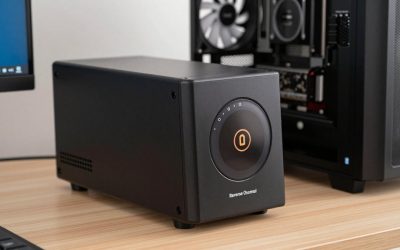
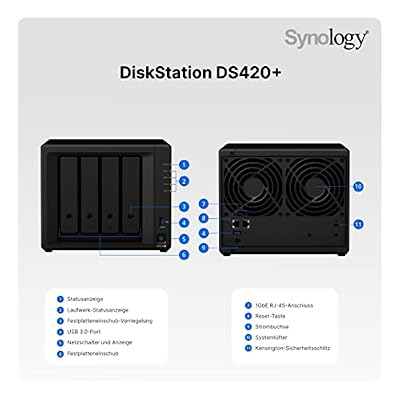
The Synology DS925+ is the 2025/2026 refresh of Synology’s popular 4-bay desktop line, and it brings two important upgrades over the DS923+: a more capable quad-core AMD Ryzen V1500B processor, and dual 2.5GbE network ports as standard. Aimed at prosumers and small businesses, it runs Synology’s DSM operating system and is a natural step up for users who outgrew gigabit networking. This bundle ships with 24TB of drives for around $1,899. This Synology DS925+ review covers the hardware, software and value.



As an Amazon Associate we earn from qualifying purchases. Product prices and availability are accurate as of the date/time indicated.
🛒 Best Price Today on Amazon
Prime members get fast, free shipping on everything above, plus member-only deals. New members get a 30-day free trial — cancel anytime.
As an Amazon Associate we earn from qualifying purchases.




Synology DS925+ at a Glance
| Component | Specification |
|---|---|
| Bay count | 4 bays (3.5″/2.5″ SATA HDD/SSD) |
| CPU | AMD Ryzen V1500B quad-core (4C/8T, 2.2 GHz) |
| RAM (default + max) | 4GB DDR4 ECC default, expandable to 32GB ECC |
| Network ports | 2x 2.5GbE RJ-45 (link aggregation supported) |
| USB ports | 2x USB 3.2 Gen 1 Type-A |
| Max raw capacity | Up to 72TB with 4x 18TB drives |
| RAID modes supported | SHR, SHR-2, JBOD, Basic, RAID 0/1/5/6/10 |
| OS / Software | Synology DSM 7.2+ (web-based) |
| Approx price | around $1,899 (bundle with 24TB drives) |
Hardware & Performance
The DS925+ is built around the AMD Ryzen V1500B — a quad-core, eight-thread processor running at 2.2 GHz, which is a meaningful step up from the dual-core R1600 in the DS923+. The V1500B is the same chip Synology uses in several of its higher-tier units, and it brings genuine multitasking capability: virtual machines, Docker containers, multiple Active Backup jobs and a busy file server can all coexist without the CPU becoming a bottleneck. ECC memory support is retained — a feature increasingly rare in this price tier and one that justifies a serious recommendation for important data. As with the DS923+, there is no integrated GPU, so Plex transcoding remains software-only and is the unit’s main weakness. For file serving, business workloads and snapshot-heavy environments, the quad-core CPU is a tangible improvement.
Storage & RAID Options
The DS925+ retains the 4 hot-swappable bays of its predecessor and supports 3.5″ and 2.5″ SATA HDDs and SSDs, with two NVMe M.2 slots for SSD caching or storage pools. Maximum raw capacity is 72TB with 4x 18TB drives. RAID options are the full Synology suite: SHR and SHR-2 for flexible mixed-size arrays with single or dual fault tolerance, plus RAID 0, 1, 5, 6 and 10. BTRFS is the recommended filesystem, bringing snapshots, self-healing and integrity checks. As a bundle this listing includes drives, but the standard DS925+ SKU ships with empty bays — typical of every Synology NAS — so do not be surprised if other listings appear cheaper because they bundle no drives.
Software & App Ecosystem
Synology DSM 7.2+ is the headline feature for many buyers. It is the most mature NAS operating system on the market, with a polished web UI, a comprehensive app ecosystem and excellent backup tooling. Synology Drive handles cloud-style file sync; Synology Photos delivers AI-organised libraries; Hyper Backup covers off-site and cloud destinations; Active Backup for Business protects Windows, Mac, Linux, VMware, Hyper-V and SaaS workloads. Container Manager and Virtual Machine Manager are supported on this unit’s quad-core CPU, with enough headroom for several lightweight VMs or numerous Docker containers — a meaningful step up from dual-core models. For comparisons against rival platforms, our best QNAP NAS roundup is a useful reference.
Networking & Throughput
The DS925+ ships with two 2.5GbE RJ-45 ports as standard — a significant upgrade over the gigabit pair on the DS923+, and one that aligns with the 2.5GbE switches now common in prosumer and small-business networks. Link-aggregated, the two ports give 5Gbps of theoretical throughput, and even a single 2.5GbE link is sufficient to saturate most spinning-rust RAID 5 arrays in sequential transfers. SMB 3.0, NFS, AFP, iSCSI and WebDAV are all supported. The unit does not have a PCIe slot for 10GbE expansion on this model — Synology’s strategy is that dual 2.5GbE is fast enough for the target buyer.
Use Cases — Plex / Backup / Files
For file serving and backup the DS925+ is excellent — the quad-core CPU and dual 2.5GbE networking remove the bottlenecks that limited the DS923+. For Plex it is still not the best choice; the lack of an integrated GPU means software transcoding only, and buyers who lead with Plex should check our best NAS for Plex Media Server guide for hardware-accelerated alternatives. For Active Backup workloads, light VM hosting and busy small-business file sharing, the DS925+ is well judged. Synology Surveillance Station runs comfortably on the quad-core CPU and is a popular use case for the unit, with up to 40 camera channels supported via add-on licences. For households running Synology Photos with large libraries the V1500B’s four cores are a noticeable improvement over the R1600 — AI indexing for facial and object recognition completes meaningfully faster, which matters once libraries pass 50,000+ photos.
Verdict
At around $1,899 the Synology DS925+ in this 24TB bundle is a sensible upgrade choice for buyers who want a polished NAS platform with modern networking. The quad-core CPU, dual 2.5GbE ports and ECC memory support make it a meaningfully better foundation than the DS923+ for multitasking and busy networks. The lack of an Intel iGPU keeps Plex transcoding off the table, but for file serving, backup, virtualisation and business workloads it is hard to fault. See our best Synology NAS guide for sibling models, or compare it with QNAP rivals in our best QNAP NAS roundup.
Buyers weighing the DS925+ against newer competitors should consider TOS-based and UGOS-based alternatives — TerraMaster and UGREEN both offer more aggressive hardware-per-dollar specifications in this price tier, though they trade ecosystem maturity for that hardware advantage. Synology’s response in 2026 has been to lean into software polish and integration: Synology C2 cloud, Active Backup ecosystem and DSM’s stability are real advantages for buyers who plan to deploy the unit and largely leave it alone for years. The DS925+ also pairs nicely with Synology’s BeeStation and BeeDrive consumer products for households that want a unified backup story. For Plex-focused households see our best NAS for Plex Media Server guide; for buyers needing more capacity than 4 bays our best NAS for small business covers larger Synology models.
Frequently Asked Questions
How is the DS925+ different from the DS923+?
Two upgrades: the DS925+ has a quad-core AMD Ryzen V1500B (vs the DS923+’s dual-core R1600), and dual 2.5GbE network ports (vs dual gigabit on the DS923+). The chassis, bays and DSM software are essentially identical.
Does the Synology DS925+ have a PCIe slot for 10GbE?
No. Unlike the DS923+, the DS925+ does not offer a PCIe 10GbE expansion option — Synology’s design choice is that the dual 2.5GbE ports satisfy the target user.
Is the DS925+ good for Plex?
It works for Plex but is not optimal. The Ryzen V1500B has no integrated GPU, so transcoding is software-only — fine for direct-play, but multiple transcoded streams will struggle. Consider a unit with an Intel iGPU if Plex is your priority.
Can the DS925+ run virtual machines?
Yes, well. The quad-core, eight-thread V1500B with up to 32GB of ECC RAM is comfortable hosting several lightweight VMs or numerous Docker containers via Container Manager.
More NAS Reviews
- Synology DS420+ Review: 4-Bay NAS with 1TB M.2 Cache + 6GB Bundle
- Synology DS224+ Review: 2-Bay NAS with 24TB Bundle (2026)
- Synology DS224+ 16TB Bundle Review: 2-Bay NAS Smaller Build
- Synology DS1520+ Review: 5-Bay 80TB Celeron 8GB NAS Bundle
- QNAP TS-873A Review: 8-Bay NAS with 2.5GbE + PCIe Gen3
- QNAP TS-1264U-RP Review: 12-Bay 1U Rackmount NAS
- TerraMaster U12-500 Plus Review: 12-Bay i7 Rackmount NAS
- UGREEN NAS DXP4800 Pro Review: 4-Bay Intel i3 NAS (2026)
Affiliate Disclosure: As an Amazon Associate, we earn from qualifying purchases. If you click a link and make a purchase, we may earn a small commission at no extra cost to you. Prices and availability are accurate as of publication and may change.
Related Articles
Looking for more on this topic? Browse the hand-picked guides below — each one applies the same scoring rubric used in this review.