

- Top Pick: NZXT H9 Flow – Dual-Chamber ATX PC Case – Black
- Best Value: NZXT H9 Flow RGB – Dual-Chamber ATX PC Case – White
- Premium Choice: NZXT H9 Flow RGB – Dual-Chamber ATX PC Case – Black
The NZXT H9 Flow (2025) is the larger, more premium sibling to the H6 Flow, offering a properly spacious dual-chamber ATX mid-tower aimed at enthusiast builds. Priced at around $120 it ships with three pre-installed fans and is engineered around a panoramic showcase view, with vertical GPU mounting support to suit modern enthusiast graphics cards. The H9 Flow is NZXT’s most accomplished dual-chamber chassis to date.
- NZXT H9 Flow 2026 at a Glance
- Design and Aesthetics
- Build Quality and Materials
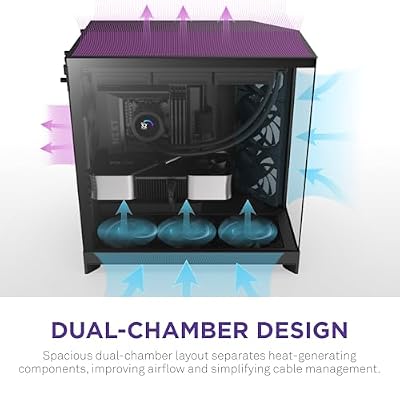
- Airflow and Cooling Layout
- Component Compatibility and Cable Management
- Who Is the NZXT H9 Flow 2026 For?
- Pros and Cons
- Is the NZXT H9 Flow 2026 Worth It?
- Frequently Asked Questions
- More PC Case Reviews
- Related Articles
- Related Articles
- Related Guides

NZXT H9 Flow - Dual-Chamber ATX PC Case - Black | Dual-chamber ATX flagship with 4 included fans, 420mm top and front radiator support, and wraparound tempered glass.




As an Amazon Associate we earn from qualifying purchases. Product prices and availability are accurate as of the date/time indicated.
🛒 Best Price Today on Amazon
Prime members get fast, free shipping on everything above, plus member-only deals. New members get a 30-day free trial — cancel anytime.
As an Amazon Associate we earn from qualifying purchases.


NZXT H9 Flow 2026 at a Glance
| Component | Specification |
|---|---|
| Form factor | Large dual-chamber ATX mid-tower |
| Motherboard support | ATX, Micro-ATX, Mini-ITX |
| Dimensions | Large dual-chamber ATX mid-tower |
| Side panel | Panoramic tempered glass |
| GPU clearance | Supports modern long graphics cards (vertical mount supported) |
| Cooler clearance | Supports tall tower air coolers and large AIO radiators |
| Pre-installed fans | 3x pre-installed fans |
| Front I/O | Standard NZXT front-panel set |
| Price | Around $120 |
Design and Aesthetics
The H9 Flow is the more confident, larger statement in NZXT’s current dual-chamber line. Where the H6 condenses the layout into a compact footprint, the H9 gives the design room to breathe, with a generous interior, panoramic glass and proportions that feel properly enthusiast-grade. NZXT’s measured visual language carries through, so the case looks expensive without resorting to ornamentation.
The 2025 update keeps the H9 Flow firmly modern, and the dual-chamber separation of the motherboard area from PSU and storage gives the showcase side an unusually clean appearance. With three pre-installed fans on display through the panoramic glass, the case has a clear visual signature when running. For buyers who want a premium-feeling chassis from a trusted brand, the H9 Flow looks comfortably the part.
Build Quality and Materials
NZXT builds the H9 Flow from steel and panoramic tempered glass, with the larger dual-chamber layout requiring more material and more careful engineering than a standard mid-tower. The chassis is rigid, the glass is well mounted and the construction generally feels premium in handling. NZXT has clearly invested in the build, and at the H9’s price tier the result earns the position.
Detail-level work — internal panel removal mechanisms, dust filtration, cable cutouts and screw quality — is consistent with NZXT’s higher-end reputation. The H9 Flow is the kind of chassis where buyers do not need to scrutinise small details to feel that the case has been engineered properly. It is one of the more polished dual-chamber cases at this point in the market and a clear step above the mainstream tier.
Airflow and Cooling Layout
The Flow designation again carries weight. The H9 Flow is engineered around proper airflow paths despite its panoramic glass — the dual-chamber layout helps separate PSU and storage thermals from the main showcase chamber, and three pre-installed fans handle the principal cooling work out of the box. Radiator support is generous, with the case accepting substantial AIO units to suit enthusiast Ryzen and Intel hardware.
The large interior offers thermal headroom that compact dual-chamber cases simply cannot match. Builders pushing high-end CPUs and GPUs benefit directly from the additional volume and the engineered airflow paths. For buyers who want a premium showcase chassis and refuse to compromise on thermals, the H9 Flow is one of the more credible answers — it manages to make the dual-chamber format genuinely cooling-friendly rather than purely visual.
Component Compatibility and Cable Management
The case accepts ATX, Micro-ATX and Mini-ITX motherboards within its large dual-chamber footprint and supports vertical GPU mounting, which is increasingly important as enthusiast graphics cards have grown in size and visual presence. AIO radiator and tower cooler clearance is generous, and PSU placement in the secondary chamber removes the messiest cable runs from the showcase area entirely.
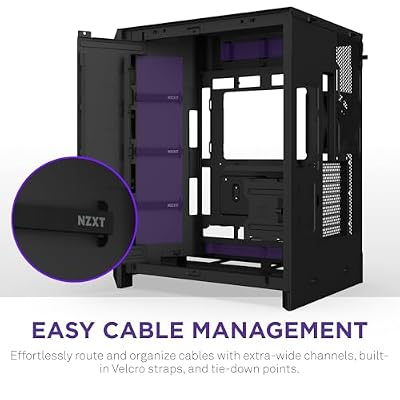
Cable management is the dual-chamber layout’s quiet advantage, and the H9 Flow exploits it well. With the PSU and storage in a separate chamber, the showcase side of the build can be exceptionally clean even on a moderate cable-management effort. Combined with generous routing space behind the motherboard tray, the H9 Flow makes a properly tidy enthusiast build straightforward to achieve. It is a forgiving chassis for first-time premium builders.
Who Is the NZXT H9 Flow 2026 For?
The H9 Flow 2025 is for the buyer building a premium ATX system where the chassis is part of the experience, not merely a container. It suits enthusiast Ryzen or Intel builds with high-end graphics cards, particularly those that benefit from vertical GPU mounting, and the dual-chamber layout makes managing high-end hardware visually clean. Around $120 buys an NZXT chassis with proper enthusiast credentials.
It is less suited to buyers focused purely on cooling per dollar — a conventional high-airflow mid-tower will produce similar thermals for less money. But for buyers who want the dual-chamber showcase experience from a trusted brand with proper build quality, the H9 Flow 2025 is one of the most attractive options on the market and is unusually well rounded for its tier.
Pros and Cons
Pros: Large premium dual-chamber layout; three pre-installed fans; panoramic tempered glass; vertical GPU mount support; spacious interior for enthusiast hardware; trusted NZXT build quality.
Cons: Premium price; larger footprint than mainstream mid-towers; dual-chamber adds slight build complexity; not the cheapest cooling-per-dollar option.
Is the NZXT H9 Flow 2026 Worth It?
At around $120 the NZXT H9 Flow 2025 is one of the more complete premium dual-chamber cases on the market. The combination of large interior, three pre-installed fans, panoramic glass, vertical GPU mounting and NZXT’s build standards adds up to a chassis that feels comfortably at home with high-end Ryzen or Intel hardware. For buyers ready to invest in a premium chassis, it is one of the easier mainstream-premium recommendations.
Buyers who do not want a dual-chamber layout or who would prefer a smaller footprint should look elsewhere in NZXT’s range. But for the enthusiast specifically attracted to the dual-chamber showcase aesthetic, the H9 Flow 2025 earns a strong recommendation.
Frequently Asked Questions
Does the NZXT H9 Flow 2026 support vertical GPU mounting?
Yes. The H9 Flow 2025 supports vertical GPU mounting, which is increasingly important as enthusiast graphics cards have grown in size and visual presence.
How many fans come pre-installed?
Three fans are pre-installed in the H9 Flow 2025, providing a strong cooling baseline straight out of the box.
How does the H9 Flow differ from the H6 Flow?
The H9 Flow is a larger, more premium dual-chamber chassis with more interior volume and vertical GPU mount support, while the H6 Flow is a more compact dual-chamber design.
Is the H9 Flow 2026 a good case for high-end builds?
Yes. The large interior, generous radiator support and dual-chamber layout make it well suited to high-end enthusiast Ryzen or Intel builds.
More PC Case Reviews
- Fractal Design North Chalk White Case Review (Oak Wood Front)
- ASUS TUF Gaming GT502 Horizon ATX Case Review
- Cooler Master MasterBox Q300L Micro-ATX Case Review
- ASUS A31 ATX Mid-Tower Case Review (BTF Hidden Connectors)
- MONTECH XR-B ATX Mid-Tower Case Review
- NZXT H5 Flow 2026 Compact ATX Case Review
- NZXT H6 Flow Dual-Chamber ATX Case Review (White)
- Corsair 4000D RS ARGB Frame Modular ATX Case Review
Affiliate Disclosure: As an Amazon Associate, we earn from qualifying purchases. If you click a link and make a purchase, we may earn a small commission at no extra cost to you. Prices and availability are accurate as of publication and may change.
Related Articles
Looking for more on this topic? Browse the hand-picked guides below — each one applies the same scoring rubric used in this review.










