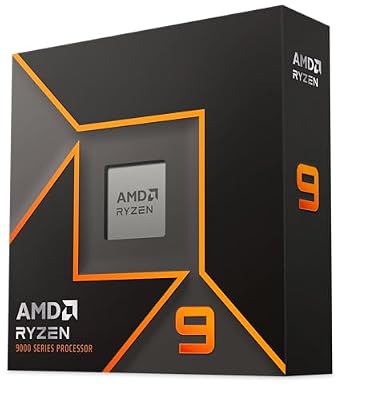
Ryzen 9900X3D vs 9950X3D Comparison for Gaming and Work
The Ryzen 9900X3D and the Ryzen 9950X3D sit side by side in AMD’s product lineup, and they share the most important feature of the family: a large stacked cache sitting on one of their two core chiplets. Both chips are built for players who want strong gaming performance without giving up serious multi-core capability. The difference between them is the number of cores, the size of the cache-equipped chiplet and the price you pay for each step up.
This guide compares the two chips on design and buying logic. It does not publish frame-rate charts or benchmark scores, because those depend on the game, the graphics card, memory and the Windows build. Treat the explanation below as a framework for reading current reviews, and confirm the exact model, price and stock status on the listing card before you buy.
The listing below is the primary pick for this comparison, and the alternatives are nearby options in the same AM5 product space. The listing above may not match the exact model you had in mind, so check the card for the precise model and price.

AMD Ryzen 9 9900X3D 12-Core Processor

AMD Ryzen 9 9950X3D 16-Core Processor
AMD Ryzen™ 7 9850X3D Desktop Processor

How the Two Chips Are Built
Both processors use two core chiplets, often called CCDs. On the 9900X3D, each chiplet holds six cores. On the 9950X3D, each chiplet holds eight. In both chips, only one of the two chiplets carries the extra 3D V-Cache, while the other chiplet uses standard cache. That layout is the single most important detail for buyers, because it means the cache benefit does not apply evenly to every core on the processor.
Why Only One Chiplet Has the Extra Cache
Stacking cache on a chiplet adds capacity and helps latency-sensitive workloads, including many games. Putting cache on only one chiplet keeps the design practical in terms of heat, cost and clock behavior. The trade-off is that games need to run on the cache-equipped chiplet to get the full benefit. AMD’s chipset driver includes scheduling support that aims to steer game threads to that chiplet, and the operating system and any game launcher can also influence where threads land. Community reports describe occasional games landing on the wrong chiplet, so keep your chipset driver current and check the Windows Game Bar and power settings if you see inconsistent results.
What the Extra Two Cores Change
The 9950X3D’s sixteen cores, split across two eight-core chiplets, give it more room for heavy multi-threaded work. Rendering, compiling, encoding and simulation tasks scale well with more cores, and the 9950X3D has a clear advantage in those jobs over a twelve-core chip. The 9900X3D’s twelve cores are still plenty for most gamers, and for players whose main concern is gaming, the difference in day-to-day gaming can be small. Whether the extra cores matter depends on how much work you run beside the game.
AMD Ryzen 9 9900X3D 12-Core Processor


As an Amazon Associate we earn from qualifying purchases. Product prices and availability are accurate as of the date/time indicated.
Comparison Table: 9900X3D and 9950X3D
The table compares the two chips on the factors that matter when you choose between them. Prices are left as guidance because they change and vary by retailer.
| Factor | Ryzen 9 9900X3D | Ryzen 9 9950X3D |
|---|---|---|
| Core layout | 12 cores across two 6-core chiplets | 16 cores across two 8-core chiplets |
| Cache design | 3D V-Cache on one chiplet | 3D V-Cache on one chiplet |
| Best for | Gamers who also run moderate multi-core work | Gamers who run heavy rendering or compiling |
| Typical price range | Check current price | Check current price |
| Main trade-off | Fewer cores for the heaviest jobs | Higher cost and more power for the same cache design |
The table makes one point clear. Both chips share the same cache strategy, so the decision comes down to core count, budget and how often you run heavy non-gaming work. A player who mainly wants the best gaming experience may not need the extra cores, while a creator who games in the evening will feel the difference during the working day.
Choosing the Right Chip for Your Use
When the 9900X3D Is the Smarter Buy
The 9900X3D makes sense when gaming is the main job and multi-core work is occasional. Its twelve cores handle background apps, streaming overlays and a few parallel tasks without much fuss. Because the cache-equipped chiplet is smaller, the chip may suit a builder who wants strong gaming behavior while keeping the budget tighter than a flagship purchase allows. Pair it with a graphics card that matches your resolution, since the card often sets the frame rate in demanding titles.
When the 9950X3D Earns Its Price
The 9950X3D makes sense when your workload is split between gaming and serious production. Video editing, 3D rendering, software builds and large simulation jobs all scale with core count. If you are paying for the chip to finish work faster, the extra cores carry real value. If you are paying mainly for gaming, the premium is harder to justify, and you may get more benefit from spending the difference on the graphics card or on a larger, faster memory kit.
Platform and Cooling Considerations
Both chips use the AM5 platform, so a single motherboard choice works for either one. Pick a board with solid power delivery, especially for the 9950X3D, because its higher core count draws more power in sustained loads. An AM5 motherboard guide, such as the best AM5 motherboard for gaming, helps narrow the field. For the 9950X3D in particular, the X870 motherboard guide for the 9950X3D covers boards suited to that chip. Cooling needs are moderate for gaming, but a long render session benefits from a strong cooler. The AIO cooler guide for Ryzen 9 covers the options most builders consider.
Where These Chips Sit Against the Competition
Both chips are part of a wider decision that includes Intel’s current high-end options. The Ryzen 9 9950X versus Core Ultra 9 285K comparison shows how a non-X3D high-core chip stacks up against Intel’s flagship, which helps clarify what the cache design is worth. The Ryzen 9 9950X3D review and the Ryzen 9 9900X review give more context on each chip’s place in the range. For a single-chip gaming recommendation that stays simpler, the Ryzen 7 9800X3D review covers the eight-core X3D option.
AMD Ryzen 9 9950X3D 16-Core Processor

As an Amazon Associate we earn from qualifying purchases. Product prices and availability are accurate as of the date/time indicated.
Frequently Asked Questions
Is the 9950X3D faster than the 9900X3D in games?
Not always by a large margin. Many games depend on the cache-equipped chiplet and on a few main threads, so the two chips can perform closely in gaming. The 9950X3D’s advantage tends to show in heavy multi-threaded work. Check current game reviews for your titles.
Do both chips need a special motherboard?
Both use AM5, so any compatible AM5 board works. For the 9950X3D, a board with strong power delivery is a sensible choice because the chip draws more power under sustained load.
Why does the cache only sit on one chiplet?
Placing the extra cache on one chiplet is a design choice that balances cost, heat and performance. Games that run on that chiplet gain the cache benefit, and the scheduler and chipset driver aim to keep game threads there. Keeping the chipset driver current helps.
Which one should a streamer choose?
A streamer who runs encoding on the CPU may value the 9950X3D’s extra cores. A streamer who encodes on the graphics card often finds the 9900X3D enough. Check how your encoder is set up before deciding.
Final Verdict
The Ryzen 9900X3D is the better fit for a gaming-first build that needs some extra multi-core headroom without the top-tier cost. The Ryzen 9950X3D is the better fit for a builder who games and produces heavy workloads on the same machine. Both share the same cache strategy, so neither is the wrong choice for gaming. Confirm the exact model, socket and price on the card above, and choose based on how much of your week is spent on work rather than play.