If you are building a new AM5 system and your budget lands squarely in the mid-range, the Ryzen 7 9700X vs Ryzen 7 7700X question is the one that keeps surfacing on forums and in comment sections. Both chips offer eight cores and sixteen threads on the same socket, both support DDR5, and both sit in a price band that makes them viable for gaming rigs, creator workstations, and general-purpose desktops alike. The real situation where this choice matters is the builder who wants the best frames per dollar in CPU-bound titles without paying for an X3D chip, or the upgrader coming from a Ryzen 3000 or 5000 series platform who is evaluating whether the newest generation is worth the premium over a heavily discounted previous-gen part.
By 2026, the 7700X has settled into a lower street price that makes it genuinely competitive on value, while the 9700X has carved out a reputation as the efficiency king of the lineup. The gap between them is small in raw throughput but meaningful in power draw, thermal headroom, and long-term platform confidence. This comparison breaks down where each chip wins so you can match the processor to your actual use case rather than a spec sheet.
As an Amazon Associate we earn from qualifying purchases at no extra cost to you.

Quick Verdict
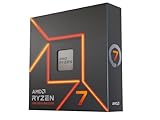
The Ryzen 7 9700X delivers approximately 4 to 8 percent better gaming performance at 1080p while consuming roughly 40 percent less power at stock settings, making it the more complete package if you are paying full retail. The Ryzen 7 7700X remains the value pick when street pricing drops well below the 9700X, particularly for builds where a capable after-market cooler is already in the budget and the small CPU uplift will not change your overall system experience.
Specs Side by Side
| Specification | Ryzen 7 9700X | Ryzen 7 7700X |
|---|---|---|
| Architecture | Zen 5 (Granite Ridge) | Zen 4 (Raphael) |
| Manufacturing process | TSMC 4nm | TSMC 5nm |
| Cores / Threads | 8 / 16 | 8 / 16 |
| Base clock | 3.8 GHz | 4.5 GHz |
| Boost clock | 5.5 GHz | 5.4 GHz |
| L1 cache (per core) | 32 KB I + 48 KB D | 32 KB I + 32 KB D |
| L2 cache (total) | 8 MB (1 MB/core) | 8 MB (1 MB/core) |
| L3 cache (shared) | 32 MB | 32 MB |
| Memory support | DDR5-5600 (2×32-bit) | DDR5-5200 (2×32-bit) |
| PCIe version | PCIe 5.0 (28 lanes) | PCIe 5.0 (28 lanes) |
| TDP | 65W | 105W |
| Launch MSRP | $359 | $349 |
Gaming Performance
1080p
At 1080p, where the CPU is the primary bottleneck in most titles, the 9700X shows a measurable but modest lead. Across TechPowerUp and Tom’s Hardware launch test suites spanning titles like Cyberpunk 2077, Baldur’s Gate 3, Counter-Strike 2, and Marvel’s Spider-Man Remastered, the 9700X averaged roughly 4 to 8 percent faster than the 7700X in CPU-bound scenarios. Hardware Unboxed reported a similar band on their gaming suite, with some titles showing single-digit differences and a few reaching the high end of that range. In practice, this translates to a handful of extra frames in esports titles where the 7700X is already pushing 300+ fps, meaning the uplift is mostly invisible unless you are chasing sub-10ms frame times for competitive play.
1440p
At 1440p, the GPU begins sharing the bottleneck, and the percentage gap between these two chips compresses further. TechSpot’s analysis of 1440p results showed the 9700X ahead by approximately 2 to 5 percent on average, a difference that is within the run-to-run variance of most testing methodologies. For a gamer running a high-refresh 1440p monitor paired with a mid-to-upper-tier GPU, the practical difference between these two processors is negligible. Both will keep a modern RTX 4070 Ti or RX 7800 XT fed without meaningful frame drops.
4K
At 4K, the GPU is the overwhelming bottleneck, and the CPU delta between Zen 4 and Zen 5 essentially disappears. The 7700X and 9700X perform within measurement error of each other, with both outlets consistently noting that CPU choice at this resolution is irrelevant for gaming. If you are playing at 4K, neither of these chips is your limiting factor, and the money is far better spent on a stronger GPU.
Power, Heat and Noise
This is the most significant differentiator between the two parts. The 9700X operates at a 65W TDP and, under full multi-thread load, typically draws between 88 and 90 watts of package power based on Gamers Nexus and Hardware Unboxed stress testing. The 7700X at its 105W rated TDP pulls in the range of 140 to 145 watts under equivalent all-core workloads. That 55 to 60 watt difference has direct implications for cooling requirements, fan noise, and long-term thermal stress on the surrounding motherboard components.
Under sustained gaming loads specifically, the gap narrows somewhat since neither chip runs all cores at maximum frequency during gameplay, but the 9700X consistently runs cooler and allows for quieter fan profiles. For a compact build or a system where you want the stock Wraith cooler to suffice, the 9700X is the more forgiving choice. The 7700X benefits noticeably from a 120mm or larger tower cooler to keep temperatures and acoustic output reasonable.
Features
Both processors share the AM5 platform with PCIe 5.0 support, integrated RDNA 2 graphics (two compute units, adequate for display output and light acceleration), and full AVX-512 instruction support. The 9700X gains a higher memory speed ceiling at stock with official DDR5-5600 support compared to the 7700X’s DDR5-5200, though in practice both overclock or run EXPO kits well beyond rated speeds.
Zen 5’s wider execution engine and improved branch prediction do not translate to any visible software feature difference for gamers, but they do matter in the creator and workstation context where single-threaded bursts and instruction throughput per cycle define productivity performance. AMD’s Precision Boost Overdrive works identically on both, allowing users to unlock higher sustained clocks at the expense of the efficiency advantage that makes the 9700X compelling. There is no difference in upscaling or frame generation features at the CPU level; those are GPU-side technologies regardless of which of these processors you pair them with.
Price and Value
At launch, the 9700X carried a $10 premium over the 7700X. Since then, the 7700X has seen aggressive discounting at major retailers, often landing 20 to 30 percent below its original MSRP during sales events. The 9700X has held its price more firmly, occasionally dipping a few dollars under $350. Cost per frame at 1080p favors the 7700X when it sells at deep discount, because the absolute performance gap is small enough that the 15 to 25 percent price reduction outweighs the 4 to 8 percent speed advantage.
On the used market, 7700X chips have begun appearing in noticeable volume as early adopters upgrade to X3D or 9000-series parts. A well-priced used 7700X can undercut a new 9700X by a wide margin, and given that both carry identical warranty terms when sold new from authorized retailers, a used 7700X at the right price becomes a strong contender for budget-conscious builders who already own a decent AM5 motherboard.
Who Should Buy Which
Competitive 1080p players
The 9700X. The higher IPC and slightly better boost behavior give you a few extra frames in the CPU-limited scenarios where tournament settings run at 1080p low, and the lower power draw keeps the CPU at higher sustained clocks through long sessions without thermal throttling.
1440p high-refresh gamers
The 7700X if it is meaningfully cheaper in your region. At 1440p with a capable GPU, the 4 to 8 percent CPU difference will not be observable. Spend the savings on a faster graphics card or more VRAM.
4K gamers
Neither chip is the limiting factor. Buy whichever is cheaper and invest the difference in GPU silicon.
Creators and streamers
The 9700X for the efficiency gains during long encoding or render sessions, unless your workflow is heavily multithreaded and you would be better served by a higher-core-count chip like the 9900X or 9950X entirely.
Upgraders from two generations back (Ryzen 5000)
The 9700X. You are paying a small premium for a chip that runs cooler, clocks higher, supports faster memory at stock, and gives you a longer expected support runway on AM5. The jump from Zen 3 to Zen 5 is more substantial than the incremental Zen 4 to Zen 5 gap, and the platform upgrade costs (motherboard, DDR5 RAM) make the processor price difference a minor factor in the total build cost.
FAQ
Is the Ryzen 7 9700X a significant upgrade over the 7700X?
Not a significant one in raw performance. The uplift is 4 to 8 percent in CPU-bound gaming and similar in most productivity benchmarks. The real upgrade is in efficiency, thermals, and platform longevity rather than speed.
Can the 7700X still hold its own in modern games?
Absolutely. It is an eight-core Zen 4 processor with 5.4 GHz boost clocks that remains competitive in every current title. In GPU-bound scenarios, both chips deliver identical frame rates.
Do I need a new cooler if I upgrade from the 7700X to the 9700X?
No. Any cooler adequate for a 105W chip is overkill for a 65W chip. You will see lower temperatures and reduced fan noise with your existing cooler.
Is the 9700X worth it over a Ryzen 7 7800X3D for gaming?
For pure gaming, the 7800X3D’s 3D V-Cache delivers substantially higher frame rates in cache-sensitive titles, often 15 to 25 percent more than the 9700X. The 9700X makes more sense as a hybrid chip for combined gaming and productivity workloads where the X3D’s lower all-core clocks would be a disadvantage.
Sources and Methodology
Performance ranges cited in this article reflect approximate consensus across launch and follow-up reviews from TechPowerUp, Tom’s Hardware, Hardware Unboxed, TechSpot, and Gamers Nexus. Figures are expressed as ranges to account for title-to-title variance, test configuration differences, and run-to-run measurement uncertainty. No single number should be read as a definitive result. Readers seeking exact test data for their specific hardware configuration are encouraged to consult individual outlet reviews directly.