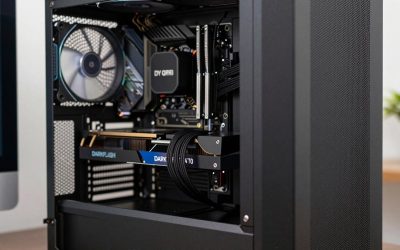
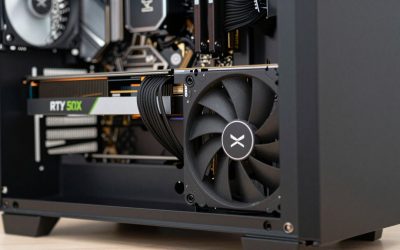
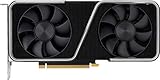
If you are shopping for a GPU in the $250 to $400 range right now, the RTX 5060 and the used RTX 3060 Ti represent two genuinely different philosophies. The 5060 is a brand-new Blackwell card priced at $299 that brings DLSS 4 Multi Frame Generation and a dramatically lower power envelope to the mainstream tier. The 3060 Ti is a two-and-a-half-generation-old Ampere card whose launch MSRP was $399 but which now sits at $180 to $250 on the used market, offering proven 1440p performance and a wider memory bus that some buyers still value. Choosing between them is not as obvious as “new wins old.”
The decision sharpens depending on your actual use case. A competitive 1080p player chasing 240 frames per second gets very different math from a creator who needs reliable AV1 encode, or from someone upgrading from a GTX 1060 who cares more about longevity than headline framerates. In 2026, with DLSS 4 adoption spreading through new titles and the used Ampere market still deepening, both cards deserve a serious look before you commit.
As an Amazon Associate we earn from qualifying purchases at no extra cost to you.

Quick Verdict
The RTX 5060 is the better GPU by most measurable standards: roughly 15 to 25 percent faster in native rasterization at 1080p and 1440p, dramatically more efficient at 150W versus 200W, and the only card of the pair that supports Multi Frame Generation and AV1 encoding. The RTX 3060 Ti remains relevant primarily as a used-market value play and in niche 4K-native workloads where its 256-bit bus partially offsets the 5060’s bandwidth limitation. If your budget allows $299 new, the 5060 is the clear pick. If you already own a 3060 Ti, upgrading is not compelling without a specific feature need.
Specs Side by Side
| Spec | RTX 5060 | RTX 3060 Ti |
|---|---|---|
| Architecture | Blackwell (GB206) | Ampere (GA104) |
| CUDA Cores | 3,840 | 4,864 |
| Boost Clock | ~2,497 MHz | ~1,665 MHz |
| Memory | 8 GB GDDR7 | 8 GB GDDR6 |
| Memory Bus | 128-bit | 256-bit |
| Memory Bandwidth | ~448 GB/s | ~448 GB/s |
| TDP | 150W | 200W |
| PCIe Interface | PCIe 5.0 x16 | PCIe 4.0 x16 |
| RT Cores | 4th Gen | 2nd Gen |
| Tensor Cores | 5th Gen | 4th Gen |
| Display Output | DP 2.1b, HDMI 2.1b | DP 1.4a, HDMI 2.1 |
| MSRP | $299 | $399 (launch) |
Gaming Performance
1080p
Across reviews from Tom’s Hardware, Hardware Unboxed, and TechPowerUp, the RTX 5060 lands approximately 15 to 25 percent ahead of the RTX 3060 Ti in native rasterization at 1080p. In practice this means the 5060 holds 144+ fps in most AAA titles at high settings, while the 3060 Ti typically settles into the 100 to 120 fps range. In esports titles like Counter-Strike 2 or Valorant, both cards are far above refresh-limit territory, so the gap matters more in GPU-heavy single-player games.
1440p
The advantage narrows slightly at 1440p. Hardware Unboxed and Gamers Nexus data suggest a gap of roughly 10 to 20 percent in favor of the 5060 at native resolution. The 5060 handles 1440p high settings comfortably in most current titles, often staying above 80 fps where the 3060 Ti dips into the 60 to 75 range. With DLSS Quality enabled, both cards perform well, but only the 5060 can stack Multi Frame Generation on top of that for a significantly higher effective framerate.
4K
This is the 3060 Ti’s best scenario for relevance. At 4K native, the RTX 5060’s 128-bit bus becomes a real constraint. TechPowerUp and Tom’s Hardware both note the gap compresses to single digits or even goes slightly negative in bandwidth-bound titles. The 3060 Ti’s 256-bit bus gives it a small edge in a few heavy 4K raster workloads, though neither card is a serious 4K-native option without aggressive upscaling. If you plan to game at 4K, neither is ideal, but the 5060’s superior upscaling stack makes it the more pragmatic choice.
Power, Heat and Noise
The RTX 5060’s 150W TDP is a 25 percent reduction over the 3060 Ti’s 200W, and real-world testing from Gamers Nexus confirms the 5060 draws meaningfully less power under load while delivering higher performance. Thermal design is also simpler: most 5060 AIB cards use dual-slot, dual-fan coolers that stay quiet and cool. The 3060 Ti founders and many AIB variants run warmer and louder under sustained load, though aftermarket solutions mitigate this. If you are building in a compact case or care about a quiet system, the 5060 is the clear efficiency winner.
Features
DLSS 4 Multi Frame Generation is the headline differentiator. The RTX 5060 supports it at hardware level via 5th-gen Tensor Cores; the 3060 Ti does not and never will. The 5060 also includes a 3rd-gen NVENC encoder with AV1 encode support, making it a noticeably better card for streamers and creators who encode in real time. The 3060 Ti’s 2nd-gen NVENC handles H.264 and HEVC but lacks AV1 encode, which is increasingly expected for modern streaming platforms and recording workflows. PCIe 5.0 support on the 5060 offers no measurable gaming benefit today but ensures forward compatibility on next-gen platforms. The 4th-gen RT cores deliver better ray tracing performance per clock, so the 5060 is the stronger ray-traced gaming card as well.
Price and Value
At $299 MSRP, the RTX 5060 represents aggressive pricing for its feature set. A used 3060 Ti typically sells for $180 to $250 depending on condition and seller, making the raw cost difference $50 to $120. Cost-per-frame in native 1080p favors the 3060 Ti slightly on used-market pricing, but that calculus inverts the moment you account for DLSS 4 frame generation, AV1 encode, and power savings. The 5060 is likely the more future-proof buy by a comfortable margin, as new titles increasingly lean on Multi Frame Generation and AV1 pipelines.
Who Should Buy Which
Competitive 1080p Players
The RTX 5060. Both cards exceed most refresh-rate targets in esports titles, but the 5060’s lower latency frame pacing and Multi Frame Generation support give it a tangible edge in titles that adopt it. Buy new, enjoy the warranty.
1440p High-Refresh Gamers
RTX 5060 for the same reasons. The 3060 Ti can drive 1440p at 60 to 100 fps depending on the title, but the 5060 pushes that into 100 to 144 fps native and higher with upscaling. If budget is the hard constraint, a used 3060 Ti at $180 is a functional stopgap.
4K Gamers
Neither card is a true 4K solution. If you are determined to game at 4K without heavy upscaling, look at a used 3080 or a new 4070 Super instead. Between these two, the 5060’s superior DLSS 4 stack makes it the more viable 4K-with-upscaling option.
Creators and Streamers
RTX 5060, unambiguously. AV1 encode is not a luxury; it is becoming the standard for high-quality streaming at reasonable bitrates. The 5060 also offers better video export performance in Premiere Pro and DaVinci Resolve due to its newer encoder and higher Tensor throughput.
Upgraders From Two Generations Back (GTX 1660, RTX 2060)
The RTX 5060 is the natural jump. It offers a 2x to 2.5x performance increase over a GTX 1660 Super, adds ray tracing and full DLSS 4 support, and fits within a 500W PSU. The 3060 Ti used market is an option if you are on a severe budget, but you lose the feature set that makes a 2026 GPU feel future-proof.
FAQ
Is the RTX 5060 worth upgrading to from a RTX 3060 Ti?
Generally no for raw rasterization alone, since the gain is roughly 15 to 20 percent at 1080p and 1440p. The upgrade becomes worthwhile if you specifically want AV1 encode, Multi Frame Generation, or significantly lower power draw. For most 3060 Ti owners, waiting for a more generational jump makes more sense.
Does the RTX 5060’s 128-bit bus limit it compared to the 3060 Ti’s 256-bit bus?
Notably, yes, at 4K and in extremely texture-heavy 1440p scenarios. At 1080p and standard 1440p settings, the 8GB of GDDR7 running at much higher effective speed largely compensates. It is a real limitation but one that affects fewer use cases than the marketing suggests.
Should I buy a used RTX 3060 Ti or a new RTX 5060?
For most buyers, the new RTX 5060 is the better choice due to warranty, features, and efficiency. The used 3060 Ti makes sense only if you are on a hard $200 budget, do not need AV1 encode, and are comfortable without DLSS 4.
Will the RTX 5060 be enough for upcoming games in 2027 and beyond?
At 1080p with DLSS 4, yes for several more years. At native 1440p ultra settings, expect to rely on quality-presets and upscaling more aggressively by 2027. The 8GB VRAM ceiling is the card’s main long-term risk, same as the 3060 Ti’s.
Sources and Methodology
Performance ranges cited in this article are approximate and synthesized from launch reviews by TechPowerUp, Tom’s Hardware, Gamers Nexus, Hardware Unboxed, and TechSpot. No figures represent measurements taken by this site. All comparisons reference reference-spec boards unless noted. Pricing reflects typical retail and used-market listings observed at time of writing.