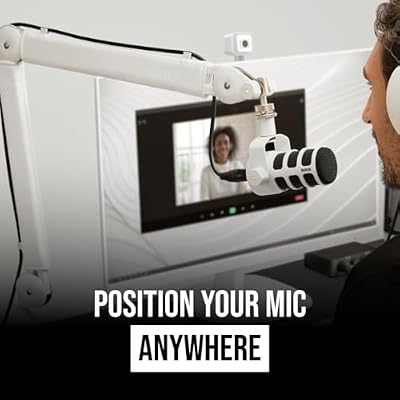
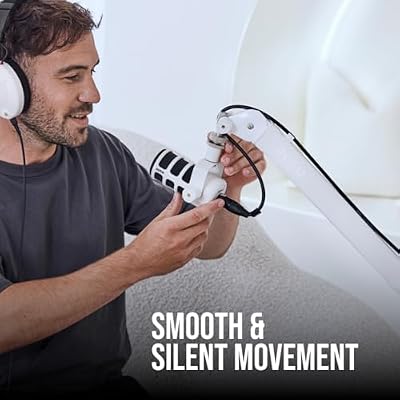
The RØDE PSA1 Professional Studio Arm is the original — the spring boom that defined the modern streaming-arm category and has been on broadcast and streaming desks for over a decade. It uses a sprung two-section design with concealed spring chambers, a heavy steel desk clamp, broad mic compatibility and hidden cable routing through the arm tubes. The newer PSA1+ adds internal damping at every pivot for silent operation, but the original PSA1 remains a legitimate option at a meaningfully lower price. At around $130 it is the value alternative to the PSA1+. This RØDE PSA1 review covers the specifications, build, reach, mic compatibility and value.

RØDE PSA1+ Professional Studio Boom Arm with Spring Damping, White | Management (White)




As an Amazon Associate we earn from qualifying purchases. Product prices and availability are accurate as of the date/time indicated.
🛒 Best Price Today on Amazon
Prime members get fast, free shipping on everything above, plus member-only deals. New members get a 30-day free trial — cancel anytime.
As an Amazon Associate we earn from qualifying purchases.




RØDE PSA1 at a Glance
| Specification | Detail |
|---|---|
| Arm type | Professional spring boom (no damping at joints) |
| Load capacity | Approximately 2.4 lb, suitable for most streaming and broadcast mics |
| Mic compatibility | Universal via 5/8-inch and 3/8-inch threaded screws; ships with both adapters |
| Mount type | Desk clamp (included) plus optional desk-thread mount; desk lip up to about 2.2 inches |
| Reach | Horizontal extension around 32.5 inches; vertical reach around 33 inches |
| Cable management | Hidden cable channels routed through the inside of the arm tubes |
| Construction | All-metal arm sections and pivot joints with matte black broadcast finish |
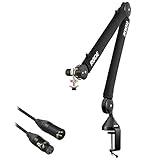
| Included accessories | Desk clamp, desk insert, 3/8-inch and 5/8-inch adapters |
| Approx price | Around $130 |
Build Quality & Materials
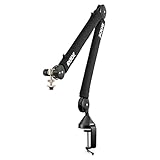
The original PSA1 is built to the same broadcast-grade standard that has kept it on professional desks for over a decade. The arm sections are metal tubes with the springs concealed inside, the pivot joints are metal-on-metal with adequate friction, and the matte black finish is consistent and durable. The desk clamp is heavy steel and shares the substantial feel of the newer PSA1+, the joints have no slack or rattle, and the assembly has the broadcast-tool feel that has defined the design.
What the PSA1 lacks — and what the PSA1+ added — is internal damping at the joints. The original relies purely on spring tension and joint friction to hold position. That works well, but it does produce the characteristic creak of a spring boom when adjusted quickly. The original PSA1 is not loud during adjustment, but it is not silent like the PSA1+. For buyers who do not adjust the mic mid-stream, this distinction matters less; for buyers who do, the PSA1+ is worth the upgrade. The original PSA1 still represents excellent broadcast-grade engineering at a meaningfully lower price.
Reach & Adjustability
Reach is the same as the PSA1+ — roughly 32.5 inches horizontal and 33 inches vertical — which is at the top of this guide. The arm folds back to the clamp when not in use and extends to position the mic comfortably in front of the speaker. For broadcasters and streamers who require the mic in a precise position relative to the speaker’s mouth and the camera framing, the generous reach gives the flexibility to find the right spot.
Adjustability is via the sprung two-section design with metal-on-metal pivot friction. Position the mic and the friction at the joints, combined with the spring tension, holds it. Motion is smooth and confident, but the lack of damping means a quick adjustment will produce a faint spring creak that a sensitive microphone may pick up. Adjust between takes rather than mid-take and the design works well. For ten years it has been the reference broadcast spring boom, and the design remains valid.
Cable Management
Cable management is fully internal, identical in principle to the PSA1+. The mic cable enters the tube at the mic-end pivot, runs through the arm tubes, and exits at the clamp end behind the desk. There are no visible external wraps or clips along the arms. From any normal camera angle the cable does not appear, which is the broadcast-clean appearance the PSA1 has delivered for over a decade.
Threading the cable during install adds a few minutes but the result is worth the time. Feed the cable through the upper arm section before connecting the mic, leave a small amount of slack at each pivot, and route the exit at the clamp end neatly down behind the desk. Combined with a tidy desk from our best gaming desks guide, the original PSA1 still delivers the streaming-corner look that defined the category. The visual result is essentially indistinguishable from the PSA1+.
Mic Compatibility — Blue Yeti / HyperX / Shure
Up to its roughly 2.4 lb rating, the PSA1 carries the bulk of streaming and broadcast mics. The HyperX QuadCast and SoloCast, the Shure MV7 family, the Rode NT1 family, the Rode Procaster and Podmic, and most lighter XLR dynamics are all within the load envelope. For the Shure SM7B with its native yoke the rating is at the edge; verify the SM7B’s specific weight before purchase. For the Blue Yeti at roughly 3.4 lb assembled the rating is below — the PSA1 will hold a Blue Yeti at restricted positions, but the springs will be at the upper limit and full extension is not advised.
With the supplied 5/8-inch and 3/8-inch threaded screws mic mounting is universal. For most users the PSA1 is more than enough arm for the mic they own. See our best streaming microphones guide for streaming mics in the PSA1’s load envelope, our best XLR microphones guide for the broadcast options it pairs naturally with, and our best audio interfaces guide for the audio interface to complete the signal chain.
Installation & Setup
Installation is identical to the PSA1+. The heavy steel desk clamp slides under the back edge of the desk and tightens with a bolt; the clamp fits desks with a lip up to about 2.2 inches, which covers most gaming and office desks. RØDE supplies a desk-thread insert option for permanent installations through a through-desk mounting hole. Total setup time is about twenty minutes including cable routing.
Thread the cable through the arm tubes before fitting the upper section, leaving slack at the pivots so the cable is not stressed when the arm articulates. The PSA1 has been in continuous production for over a decade and the installation instructions are well refined; even first-time users have no trouble with the setup. Re-check the clamp after the first week of use, particularly with heavier mics. The matte black finish is durable and needs no special care.
Verdict
The original RØDE PSA1 remains a sensible buy for a specific user: a streamer or podcaster who wants the broadcast-grade build, hidden cable routing and generous reach of the PSA1 family, but does not need the silent damping that the newer PSA1+ delivers — and who therefore wants to save roughly $120 by choosing the original over the new model. Inside that envelope the PSA1 is excellent. Ten years of production has refined the engineering, the build is durable, and the visual appearance is essentially identical to the PSA1+.
For buyers who adjust the mic mid-stream or who want the absolute best damping money can buy, the PSA1+ is the right upgrade. For everyone else, the original PSA1 at around $130 sits in a strong value position. Combine it with a mic from our best USB microphones guide, a webcam from our best streaming webcams guide, and a complete streaming kit from our best streaming gear category for a coherent setup.
Frequently Asked Questions
How does the PSA1 differ from the PSA1+?
The PSA1+ adds internal damping at every pivot, which makes the arm move silently. The original PSA1 relies purely on spring tension and joint friction, so quick adjustments produce a faint spring creak. The engineering and build are otherwise similar.
Will the original PSA1 hold a Blue Yeti?
The Blue Yeti at roughly 3.4 lb assembled is above the PSA1’s approximately 2.4 lb rating. The arm will hold a Blue Yeti at restricted positions, but the springs will be at the upper limit and full extension is not advised. For a Blue Yeti specifically, the PSA1+ or one of the heavier-duty arms is the safer choice.
Does the original PSA1 have hidden cable routing?
Yes. The cable runs internally through the arm tubes from the mic-end pivot to the clamp end. There are no visible external cable wraps. The visual appearance is broadcast-clean and essentially identical to the PSA1+.
What is the desk thickness limit for the PSA1 clamp?
The clamp fits a desk lip up to about 2.2 inches, which covers most gaming and office desks. RØDE also supplies a desk-thread insert option for permanent installations through a through-desk mounting hole.
More Boom Arm Reviews
- InnoGear Heavy Duty Mic Stand for Blue Yeti with Pop Filter Review
- TONOR Microphone Arm Stand with Pop Filter Review
- InnoGear Mic Boom Arm for Yeti, HyperX, SoloCast Review
- Aokeo AK-49 Adjustable Compact Boom Scissor Arm Review
- InnoGear Mic Stand for Blue Snowball with Pop Filter Review
- NEEWER Microphone Arm Stand Suspension Scissor Review
- NEEWER Boom Scissor Mic Arm with Screws Review
- NEEWER Low Profile Mic Arm with Damping 360° Review
Affiliate Disclosure: As an Amazon Associate, we earn from qualifying purchases. If you click a link and make a purchase, we may earn a small commission at no extra cost to you. Prices and availability are accurate as of publication and may change.