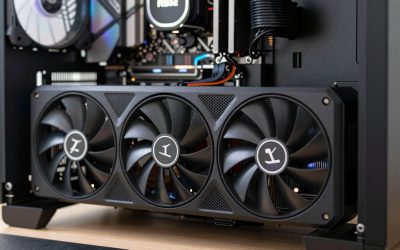
- Top Pick: msi Gaming RTX 5080 16G Ventus 3X OC Black Graphics Card (16GB GDDR7, 256-bit, Extreme Clock 2640 MHz, DisplayPort x 3 2.1a, HDMI 2.1b, NVIDIA Blackwell Architecture)
- Best Value: ASUS TUF Gaming GeForce RTX™ 5080 16GB GDDR7 OC Edition Graphics Card | PCIe 5.0, HDMI/DP 2.1, 3.6-slot, Military-grade Components, Protective PCB Coating, Axial-tech Fans
- Premium Choice: msi Gaming RTX 5080 16G SUPRIM Liquid SOC Graphics Card (16GB GDDR7, 256-bit, Extreme Performance: 2760 MHz, DisplayPort x 3 2.1a, HDMI 2.1b, NVIDIA Blackwell Architecture)
The best performance per dollar graphics cards in 2026 are the Intel Arc B580 and GeForce RTX 5060 at the budget end, and the Radeon RX 9070 and RX 9070 XT in the mid-range, where you get the most frames for each dollar without falling into the VRAM traps that make some cheap cards poor long-term value. Pure cost-per-frame favors the cheapest cards, but once you factor in memory, power supply needs and how long the card stays useful, the picture shifts toward 16GB mid-range models.
Rather than repeat benchmark charts, this guide shows the cost-per-frame math, then adjusts it for the factors that decide whether a “value” card is still good value two or three years from now.
As an Amazon Associate we earn from qualifying purchases at no extra cost to you.



How to calculate performance per dollar
The method is simple: divide the card’s typical price by its relative performance. To keep the numbers comparable, the table uses an approximate 1440p rasterization index with the RTX 5060 set to 100, and the midpoint of each card’s typical market range. Prices move constantly, so treat the ranges as a guide and rerun the math with whatever you see when you shop.
| GPU | VRAM | Approx. performance index (1440p) | Typical market range | Midpoint ÷ index ($ per point) |
|---|---|---|---|---|
| Intel Arc B580 | 12GB | 95 | usually $250–$290 | 2.84 |
| GeForce RTX 5060 | 8GB | 100 | usually $280–$320 | 3.00 |
| Radeon RX 9060 XT 16GB | 16GB | 110 | usually $350–$400 | 3.41 |
| Radeon RX 9070 | 16GB | 160 | usually $560–$640 | 3.75 |
| Radeon RX 9070 XT | 16GB | 185 | usually $650–$750 | 3.78 |
| GeForce RTX 5070 | 12GB | 150 | usually $550–$620 | 3.90 |
| GeForce RTX 5060 Ti 16GB | 16GB | 115 | usually $430–$500 | 4.04 |
| GeForce RTX 5070 Ti | 16GB | 190 | usually $750–$850 | 4.21 |
| GeForce RTX 5080 | 16GB | 220 | usually $1,000–$1,200 | 5.00 |
A lower dollars-per-point figure means better raw value. The Arc B580 and RTX 5060 lead, the RX 9070 and RX 9070 XT are remarkably efficient for mid-range cards, and value drops steadily as you climb toward the RTX 5080. Interestingly, the RX 9070 XT delivers nearly 2x the RTX 5060’s performance for only about 26% more cost per point, which is unusual at this tier.
Adjusting for VRAM: the hidden cost of 8GB
The raw table flatters 8GB cards. At 1440p, many recent games already need 9–11GB at high textures. When an 8GB card runs out, you must lower textures or accept stutter, which effectively reduces its real performance in those titles. A simple adjustment shows the difference:
| GPU | Raw $ per point | VRAM-limited games at 1440p high | Practical value verdict |
|---|---|---|---|
| RTX 5060 8GB | 3.00 | Frequent compromises | Great at 1080p, weaker at 1440p |
| Arc B580 12GB | 2.84 | Occasional | Best budget 1440p value |
| RX 9060 XT 16GB | 3.41 | Rare | Long-lived budget choice |
| RX 9070 16GB | 3.75 | Rare | Best overall value |
If you plan to keep a card for three years or more, the extra memory on the B580, RX 9060 XT 16GB and RX 9070 is worth a modest premium over 8GB alternatives.
The full cost: power supply and platform
A card’s price is not the whole story. Higher-tier cards may require a larger power supply, and an older CPU can hold back a fast GPU, wasting money you paid for performance.
- Arc B580, RTX 5060, RX 9060 XT: board power around 115–190W. A quality 550W unit is plenty, so most existing builds need no PSU upgrade.
- RX 9070, RTX 5070: around 220–250W. A 650W unit is recommended.
- RX 9070 XT, RTX 5070 Ti: around 300W. Plan for 750W.
If moving from the RX 9070 to the RX 9070 XT forces a $90–$120 PSU upgrade, the XT’s cost per point effectively rises from 3.78 to around 4.3, making the non-XT model the better value for that system.
Older platforms and the Arc B580
Intel Arc cards rely on Resizable BAR and are more sensitive to slow CPUs. On older systems without ReBAR support or with weak quad-core processors, the B580 can lose a noticeable part of its performance advantage. In those builds, the RTX 5060 or RX 9060 XT is often the better budget GPU for gaming.
Best bang for buck graphics card by budget
| Budget | Best value pick | Why |
|---|---|---|
| Under $300 | Arc B580 (modern platform) or RTX 5060 (older platform) | Lowest cost per frame; pick by platform compatibility |
| $350–$450 | RX 9060 XT 16GB | 16GB memory at a budget price |
| $550–$650 | RX 9070 | Best balance of value, efficiency and VRAM |
| $650–$800 | RX 9070 XT | Near high-end speed with strong value |
| Need DLSS and strong ray tracing | RTX 5070 or RTX 5070 Ti | Feature set justifies a higher cost per point |
When paying more per frame makes sense
Cost per frame measures rasterization, but some features have real value that a number cannot capture. NVIDIA’s DLSS 4 is supported in a very large number of games and often lets a card run at a lower internal resolution with excellent image quality, which effectively increases its usable performance. Ray tracing performance is also stronger on GeForce cards. If you play many ray-traced titles or rely on upscaling, an RTX 5070 can deliver better results than its raw cost per point suggests. For streamers, NVIDIA’s encoder and broad software support can tip the balance as well.
Bottom line
On pure numbers, the Arc B580 and RTX 5060 offer the cheapest frames, but the best value GPU for most gamers is the 16GB RX 9070, with the RX 9060 XT 16GB as the budget alternative and the RX 9070 XT for higher frame rates. Run the cost-per-point math with current prices, add any PSU upgrade to the total, and favor 16GB cards if you want your money to last.