- Top Pick: CORSAIR iCUE Link RX120 RGB 120mm PWM Fans with iCUE Link System Hub – Magnetic Dome Bearing – Triple Pack – Black
- Best Value: CORSAIR iCUE Link RX120 RGB 120mm PWM Fans with iCUE Link System Hub – Magnetic Dome Bearing – Triple Pack – White
- Premium Choice: CORSAIR iCUE Link RX120 RGB 120mm PWM Fan – Magnetic Dome Bearing – Single Fan – Black
The Corsair iCUE Link RX120 RGB is Corsair’s premium ecosystem fan, built around the company’s iCUE Link single-cable system. iCUE Link is Corsair’s modern wiring approach: a single cable carries both PWM signal, RGB data and the daisy-chain between fans, eliminating the cable mess of separate PWM and ARGB connections. The RX120 RGB is a 120mm fan in this ecosystem, with magnetic dome bearing and the deep iCUE software integration that defines premium Corsair builds. With more than 1,500 buyer reviews and a strong reputation in showcase-build circles, it is one of the standout premium ecosystem fans. At around $35 it sits firmly in the premium 120mm market. This Corsair iCUE Link RX120 RGB review covers airflow profile, acoustics, connection, longevity and value.
- Corsair iCUE Link RX120 RGB at a Glance
- Size and Performance Profile (Airflow vs Pressure)
- Acoustics and Noise
- Connection: PWM, Daisy-Chain and Hub Support
- Bearing Quality and Longevity
- Who Is the iCUE Link RX120 RGB For?
- Pros and Cons
- Is the iCUE Link RX120 RGB Worth It?
- What to Look for in a Case Fan: Quick Buyer’s Guide
- Frequently Asked Questions
- More Case Fan Reviews
- Related Articles
- Related Articles
- Related Guides

CORSAIR iCUE Link RX120 RGB 120mm PWM Fan - Magnetic Dome Bearing - Single Fan - Black


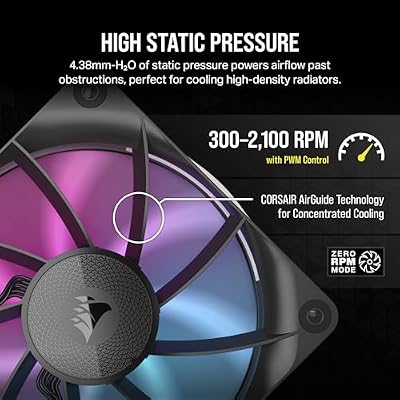


As an Amazon Associate we earn from qualifying purchases. Product prices and availability are accurate as of the date/time indicated.
🛒 Best Price Today on Amazon
Prime members get fast, free shipping on everything above, plus member-only deals. New members get a 30-day free trial — cancel anytime.
As an Amazon Associate we earn from qualifying purchases.


Corsair iCUE Link RX120 RGB at a Glance
| Component | Specification |
|---|---|
| Size | 120mm |
| Speed (RPM) | PWM-controlled premium range |
| Airflow (CFM) | Balanced airflow profile |
| Connection | Corsair iCUE Link (single-cable ecosystem) |
| Bearing | Magnetic dome bearing |
| RGB | RGB with iCUE software control |
| Noise level | Premium Corsair acoustic engineering |
| Best for | Premium Corsair iCUE Link ecosystem builds |
| Price | Around $35 |
Size and Performance Profile (Airflow vs Pressure)
The iCUE Link RX120 RGB is a 120mm premium ecosystem fan with a balanced airflow profile, designed to be the default fan in a Corsair iCUE Link-equipped build. As a premium 120mm fan it is engineered for competent performance across intake, exhaust and AIO radiator positions, with Corsair’s flagship blade design and bearing technology. It sits above the mainstream RS120 in the Corsair lineup on engineering and software integration. For builders thinking about case airflow design with these fans, see the wider best airflow PC cases guide; for premium 140mm alternatives, see the best 140mm case fans roundup.
Acoustics and Noise
Corsair’s premium acoustic engineering on the iCUE Link line is meaningfully better than the mainstream RS line. The bearing, blade design and motor control are tuned together for quiet operation across the PWM speed range. With iCUE software, buyers also have fine control over fan curves: rather than the limited fan-curve options exposed by motherboard BIOS, iCUE allows custom curves tuned to temperature sensors elsewhere in the system, which is one of the genuine advantages of investing in the ecosystem. The RX120 RGB is not as quiet as a Noctua A14 or Silent Wings 4 at a given RPM — those are pure quiet-cooling specialists — but for a premium RGB ecosystem fan, the acoustics are competitive.
Connection: PWM, Daisy-Chain and Hub Support
This is the iCUE Link RX120’s defining feature. Corsair’s iCUE Link is a single-cable ecosystem: one cable carries PWM signal, RGB data and the daisy-chain between fans, all simultaneously. Compared with traditional RGB fan wiring — where each fan needs both a 4-pin PWM cable and a separate 3-pin 5V ARGB cable, plus often a fan hub and an ARGB hub — iCUE Link is a major step forward in cable cleanliness. Multiple iCUE Link devices (fans, AIO pumps, lighting strips, even some peripherals) connect into one chain that ends at a single iCUE Link System Hub, which in turn plugs into the motherboard. For showcase builds where cable management matters, this is genuinely transformative. It is, however, a closed ecosystem: iCUE Link fans only work with the iCUE Link System Hub, not with regular motherboard fan headers, so this is a fan to buy when committing to the Corsair ecosystem.
Bearing Quality and Longevity
The iCUE Link RX120 RGB uses Corsair’s premium magnetic dome bearing — engineered for quiet, long-life operation at the same general level as Fluid Dynamic Bearings. As a premium product from a major brand with extensive warranty support, longevity is part of the value proposition: for the kind of buyer investing in a full iCUE Link ecosystem, the fans need to last as long as the system. Corsair’s brand and software support are part of what is being paid for.
Who Is the iCUE Link RX120 RGB For?
The iCUE Link RX120 RGB is for the premium Corsair builder who is committing to the iCUE Link ecosystem — typically also buying an iCUE Link AIO liquid cooler, iCUE Link RGB strips and other iCUE Link devices, all controlled together through the iCUE software. The single-cable advantage and the deep software integration only really pay off when the whole system is in the ecosystem. It is not the right pick for builders mixing brands or building outside iCUE Link — for that the mainstream Corsair RS120 ARGB in this guide is the right pick. For premium iCUE Link ecosystem builds, it is the default fan. For mixed-brand premium showcase builds, see the broader best RGB case fans guide.
Pros and Cons
Pros: Single-cable iCUE Link ecosystem dramatically simplifies wiring; deep iCUE software integration for custom fan curves; premium magnetic dome bearing and acoustic engineering; from major recognised brand with long warranty.
Cons: Closed ecosystem — only works with the iCUE Link System Hub, not with regular motherboard fan headers; premium price; locks builder into Corsair for future expansion.
Is the iCUE Link RX120 RGB Worth It?
At around $35 the Corsair iCUE Link RX120 RGB is a premium product priced accordingly. For the buyer who is already in or committing to the iCUE Link ecosystem — and who values the single-cable wiring simplicity and the deep iCUE software integration — it is the right premium ecosystem fan. The closed-ecosystem nature is the trade-off: builders buy into the Corsair iCUE Link world, and future expansion stays within it. For premium ecosystem builders, it earns a recommendation. Buyers who want RGB without the ecosystem commitment should look at the mainstream Corsair RS120 ARGB or the be quiet! Light Wings instead. For broader options, see our best RGB case fans guide.
What to Look for in a Case Fan: Quick Buyer’s Guide
Size: 140mm fans move more air per revolution than 120mm at the same RPM, delivering equivalent cooling more quietly. Where a case supports 140mm mounts, larger is generally better.
PWM vs DC: A 4-pin PWM connection lets the motherboard control fan speed precisely via duty-cycle. A 3-pin DC fan uses voltage control only, which is less precise and tends to stall at low speeds.
Airflow vs static pressure: Open-path positions want airflow-biased fans; restrictive positions behind dust filters or radiators want pressure-biased fans. Many premium fans target a balanced profile.
Bearings: Fluid Dynamic Bearings, magnetic dome bearings and Noctua’s long-life designs all outlast cheaper sleeve bearings by years. Bearing wear is the source of most fan noise as fans age.
Frequently Asked Questions
What is Corsair iCUE Link?
iCUE Link is Corsair’s single-cable ecosystem: one cable carries PWM signal, RGB data and the daisy-chain between fans, all simultaneously. It dramatically simplifies wiring versus traditional separate PWM and ARGB cables.
Can the iCUE Link RX120 RGB plug into a regular motherboard fan header?
No. iCUE Link is a closed ecosystem — these fans only work with the iCUE Link System Hub, which in turn connects to the motherboard. They cannot be wired to a standard 4-pin PWM header directly.
Is the iCUE Link RX120 RGB worth the price over the RS120 ARGB?
Only if you are committing to the iCUE Link ecosystem. The wiring simplicity and iCUE software integration are real advantages, but they only pay off across an iCUE Link build. For mixed builds, the cheaper RS120 ARGB is the more sensible Corsair pick.
Does the iCUE Link RX120 RGB work with iCUE software?
Yes. Deep iCUE software integration is one of the headline features — buyers get custom fan curves tuned to temperature sensors anywhere in the system, beyond what motherboard BIOS exposes.
More Case Fan Reviews
- Noctua NF-P12 redux-1700 PWM Case Fan Review (120mm)
- Noctua NF-P14s redux-1500 PWM Case Fan Review (140mm)
- Noctua NF-A14 PWM Premium Quiet Fan Review (140mm Brown)
- Noctua NF-A14 chromax.Black.swap PWM Fan Review
- Noctua NF-P14s redux-1200 PWM Quiet Fan Review (140mm)
- be quiet! Light Wings 140mm PWM ARGB Fan Review
- be quiet! Silent Wings Pro 4 140mm PWM Fan Review
- be quiet! Silent Wings 4 140mm PWM Fan Review
Affiliate Disclosure: As an Amazon Associate, we earn from qualifying purchases. If you click a link and make a purchase, we may earn a small commission at no extra cost to you. Prices and availability are accurate as of publication and may change.
Related Articles
Looking for more on this topic? Browse the hand-picked guides below — each one applies the same scoring rubric used in this review.