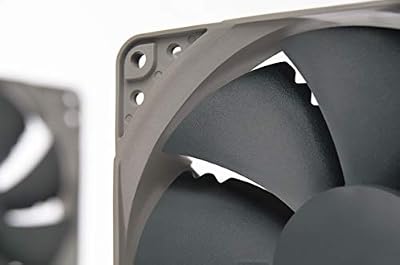
The Noctua NF-P12 redux-1700 PWM is a 120mm case fan from Noctua’s affordable redux line, offering the brand’s renowned engineering at a more accessible price point. It runs up to 1,700 RPM with PWM 4-pin control and carries Noctua’s classic grey livery rather than the brown-and-beige flagship colours. With more than 19,800 buyer reviews on Amazon, it is one of the best-known 120mm case fans on the market. At around $16 it is one of the more attainable ways into Noctua ownership. This Noctua NF-P12 redux-1700 PWM review covers airflow profile, acoustics, connection, longevity and value.
- Noctua NF-P12 redux-1700 PWM at a Glance
- Size and Performance Profile (Airflow vs Pressure)
- Acoustics and Noise
- Connection: PWM, Daisy-Chain and Hub Support
- Bearing Quality and Longevity
- Who Is the NF-P12 redux-1700 For?
- Pros and Cons
- Is the NF-P12 redux-1700 Worth It?
- What to Look for in a Case Fan: Quick Buyer’s Guide
- Frequently Asked Questions
- More Case Fan Reviews
- Related Articles
- Related Articles

Noctua NF-P12 redux-1700 PWM, Quiet Fan 120mm | High Airflow, Low Noise, 25mm Thick Fan for PC and Electronics Cooling Streamlined Package 1700rpm 4-Pin PWM



As an Amazon Associate we earn from qualifying purchases. Product prices and availability are accurate as of the date/time indicated.
🛒 Best Price Today on Amazon
Prime members get fast, free shipping on everything above, plus member-only deals. New members get a 30-day free trial — cancel anytime.
As an Amazon Associate we earn from qualifying purchases.


Noctua NF-P12 redux-1700 PWM at a Glance
| Component | Specification |
|---|---|
| Size | 120mm |
| Speed (RPM) | Up to 1,700 RPM |
| Airflow (CFM) | High-performance airflow profile (P-series) |
| Connection | PWM 4-pin |
| Bearing | Noctua-grade long-life bearing |
| RGB | No (grey redux livery) |
| Noise level | Engineered for low noise at speed |
| Best for | High-performance case airflow and radiator use |
| Price | Around $16 |
Size and Performance Profile (Airflow vs Pressure)
The NF-P12 redux-1700 is a 120mm fan from Noctua’s P-series, which is engineered with a pressure-biased blade design. Where Noctua’s A-series fans split the difference between airflow and static pressure, P-series fans are built to push air through restrictive surfaces — radiators, dense dust filters and heatsinks — without losing efficiency. That makes the NF-P12 redux-1700 a strong choice for liquid-cooling radiators and front-intake positions behind a fine dust filter, where a pure airflow fan would struggle. With a top speed of 1,700 RPM it has genuine performance headroom, and Noctua’s blade engineering means it converts that speed into useful pressure rather than just turbulence. For cases that prioritise open airflow, see the best airflow PC cases guide; for radiator-focused builds the higher pressure of the NF-P12 redux is exactly what you want.
Acoustics and Noise
Noctua’s reputation rests on quietness, and even in the more affordable redux line that engineering shows. The NF-P12 redux-1700 is designed to run as quietly as possible at any given RPM, and combined with PWM control it can be slowed substantially when the system is idle or under light load — at lower speeds it is genuinely close to inaudible. At its full 1,700 RPM it is faster and therefore louder than slower Noctua fans, but it remains better mannered acoustically than most budget fans pushed to the same speeds. For a fully quiet build the slower Noctua models in this guide and the wider best quiet PC case fans roundup are worth a look, but for buyers who want headroom for high cooling load when needed and quiet operation when not, the redux-1700 is a sensible balance.
Connection: PWM, Daisy-Chain and Hub Support
The NF-P12 redux-1700 uses a 4-pin PWM connection. That matters: PWM (Pulse Width Modulation) lets the motherboard control fan speed precisely via a duty-cycle signal, while 3-pin DC fans can only be controlled by varying voltage, which is less precise and limited at low speeds. With PWM the NF-P12 can be slowed almost to a stop when the system is cool and ramped up only when needed, which keeps the build quiet most of the time. Noctua does not include PST (PWM Sharing Technology) daisy-chain on the redux line — for that you would look at the ARCTIC P14 PWM PST in this guide — so each NF-P12 connects to its own motherboard header or a separate fan hub. Most modern motherboards offer enough headers for a typical build.
Bearing Quality and Longevity
The reason Noctua fans command brand loyalty is longevity. The NF-P12 redux-1700 uses Noctua’s long-life bearing engineering and is backed by Noctua’s class-leading 6-year warranty, which is well beyond what most fan manufacturers offer. In practical terms this is a fan you can install and forget about — Noctua bearings are widely reported to keep running quietly long after cheaper fans have started to whine or rattle. For a fan that will outlast multiple builds, this is the headline reason to choose Noctua over a cheaper alternative.
Who Is the NF-P12 redux-1700 For?
The NF-P12 redux-1700 is for the builder who wants Noctua’s engineering and longevity at a sensible price, accepts the classic grey livery rather than RGB, and needs a fan that can handle radiators and restrictive intakes. If you are building a quiet workstation, a gaming PC with an AIO liquid cooler, or a case with dense dust filters, the pressure-biased NF-P12 is exactly the right shape of fan. It is less suited to buyers who want RGB lighting or who need only the gentlest possible airflow, where slower Noctua A-series fans would be a better fit. For affordable Noctua quality with high-pressure headroom, it is well judged.
Pros and Cons
Pros: Noctua engineering at an affordable price; PWM 4-pin control; pressure-biased blade design suits radiators and restrictive intakes; long-life bearing and 6-year warranty; very large positive review base (19,800+).
Cons: No RGB lighting (grey redux livery only); no PST daisy-chain on this model; 1,700 RPM ceiling produces audible noise at full speed.
Is the NF-P12 redux-1700 Worth It?
At around $16 the Noctua NF-P12 redux-1700 PWM is one of the most sensible 120mm case fans you can buy. It brings Noctua’s engineering, bearing quality and 6-year warranty to a price that competes with much shorter-lived budget fans, and its pressure-biased profile means it works equally well as a case fan or on a radiator. The redux livery is unfussy and the PWM control keeps the system quiet most of the time. For builders who want long-term, low-maintenance cooling without paying the premium of the chromax line, it earns an easy recommendation. Buyers comparing 140mm options should also see our best 140mm case fans guide.
What to Look for in a Case Fan: Quick Buyer’s Guide
Size: 140mm fans move more air per revolution than 120mm at the same RPM, delivering equivalent cooling more quietly. Where a case supports 140mm mounts, larger is generally better.
PWM vs DC: A 4-pin PWM connection lets the motherboard control fan speed precisely via duty-cycle. A 3-pin DC fan uses voltage control only, which is less precise and tends to stall at low speeds.
Airflow vs static pressure: Open-path positions want airflow-biased fans; restrictive positions behind dust filters or radiators want pressure-biased fans. Many premium fans target a balanced profile.
Bearings: Fluid Dynamic Bearings, magnetic dome bearings and Noctua’s long-life designs all outlast cheaper sleeve bearings by years. Bearing wear is the source of most fan noise as fans age.
Frequently Asked Questions
Is the Noctua NF-P12 redux-1700 PWM good for radiators?
Yes. It is a P-series fan with a pressure-biased blade design, engineered to push air through restrictive surfaces such as radiators and dense dust filters — exactly where pure airflow fans struggle.
What does PWM mean on the NF-P12 redux-1700?
PWM (Pulse Width Modulation) is a 4-pin connection that lets the motherboard control fan speed precisely via a duty-cycle signal. It allows the fan to slow almost to a stop when the system is idle and ramp up only when needed.
Does the NF-P12 redux-1700 PWM have RGB lighting?
No. The redux line uses Noctua’s classic plain grey livery rather than RGB. Buyers who want lighting should look at ARGB models in this guide such as the be quiet! Light Wings or Corsair RS120.
How long does the Noctua NF-P12 redux-1700 PWM last?
It is backed by Noctua’s 6-year warranty, which is among the longest in the industry. Noctua bearings are widely reported to keep running quietly long after cheaper fans have started to whine.
More Case Fan Reviews
- Noctua NF-P14s redux-1500 PWM Case Fan Review (140mm)
- Noctua NF-A14 PWM Premium Quiet Fan Review (140mm Brown)
- Noctua NF-A14 chromax.Black.swap PWM Fan Review
- Noctua NF-P14s redux-1200 PWM Quiet Fan Review (140mm)
- be quiet! Light Wings 140mm PWM ARGB Fan Review
- be quiet! Silent Wings Pro 4 140mm PWM Fan Review
- be quiet! Silent Wings 4 140mm PWM Fan Review
- ARCTIC P14 PWM PST Case Fan Review (140mm)
Affiliate Disclosure: As an Amazon Associate, we earn from qualifying purchases. If you click a link and make a purchase, we may earn a small commission at no extra cost to you. Prices and availability are accurate as of publication and may change.
Related Articles
Looking for more on this topic? Browse the hand-picked guides below — each one applies the same scoring rubric used in this review.