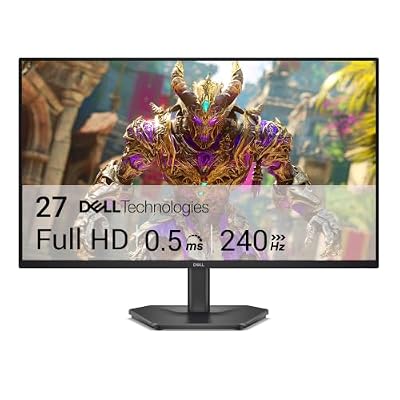
- Top Pick: Dell 27 240Hz Gaming Monitor – SE2726HG – 27-inch FHD (1920×1080) Display, in-Plane Switching (IPS) Technology, AMD FreeSync Premium, TÜV 3-Star, 2X HDMI, DisplayPort 1.4, Tilt
- Best Value: Acer 27in FHD 1920×1080 IPS 120Hz Gaming Monitor | Office KB272 G0bi
- Premium Choice: Samsung 27" Odyssey G5 (G51F) Series QHD (1440P) Gaming Monitor
Twenty-seven inches at 1440p used to be a $350+ proposition. It isn’t anymore. Panel prices dropped enough that you can get a competent 27-inch gaming monitor for $150-$200, and a genuinely good one for $250. The catch is knowing which corners got cut to hit that price, because not every “cheap” monitor cuts the same corner.
As an Amazon Associate we earn from qualifying purchases at no extra cost to you.


Resolution: 1080p vs 1440p at 27 inches
27 inches at 1080p is the one combination I’d actively steer you away from unless the price gap is huge. At that size, 1080p works out to about 82 pixels per inch, which is noticeably soft, especially for text and UI elements. You’ll see individual pixels if you sit at a normal desk distance. 1440p on the same 27 inches lands around 109 PPI, which is the sharpness most people associate with a “good” monitor.
The good news: 1440p 27-inch panels are no longer a premium feature. Panel glut, mostly from oversupply out of Chinese manufacturers (AUO, BOE, Innolux), pushed prices down across the board in 2023-2024. You can find VA and IPS 1440p 27-inchers for less than some 1080p models cost three years ago.
Panel type: what actually changes on a budget
On cheap monitors, panel type is the single biggest factor in how the screen looks and behaves, more than resolution or even refresh rate.
- VA panels are the budget default right now. Deep blacks and high contrast (often 3000:1 vs IPS’s 1000:1), but slower pixel response, which shows up as smearing in dark scenes with fast motion, think shadows trailing behind a character running across a dim room. Viewing angles are mediocre; colors shift if you’re off-center.
- IPS panels have gotten cheap enough to show up at the same price points as VA. Better color accuracy and viewing angles, worse native contrast (expect washed-out blacks in dark rooms), and historically worse response times, though budget IPS has closed that gap a lot since 2022.
- TN panels are mostly gone at 27 inches. If you see one, it’s old stock. Skip it, the color and viewing angle compromises aren’t worth whatever small savings you’d get.
If you play a lot of competitive shooters, IPS is the safer pick for response time consistency. If you mostly play slower, story-driven or strategy games and want punchy contrast, VA is fine and arguably looks better in a dim room.
Refresh rate: where cheap monitors differ most
This is the spec that varies wildly for the same price. You’ll see 100Hz, 144Hz, 165Hz, and even 180Hz panels all in the $150-$220 range, depending on brand and sale timing.
144Hz is the realistic floor for anything marketed as a “gaming monitor” today. Below that, you’re better off with a cheap 1080p monitor instead, since a 1440p panel stuck at 75Hz or 100Hz won’t give you enough of a smoothness upgrade to justify the extra GPU load. The jump from 60Hz to 144Hz is dramatic and immediately obvious. The jump from 144Hz to 165Hz or 180Hz is real but much smaller, and most people can’t reliably tell 165 from 180 in blind testing.
One honest trade-off: hitting 144+ fps at 1440p on a budget GPU (think a card under $300) is a stretch in modern AAA titles. If your graphics card can’t push past 90-100 fps anyway, a 165Hz monitor is partly wasted, you’re buying headroom for later rather than a benefit you’ll feel today. That’s not a bad reason to buy one, just know what you’re actually getting.
Comparison at a glance
| Spec | Budget pick | Mid-range pick | What changes |
|---|---|---|---|
| Resolution | 1440p, 144Hz, VA | 1440p, 165Hz, IPS | Color accuracy, viewing angles, response time |
| Price range | $150-$190 | $220-$280 | Panel grade, firmware/scaler quality, stand build |
| Contrast | ~3000:1 (VA) | ~1000:1 (IPS) | Deeper blacks on VA, flatter on IPS |
| Motion clarity | Some dark-scene smearing | Cleaner fast motion | VA response time curve is the weak point |
| HDR | Label only, no real HDR | Usually still label-only below $300 | Don’t buy a sub-$250 monitor for HDR, full stop |
What’s not worth paying extra for at this price
Don’t pay a premium for “HDR” badges on anything under $300. True HDR needs high peak brightness (600+ nits) and local dimming zones, neither of which shows up on cheap 27-inch panels. You’ll get HDR400 or similar labels that just mean the monitor accepts an HDR signal and tone-maps it, often looking worse than SDR. Also skip curved panels at 27 inches unless you specifically like the look, the curve does more for 32-inch-plus screens where the edges are far enough away to benefit from it.
Where it is worth spending a bit more: build quality of the stand and the OSD (on-screen display) menu. Cheap stands wobble and have limited height adjustment, which matters daily in a way panel specs don’t. If you’re comparing a few models, it’s worth browsing a 27 inch 1440p 144Hz gaming monitor listing and reading the one- and two-star reviews specifically, that’s where stand wobble and dead-pixel complaints surface.
What I’d actually buy
For most people, a 1440p, 144Hz, VA panel in the $150-$190 range is the sweet spot right now, it’s not a compromise so much as where the value curve flattens out. If you play fast multiplayer games and have the GPU to back it up, step up to an IPS model around $220-$250 for better motion clarity, and it’s worth searching a 27 inch IPS 165Hz monitor listing to compare current pricing, since IPS and VA prices move independently depending on oversupply. If your budget caps out under $150, a 1080p 144Hz panel is a more honest buy than a 1440p 100Hz one, you’ll actually feel the refresh rate instead of straining to notice it. For anyone upgrading from a monitor older than five years, even checking a basic cheap 27 inch gaming monitor search will turn up something that beats what you have now by a wide margin.