Before sound quality enters the picture, your phone’s port has already narrowed the field. A USB-C flagship, a Lightning-era iPhone, and a handset that still carries a 3.5mm jack each demand a different product class, and buying the wrong connector means a dongle in your pocket or a return label on the box. Driver size, tuning, and microphone quality only matter once the plug physically fits and the phone actually routes game audio and voice chat through it without an adapter lottery.
This guide serves three groups: Android players on current USB-C phones, iPhone owners split between Lightning and USB-C generations, and anyone whose phone or handheld still offers a proper headphone jack. Every pick below was chosen from the names, connector types, and published specifications on its Amazon product page, so the variant described here is the variant that ships.
Quick Picks
As an Amazon Associate we earn from qualifying purchases.
| Product | Best for | Key spec from title |
|---|---|---|
| JBL Tune 310C (Black) | USB-C phones that need full inline controls | 3-button remote with microphone |
| Apple EarPods (USB-C) | iPhone 15 and later, plus USB-C Android | Built-in remote to control calls and volume |
| Apple EarPods (Lightning) | iPhone 14 and older Lightning models | Built-in remote to control calls and volume |
| HyperX Cloud Earbuds II (Red) | Phones and handhelds with a 3.5mm jack | 14mm drivers with built-in microphone |
How to Choose
Match the Connector to Your Phone First
Start by looking at the bottom edge of your phone, because that single detail eliminates most of the catalog. Current Android flagships and the iPhone 15 generation onward take USB-C audio natively, so a USB-C plug connects with no adapter and carries both game sound and microphone signal digitally. Lightning iPhones need a Lightning plug or Apple’s own adapter, while a surviving 3.5mm jack accepts the widest range of gaming earbuds ever made. Our roundup of the best wired headphones for gaming covers desk and console setups; here, the port on your handset is the filter that comes before everything else.
Prioritize the Inline Microphone for Voice Chat
Mobile shooters and squad games live or die on callouts, so the microphone deserves as much attention as the drivers. A wired inline mic sits close to your mouth, needs no battery, and avoids the compression a phone applies when it falls back to a headset’s weakest Bluetooth profile. Check the listing for a microphone that is built in rather than optional, and look at the remote layout too: a multi-button remote handles volume and call answering, while a single-button design forces you back to the touchscreen mid-match. Voice chat in most mobile titles runs over the same wired path as game audio, so one good cable replaces two compromises.
Choose Sealed In-Ears or Open Earbuds for Your Commute
Form factor changes how a pair behaves between matches. Sealed in-ear models with silicone tips block train and street noise passively, which keeps footsteps and reload cues audible at lower, safer volumes, and the seal also anchors bass response. Open earbuds in the EarPods style rest at the ear’s entrance instead; they leak sound and admit traffic noise, yet they stay comfortable for hours and let you hear a platform announcement without pausing. Neither design is universally better. Pick the sealed fit for noisy commutes and ranked sessions, and the open fit for home play, office breaks, and anyone who dislikes deep-insertion tips.
Know When a DAC Dongle Is Worth Carrying
A USB-C to 3.5mm dongle is a small DAC and amplifier in a cable, and it decides the sound of any passive earbud plugged into it. Dongles earn their place when your phone lacks a jack but you already own a good 3.5mm pair, or when a phone’s built-in output is noisy. They make less sense as a default: each adapter is another failure point, inline remotes can lose volume-button support across brands, and a native USB-C earbud removes the whole question. If you do go the dongle route, buy the phone maker’s own adapter first, since microphone and button behavior is most predictable there.
The 4 Best Options
JBL Tune 310C (Black)

The Tune 310C is the straightforward answer for a USB-C phone that needs proper controls. Its three-button remote adjusts volume, manages playback, and switches EQ presets from the cable, and the built-in microphone handles calls and in-game chat without extra hardware. A pair of 9mm dynamic drivers carries JBL Pure Bass tuning with High-Resolution Audio support, and the flat cable resists the pocket tangles that plague round cords. At 14.3 grams it disappears during long sessions. Because the plug is USB-C end to end, there is no dongle to lose and no adapter compatibility guessing before a match starts.
Specs
- Connector: USB-C
- Driver: 9mm dynamic driver
- Controls: 3-button remote with built-in microphone, EQ preset switching
- Cable: flat, tangle-free
- Weight: 14.3 g
- Item model number: JBLT310CBLKAM
Best for: USB-C Android players who want volume and EQ control on the cable itself.
Watch out for: JBL also sells similarly named Tune models with 3.5mm plugs; confirm the listing title says USB-C and the model number ends in CBLKAM before ordering.
ASIN: B0CT9PYXGY
Apple EarPods (USB-C)

Apple’s USB-C EarPods are the default recommendation for iPhone 15 and later owners who want zero setup. The open earbud housing is shaped around ear geometry rather than sealing with tips, so there is nothing to size and nothing to fall out of a pocket case. A built-in remote controls music, phone calls, and volume, and the integrated microphone covers FaceTime and game chat alike. The Amazon listing names a long run of compatible iPhone, iPad, and Mac models, and the same plug works on USB-C Android phones. Nothing here needs charging, pairing, or firmware attention before it works.
Specs
- Connector: USB-C plug
- Model name: EarPods with USB-C Connector
- Microphone: included, with media and call controls on the remote
- Special features listed: microphone included, volume control, iOS phone control
- Item weight: 1.12 ounces
- Item model number: MYQY3AM/A
Best for: iPhone 15, 16, and 17 owners who want a native plug and a remote that simply works.
Watch out for: two EarPods generations share near-identical packaging; check that the listing’s model number is MYQY3AM/A and the style says USB-C, not the older MTJY3AM/A revision or the Lightning version.
ASIN: B0DCH8VDXF
Apple EarPods (Lightning)
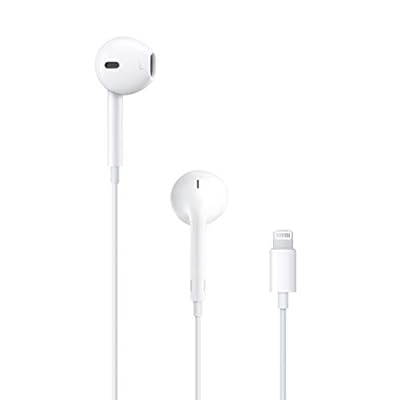
For the large installed base of Lightning iPhones, this is still the cleanest wired route into mobile gaming. The Lightning plug carries digital audio straight from the phone, the built-in remote adjusts volume and answers calls with a pinch of the cord, and the integrated microphone captures voice for calls and chat. Apple rates the pair for every device with a Lightning connector running iOS 10 or later, which covers the iPhone 7 through the iPhone 14 line. The open design will not isolate a busy bus, but it keeps ears aware of surroundings and stays comfortable through long sessions.
Specs
- Connector: Lightning
- Model name: EarPods with Lightning Connector
- Microphone: integrated, with built-in remote for volume, playback, and calls
- Compatibility listed: devices with a Lightning connector, iOS 10 or later
- Sensitivity: 94 dB
- Item model number: MMTN2AM/A
Best for: iPhone 14 and older owners who want first-party wired audio with a working remote and mic.
Watch out for: this listing draws heavy third-party seller traffic and endless lookalike Lightning earbuds; confirm the seller ships the Apple model MMTN2AM/A, and remember it cannot plug into a USB-C iPhone at all.
ASIN: B01M0GB8CC
HyperX Cloud Earbuds II (Red)

HyperX built the Cloud Earbuds II specifically for handheld and mobile play, and the published details show it. The 14mm drivers are tuned, per the listing, to prioritize clear game chat and tactical cues such as footsteps, and the built-in microphone keeps squad communication on the same cable. Four ear tip sizes, from extra small to large, let you dial in a seal, while the low-profile 90-degree plug sits flat against a phone or handheld instead of jutting into your palm. A hard-shell carrying case comes in the box, which matters for a pair that will live in a bag.
Specs
- Connector: 3.5mm jack, low-profile 90-degree plug
- Driver: 14mm
- Ear tips: 4 sizes (XS, S, M, L)
- Microphone: built-in
- Impedance: 65 ohms
- Included: hard-shell carrying case
Best for: players whose phone, tablet, or handheld still has a 3.5mm jack and who play chat-heavy titles.
Watch out for: the Red and Black colorways and the earlier Cloud Earbuds generation carry different listings; verify the title says Cloud Earbuds II and that your phone actually has a 3.5mm jack before relying on this pick.
ASIN: B0C14GFQL8
Which One Fits Your Situation
USB-C Android Flagship
If your Galaxy, Pixel, or similar flagship has only a USB-C port, the JBL Tune 310C is the natural fit. It plugs in directly, its three-button remote gives you volume control that many single-button earbuds skip, and the EQ presets let you shift emphasis without opening an app mid-session. The EarPods (USB-C) also work on these phones, though their remote behavior is most predictable on Apple hardware.
iPhone 15 or Newer
Your phone speaks USB-C, so either USB-C pick connects natively. Choose the EarPods (USB-C) if you value the open fit, a first-party remote, and a microphone that behaves identically across calls, FaceTime, and games. Choose the Tune 310C if you prefer a sealed in-ear fit for noisy environments and want EQ switching on the cable. Skip anything Lightning; it would need an adapter your phone no longer bundles.
iPhone With a Lightning Port
Owners of the iPhone 14 and everything back to the iPhone 7 should buy the EarPods (Lightning) and stop researching. The plug matches, the remote and microphone are first-party predictable, and compatibility stretches across every Lightning iPad and iPod touch as a bonus. Third-party Lightning earbuds exist, but certification and button behavior vary enough that the genuine article is the safer spend for voice chat.
Phone or Handheld With a 3.5mm Jack
A working headphone jack is now a feature worth exploiting. The HyperX Cloud Earbuds II plug straight into older Android phones, budget handsets, tablets, and handheld consoles, with a 90-degree plug shaped for landscape grip and four tip sizes for a proper seal. You also keep the option of every other 3.5mm gaming earbud ever released, and no dongle drains pocket space or adds a failure point.
Common Mistakes
- Buying by brand name alone and missing that USB-C, Lightning, and 3.5mm variants of the same earbud are separate listings with separate ASINs.
- Assuming a USB-C plug guarantees audio: some very old or unusual USB-C phones route analog audio differently, so check the listing’s compatible-device list against your exact model.
- Judging a gaming earbud only on driver size while ignoring the microphone; a big driver cannot rescue voice chat your squad cannot understand.
- Throwing a sealed in-ear pair into a bag without a case, then blaming the cable when a tip tears or a plug bends.
- Ordering Lightning earbuds for a USB-C iPhone, or the reverse, because the product photos look identical at thumbnail size.
Frequently Asked Questions
Do wired earbuds have less audio delay than Bluetooth for mobile games?
Yes, as a rule of connection, not a brand claim. A wired path sends audio with no wireless encoding, pairing, or battery management, so gunshots and footsteps land when the screen shows them. Bluetooth adds codec processing at both ends. For rhythm games and competitive shooters, that is why wired picks anchor this category.
Will USB-C earbuds work on any phone with a USB-C port?
Almost always on current phones, because modern USB-C audio earbuds carry their own digital conversion and present themselves as a standard audio device. Problems cluster around very old USB-C handsets and a few models with nonstandard audio routing. The safe move is checking the Amazon listing’s compatible devices against your phone model before ordering, especially with budget handsets.
Can I use the inline microphone for in-game voice chat?
On these picks, yes. Each includes a built-in microphone on the cable, and games that support voice chat treat a wired headset as the audio route for game sound and chat. The exception is a dongle in the chain: some third-party adapters pass audio out but drop microphone input, another reason to prefer a native plug.
Are EarPods good enough for competitive mobile gaming?
They cover the fundamentals: zero-latency wired audio, a working microphone, and a remote needing no charging. They give up isolation, since the open housing admits noise and leaks bass in loud settings. At home or in quiet rooms they are serviceable; on a train, a sealed pick like the Tune 310C or Cloud Earbuds II protects quiet cues.