

- Top Pick: Retroid Pocket 5: The 2D Specialist
- Runner-up: Legion Go 2: The Flagship and the Dock
- Also consider: Mayflash F500 Elite: The Stick Upgrade
Fighting games are the genre where the handheld itself matters most. A role-playing game forgives a mushy D-pad and a few frames of delay; a fighter punishes both, because every quarter-circle, charge motion and one-frame link runs through the pad under your thumb. The emulation side is unusually kind — most of the canon is light — so this guide ranks controls first, chip second and screen third.
As an Amazon Associate, we earn from qualifying purchases.
It is also a different guide from our arcade handhelds roundup, which ranks machines for the whole MAME and FBNeo catalogue. Here the lens is one genre across five systems: CPS and Neo Geo 2D fighters, the PlayStation generations, and the Dreamcast, the console that became the genre’s second arcade. Everything below assumes games dumped from your own cartridges and discs.
This article contains affiliate links, and we may earn a commission when you buy through them at no extra cost to you.
Quick Answer
Buy the Retroid Pocket 5 if your library is 2D: its D-pad sits in the primary position and FBNeo, PS1 and Dreamcast fighters ask little of its chip. Step up to the Legion Go S for the PS2 3D tier on Windows, or the Legion Go 2 for the big OLED and docked play. Serious players on any of them should budget for a real arcade stick.
Three Tiers of Library, Three Levels of Demand
The 2D bedrock is Capcom’s CPS1, CPS2 and CPS3 boards and SNK’s Neo Geo, all carried by FBNeo. Street Fighter II and III, the King of Fighters series, Garou and the Marvel crossovers live here, and FBNeo’s demands are modest: this tier runs well on modest hardware. If this is your library, the chip is nearly irrelevant and the pad is everything.
The middle tier is the 3D migration: Tekken and Soul Edge on the original PlayStation through DuckStation, then Tekken 5, SoulCalibur II and III and Virtua Fighter 4 on PlayStation 2 through PCSX2. DuckStation is light; PCSX2 is the one place in this guide where processor strength genuinely separates the picks, because its heavier 3D titles reward stronger cores at raised internal resolutions.
The third tier is the Dreamcast through Flycast, the genre’s golden shelf: Marvel vs. Capcom 2, Capcom vs. SNK 2, Street Fighter III: 3rd Strike’s home port, SoulCalibur and Power Stone. Flycast sits between the other tiers in demand and adds a bonus the others lack, covered below: its ecosystem is one of the two places rollback netplay lives.
What Actually Decides a Fighting Handheld
The D-pad is the controller. Fighters are played on the pad, not the stick, and the test is diagonals: a pad that rocks cleanly into down-forward without dropping to plain down is the difference between a fireball and a crouching jab. Placement matters too. Pads in the primary upper position suit the genre; pads placed below a tall analogue stick force a cramped thumb angle over long sessions.
Button layout is the second filter. Capcom’s arcade standard is six buttons in two rows of three, Sega’s home pads followed it, and SNK’s Neo Geo used four in a row. A handheld’s four face buttons cover the Neo Geo layout natively, but six-button games need the shoulder buttons drafted into the front row, which some hands never accept. Back buttons, where a handheld offers them, are the elegant fix: map the two missing punches or kicks there and keep your thumb still.
Latency is a stack, not a single number: the emulator’s internal delay, the display, and the input path all add their share. RetroArch documents its answer as run-ahead, which runs the core forward and rewinds to hide the game’s own internal lag, and it works across the FBNeo and Flycast cores most of this library uses. The standalone emulators expose their own frame-pacing and synchronisation settings at a documented level; the honest advice is to enable what your emulator offers and prefer wired or docked play when a match matters. We quote no millisecond figures here, because none are published on a comparable basis.
Finally, online play. Rollback netplay — the technique that predicts inputs and corrects them, keeping matches responsive — exists in this ecosystem at a documented level: Fightcade, the community platform built on FBNeo, has offered GGPO-based rollback for the CPS and Neo Geo library on desktop for years, and the Flycast ecosystem has rollback implementations for Dreamcast titles. A Windows handheld joins that world directly; an Android handheld mostly watches it.
The Picks, Ranked by Controls
Retroid Pocket 5: The 2D Specialist
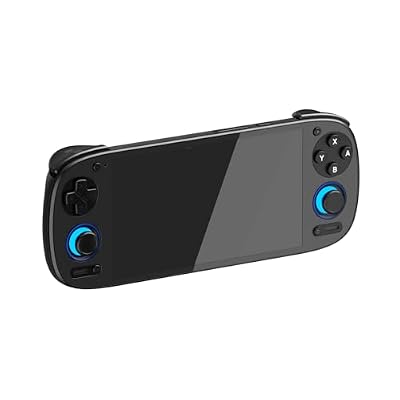
The Pocket 5 gets the genre’s fundamentals right in hardware: the D-pad occupies the primary position above the left stick, the way retro-first layouts should, and the 5.5-inch AMOLED keeps sprites crisp at the integer scales FBNeo titles use. Its Snapdragon 865 covers the full 2D tier, DuckStation and Flycast’s Dreamcast shelf without drama. The four face buttons mean six-button Capcom games lean on the shoulders, the one compromise in an otherwise ideal portable fighter.
Specs:
– Chip: Qualcomm Snapdragon 865
– Display: 5.5-inch AMOLED, 1920 x 1080, touchscreen
– Memory and storage: 8GB RAM, 128GB, microSD expansion
– Battery: 5,000 mAh
– System: Android 13
– Weight: about 280 g
Buy the Retroid Pocket 5 on Amazon
Legion Go S: The PS2 Tier at a Sensible Size
The Go S is the value route into the full library. Its Ryzen Z2 Go chip handles FBNeo and Flycast trivially and takes the PCSX2 tier in stride at sensible resolutions, which the flagship below only improves at the margins for this genre. The 8-inch 1200p screen gives 2D games room to breathe, the D-pad is placed for pad play, and Windows means Fightcade and the standalone emulators install exactly as they do on a desktop. This is the pick for a Tekken-to-3rd-Strike library in one machine.
Specs:
– Chip: AMD Ryzen Z2 Go
– Display: 8-inch IPS, 1920 x 1200, 120Hz
– Memory and storage: 16GB RAM, 512GB SSD
– Battery: 55.5 Wh
– System: Windows 11
– Weight: about 730 g
Legion Go 2: The Flagship and the Dock

The Go 2 is overkill for 2D and proud of it: the Ryzen Z2 Extreme flattens the PCSX2 tier at high internal resolutions, and the 8.8-inch OLED at 144Hz is the finest screen here for both sprite work and 3D fighters. Its party trick is structural — the controllers detach, so the screen becomes a tabletop display while you play on a stick or pad at a natural distance, the closest a handheld gets to a cabinet setup without a television. Buy it for the whole library plus everything else emulation offers, not for fighters alone.
Specs:
– Chip: AMD Ryzen Z2 Extreme
– Display: 8.8-inch OLED, 1920 x 1200, 144Hz
– Memory and storage: 32GB RAM, 1TB SSD
– Battery: 74 Wh
– Controllers: detachable TrueStrike controllers
– Weight: about 920 g
Mayflash F500 Elite: The Stick Upgrade

Every handheld above improves the moment a real stick takes over, and the F500 Elite is the accessible way in: it ships with Sanwa Denshi lever and buttons, the parts the Japanese arcade standard is built on, in a metal-cased body that sits still on a desk or lap. It connects over wired USB to PC and a long list of consoles, which covers the Windows handhelds docked and, through their USB ports, most other setups. For six-button games it restores the layout the genre was designed around.
Specs:
– Lever and buttons: Sanwa Denshi lever and pushbuttons
– Connection: wired USB
– Compatibility: PC, PlayStation, Xbox and Switch consoles (see listing)
– Case: metal top panel, mod-friendly layout
– Extras: turbo function, headset support
Buy the Mayflash F500 Elite on Amazon
HORI Fighting Stick Alpha: The Tournament Pattern

The Alpha is HORI’s current tournament stick for PlayStation and PC: Hayabusa lever and buttons with their short, fast actuation, a tournament lock switch that disables stray inputs, and a clamshell case that opens on a hinge so lever, buttons and top-panel artwork swap without surgery. Wired over a long cable, it is the stick to pair with a docked Windows handheld when the session is competitive rather than casual, and its profile system stores four button configurations for different games. As with the Mayflash, confirm the exact platform version on the listing before ordering.
Specs:
– Lever and buttons: HORI Hayabusa lever and buttons
– Compatibility: PlayStation 5, PlayStation 4 and PC (this version)
– Connection: wired USB, about 3 m cable
– Case: clamshell design, opens for part and artwork swaps
– Extras: tournament lock switch, four stored profiles, 3.5 mm audio jack
Buy the HORI Fighting Stick Alpha on Amazon
How to Choose
Start with your shelf, not the spec sheet. A CPS, Neo Geo and Dreamcast library needs the Pocket 5 and nothing more; add the PlayStation 2 tier and the decision becomes Go S for value or Go 2 for screen and headroom. Then judge the pad in your hands: diagonals first, then whether the shoulder buttons can carry a six-button layout for you, then whether back buttons exist to rescue it.
Decide the stick question separately. If you play at a desk or table even half the time, a stick transforms every pick here and outlives any single handheld, so it can be the first purchase rather than the last. If online matches matter, choose Windows: Fightcade’s rollback community for the 2D canon lives on desktop, and the Flycast rollback scene assumes the same. Android remains the better pure-portable answer and the weaker online one.
Who Should Skip
Skip this entire category if your fighting games are modern titles: current Street Fighter and Tekken releases are native PC games with their own handheld requirements, covered by our general handheld guides. Skip the flagship if your library stops at the Dreamcast — the Go 2’s extra power buys nothing FBNeo can use. And skip the sticks if you play exclusively in transit; they are desk hardware, and a good D-pad handheld is the honest travel answer.
FAQ
Can these handhelds play fighting games online with rollback?
On Windows, yes, at the level the projects document: Fightcade provides rollback netplay for the FBNeo library of CPS and Neo Geo titles, and rollback exists in the Flycast ecosystem for Dreamcast games. The standalone emulators’ own netplay varies by project, so check your game’s community before counting on it.
Is a D-pad or an analogue stick better for fighting games?
The D-pad, decisively, for the 2D canon: quarter-circles, half-circles and charge motions are digital inputs, and a pad with clean diagonals executes them repeatably. Analogue sticks suit a few 3D fighters designed around them, but the libraries in this guide were built for pads and sticks.
Do I need six face buttons for Capcom games?
You need six reachable buttons, not six on the face. The standard workaround maps the remaining two attacks to the shoulders, and handhelds with back buttons offer a better home for them. SNK’s four-button layout, by contrast, fits a standard pad exactly as designed.
Which emulator runs Marvel vs. Capcom 2?
Two routes exist: the Dreamcast version through Flycast, which is the port most of the community treats as definitive, and the Naomi arcade original through Flycast’s arcade support. Either way, use your own disc or board dump; both routes sit comfortably within every pick here.
Final Verdict
Fighting games invert the usual buying logic: the library is light, so the controls are the product. The Retroid Pocket 5 wins the portable 2D crown on its D-pad alone, the Legion Go S is the one-machine answer once PlayStation 2 joins the shelf, and the Legion Go 2 earns its flagship place on screen and structure rather than need. Add the Mayflash or the HORI when you play at a desk, and a handheld stops being a compromise for this genre at all.







