

- Top Pick: Lenovo Legion Go 2
- Runner-up: MSI Claw 8 AI+
- Also consider: ASUS ROG Xbox Ally
Battery figures in handheld marketing are measured on native games, but emulation rewrites the maths. Runtime on an emulator is decided by two numbers: how many watt-hours the battery holds, and how many watts the chip draws emulating the systems you actually play. A flagship with a huge battery can die first if its processor works hard, while an efficient chip loafing through cartridge-era games runs far longer on a smaller cell. This guide ranks the current handhelds on those two numbers, tier by tier, for libraries of your own dumped games.
As an Amazon Associate, we earn from qualifying purchases.
This is a buying guide, not a settings guide: it judges hardware, not tweaks. It covers the Windows and Android handhelds below, plus the Steam Deck OLED in prose — Valve sells the Deck only through its own store, so it carries no store link here, but its 50 watt-hour battery and efficient chip make it a contender in the lighter tiers.
This guide contains affiliate links, and we may earn a commission on qualifying purchases at no extra cost to you.
Quick Answer
Runtime is decided by watt-hours divided by the watts your emulation tier pulls. For cartridge-era and PS1 libraries, the Retroid Pocket 5 and ROG Xbox Ally last longest because their chips sip power. For PS2 and GameCube, the Legion Go 2 and MSI Claw 8 AI+ pair big batteries with strong chips. Heavy systems drain everything fast.
The Two Numbers That Decide Runtime
The first number is capacity, in watt-hours. The spread is wide: the Steam Deck OLED holds 50 watt-hours, the Legion Go S 55.5, the ROG Xbox Ally 60, the Legion Go 2 74, and the Claw 8 AI+ and Xbox Ally X reach the 80 watt-hour class. Emulation rarely lets capacity alone decide it.
The second number is draw, and it depends on the tier. Cartridge-era systems, PS1, DS and PSP ask so little of a modern chip that the processor loafs and the screen becomes the main drain. PS2, GameCube, Wii and 3DS demand sustained work, so draw climbs and stays up. PS3 and Xbox 360 push chips toward their ceilings, and at that level even an 80 watt-hour battery is spent quickly. Runtime is capacity divided by draw: halving the draw helps your session as much as doubling the battery.
Valve’s rating for the Steam Deck OLED makes the point: roughly three to twelve hours depending on content, measured across native games rather than emulation. Treat every maker claim the same way: a ceiling from a chosen workload, not a promise about yours.
Ranked by the Tier You Actually Play
For light libraries — cartridges, PS1, DS and PSP — efficiency beats capacity. The Retroid Pocket 5 and ROG Xbox Ally outlast every flagship here, because their chips sip power while flagship screens keep spending it.
For the middle tier — PS2, GameCube, Wii and 3DS — the Legion Go 2 leads on 74 watt-hours plus Zen 5 headroom, with the Claw 8 AI+ close behind on capacity.
For heavy libraries — PS3 and Xbox 360 — capacity is the only defence, and a limited one: everything drains fast, support is per-title, and sessions are short whatever you buy.
The Picks in Detail
Lenovo Legion Go 2

The Go 2 pairs the second-largest battery here with the strongest AMD chip in a handheld, exactly what the middle tier rewards. Its Zen 5 chip handles PS2 and GameCube emulation with headroom to spare, so it is rarely pinned at maximum draw, and the 74 watt-hour cell absorbs the rest. The cost is size: at roughly 920 grams it is the heaviest device here, and its big OLED panel is a steady drain on light libraries.
Specs:
- Battery: 74 Wh
- Chip: AMD Ryzen Z2 Extreme, Zen 5, 8 cores and 16 threads
- Memory and storage: 32 GB LPDDR5X, 2 TB SSD (M.2 2280)
- Display: 8.8-inch OLED, 1920 by 1200, 144 Hz with variable refresh
- Weight: about 920 g
- System: Windows 11, detachable controllers
MSI Claw 8 AI+

The Claw carries an 80 watt-hour battery — the joint-largest here — behind Intel’s Core Ultra 7 chip and 32 GB of memory. For the light and middle tiers that formula endures, and DuckStation’s published requirements set no Intel exclusion, so PS1-era libraries are fully legitimate here. The caveat is at the heavy end: RPCS3’s published tiers describe no supported configuration for integrated Intel graphics, so PS3 ambitions belong elsewhere. Note that the linked listing is a reseller configuration with an upgraded drive rather than the factory build, so read its exact specification before ordering.
Specs:
- Battery: 80 Wh
- Chip: Intel Core Ultra 7 258V with Arc 140V graphics
- Memory: 32 GB LPDDR5x
- Display: 8-inch IPS, 1920 by 1200, 120 Hz with variable refresh
- Weight: about 795 g
- System: Windows 11
ASUS ROG Xbox Ally

The base Xbox Ally is the efficiency sweet spot of the Windows handhelds: a Zen 2 chip tuned for low draw, yet ASUS still fit a 60 watt-hour battery — more than the Steam Deck OLED’s — in a 670-gram body. On light and middle libraries that pairing is hard to beat for runtime per gram. The ceiling is real, though: PS2 sits between the published minimum and moderate tiers for this chip class, and PS3 is light titles only. The sibling Xbox Ally X adds an 80 watt-hour battery and a far stronger chip for the heavy tier.
Specs:
- Battery: 60 Wh
- Chip: AMD Ryzen Z2 A, Zen 2, 4 cores and 8 threads
- Memory and storage: 16 GB, 512 GB SSD (M.2 2280), UHS-II microSD
- Display: 7-inch IPS, 1920 by 1080, 120 Hz, FreeSync Premium
- Weight: about 670 g
- System: Windows 11, Xbox full screen experience
Lenovo Legion Go S

The Go S holds the smallest battery of the Windows picks at 55.5 watt-hours, and its Ryzen Z2 Go is a modest Zen 3 chip, yet the two facts balance out. On light libraries its draw is low; on the middle tier it runs PS2 and GameCube at native resolution to modest upscaling, working harder per frame than the Go 2 in a much lighter 740-gram body. Judge it as the runtime compromise: never the longest-lasting in any tier, but never the shortest either.
Specs:
- Battery: 55.5 Wh
- Chip: AMD Ryzen Z2 Go, Zen 3, 4 cores and 8 threads
- Memory and storage: 16 GB LPDDR5x, 512 GB SSD (M.2 2242)
- Display: 8-inch IPS, 1920 by 1200, 48 to 120 Hz variable refresh
- Weight: about 740 g
- System: Windows 11
Retroid Pocket 5
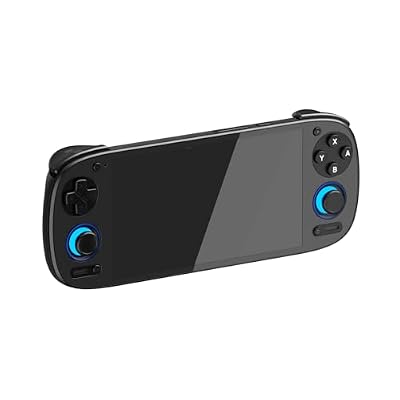
The Pocket 5 plays a different sport. Its 5,000 mAh cell is a fraction of the Windows machines’ capacity, but its Snapdragon 865 draws so little on cartridge-era, PS1 and PSP libraries that it outlasts them all there, in a 280-gram body. The boundary is clear: GameCube and PS2 are per-game stretches here, and PS3 is out of reach. If your library is the light tier, this is the battery champion that matters; if not, it is not a contender at all.
Specs:
- Battery: 5,000 mAh
- Chip: Qualcomm Snapdragon 865
- Memory and storage: 8 GB RAM, 128 GB, microSD expansion
- Display: 5.5-inch AMOLED, 1920 by 1080
- Weight: about 280 g
- System: Android 13
Screens, Charging and Power Banks
Screen choice moves runtime more than most buyers expect. An OLED panel lights each pixel individually, so dark scenes draw little; an IPS panel runs its backlight at a steady level whatever is on screen. Many classic games are bright, which narrows the OLED advantage, and a large panel of either kind draws more than a small one. Brightness discipline helps everywhere: the top of the slider costs disproportionate power.
Every pick here charges over USB-C with Power Delivery, so a power bank delivering the wattage your handheld asks for will slow the drain or hold the charge during light-tier play. Before buying any bank, check the maker’s listings and the regulator recall databases, because several popular models have been recalled in recent years.
Settings That Stretch a Charge
Hardware decides the ceiling, but three habits decide how close you get. Match the power profile to the tier — running a flagship envelope for a Game Boy library wastes the biggest lever you have. Cap the refresh rate at the rate the emulated system outputs, because a 120 or 144 Hz panel refreshing beyond the game wastes energy. Then trim brightness and switch off unused radios. A full walkthrough belongs to a settings guide; every pick here exposes power controls, so the ceiling you buy is reachable.
How to Choose
Start with your library, not the battery table. If you mostly play cartridge-era systems, PS1, DS and PSP, buy efficiency: the Retroid Pocket 5 or the ROG Xbox Ally will outlast flagships whose screens and silicon you do not need. If PS2 and GameCube are your centre of gravity, buy capacity paired with headroom: the Legion Go 2 first, the Claw 8 AI+ close behind. If PS3 or Xbox 360 matters, take the largest battery you can — the Claw or the Go 2 — and expect short, per-title sessions. Finally, weigh runtime per gram: the Xbox Ally and Go S are hundreds of grams lighter than the Go 2.
Who Should Skip
Skip this category if you play docked at a desk, where battery capacity is irrelevant and the money belongs in a mini PC. Skip the flagships if your library is light-tier only; you would be paying for watt-hours a Game Boy game cannot spend. Skip every pick here if PS3 is your main system and you expect long untethered sessions — no current handheld offers that, whatever its battery size. If you already own a Steam Deck OLED, its 50 watt-hour battery and efficient chip are genuinely competitive in the light and middle tiers; this ranking is a reason to understand your machine, not to replace it.
FAQ
Does a bigger battery always mean longer emulation runtime?
No. Runtime is capacity divided by draw, and draw changes with the system emulated. A large battery behind a hard-working flagship chip can empty sooner on PS2 games than a smaller one behind an efficient chip playing PS1 games. Compare watt-hours within your tier.
Why do maker battery claims never match emulation sessions?
Because makers measure runtime on native games at chosen settings. Emulation draw varies by console, by game and by the accuracy features you enable, so no single figure can describe it. Valve’s wide range for the Steam Deck OLED is the honest template.
Can a power bank extend emulation sessions?
Yes, provided the bank supports USB-C Power Delivery at the wattage your handheld accepts. During light-tier play a good bank can hold the charge steady; during heavy-tier play it usually slows the drain rather than stopping it. Check recall lists before buying any bank.
Which handheld is best if I only play retro cartridge systems?
The Retroid Pocket 5. Its chip draws very little on those libraries, its small AMOLED screen is frugal, and its tiny battery still outlasts the big Windows handhelds because almost nothing in it works hard. The ROG Xbox Ally is the pick if you want the same efficiency inside Windows.
Final Verdict
There is no single battery winner, because emulation runtime is a ratio, not a capacity figure. The Legion Go 2 is the best all-round endurance buy for mixed libraries centred on PS2 and GameCube. The Claw 8 AI+ holds the biggest battery and shines below the heavy tier. The ROG Xbox Ally is the efficiency sweet spot, the Legion Go S the balanced traveller, and the Retroid Pocket 5 the champion of the light libraries most retro collections are made of. Match the machine to your tier and the hours take care of themselves.







