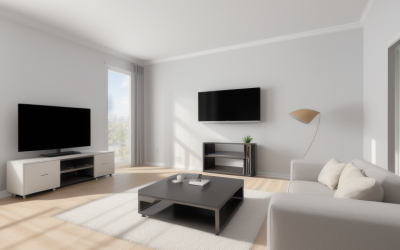
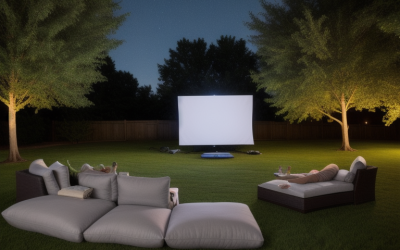
The reason to buy a short throw projector is a room that is too small, too narrow or too cluttered for a standard projector to sit far from the wall. Ultra short throw models sit inches from the screen surface and fire upward, while regular short throw models need a few feet. Either way you get a large picture without hanging a unit from the ceiling or leaving a beam across the room, which suits apartments, bedrooms, game rooms and living rooms with lots of foot traffic.
This guide covers seven projectors from the listings: four ultra short throw triple-laser home theater units, two Optoma models for portable and gaming use, and one mini smart projector marketed with short throw. The trade-offs that matter most are the throw type, the light source and brightness measurement, and how the picture looks in a lit room. One listing in the group was left out because its title never shows a short throw design, so only models that state it are covered here.
Quick Picks
| Product | Best for | Key spec from the title |
|---|---|---|
| AWOL VISION Aetherion Pro | Premium laser home theater | 4K, ultra short throw, RGB triple laser, Google TV, Dolby Vision |
| Optoma ML1080UST Photon GO | Portable small-room viewing | 1080p, ultra short throw, portable |
| Optoma GT2400HDR | Console gaming and golf simulation | Full HD 1080p, 4,200 lumens, laser, low input lag |
| Portable Smart Projector with Google TV Stick | Bedroom and ceiling movies | 4K support, Google TV Stick, HDR10, short throw |
| AWOL VISION LTV-3000 Pro | Large-screen living room | 4K, 3D, triple laser, Dolby Vision and Atmos, HDR10+, 150-inch |
| Hisense PX3-PRO | Cinema-style 80 to 150-inch image | 4K UHD, triple laser, 3,000 lumens, Dolby Vision and Atmos, IMAX Enhanced |
| XGIMI MIRA 4K | Triple-laser UST with Google TV | 4K, triple laser, 2000 ISO lumens, ISA 5.0, Dolby Vision |
How to Choose
Throw type and distance
Ultra short throw units sit on a low cabinet right below the screen, while short throw units sit several feet back. Find the throw ratio or the distance chart in the manual linked from the listing, and measure the cabinet depth in your room. Compare the screen-size range in the title, such as 80 to 150 inches, with the wall width you actually have. Placement tolerance is tighter with ultra short throw, so check the leveling features.
Brightness and light source
Laser light sources hold brightness longer than lamps, and triple laser designs use red, green and blue lasers for color. Brightness appears as ANSI lumens, ISO lumens or simply lumens, and these are not interchangeable. Look for the measurement standard in the spec table. In a room with lights on, a brighter model and an ambient light rejecting screen make a bigger difference than extra resolution.
Resolution, HDR and gaming
Native 4K means the chip produces a 4K image, while some projectors only accept 4K and scale it. Check the title for the word native. For gaming, look for low input lag or a game mode, and for HDR look for formats like Dolby Vision, HDR10 or HDR10+, which describe how the picture is encoded. HDMI port details are often missing from titles, so read the spec sheet.
Operating system, audio and screen
Several of these projectors run Google TV, which means apps are built in. Check which streaming services you need and whether the device allows them. Many ultra short throw units include speakers, but a soundbar or receiver connected through eARC is common. Remember that these projectors usually need a flat, correctly sized screen, because a wrinkled wall shows every flaw.
The 7 Best Options
AWOL VISION Aetherion Pro
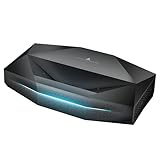
The Aetherion Pro is a 4K ultra short throw laser projector with an RGB triple laser, Google TV, Dolby Vision, PixelLock and a stated 6,000:1 contrast ratio. It suits a living-room theater where the projector sits on a media console, and the Google TV platform means a PC or console is optional for streaming.
- Strength: RGB triple laser with Dolby Vision.
- Strength: built-in Google TV.
- Limit: the title is cut off, so check the full spec sheet for brightness and ports.
Skip it if you are shopping at the budget tier.
Optoma ML1080UST Photon GO

This Optoma is a portable ultra short throw projector at 1080p. It is the pick for dorm rooms, bedrooms and small spaces that need a big image from a short distance, and the portable label suggests it moves easily between rooms or a desk and a wall.
- Strength: ultra short throw in a portable form.
- Strength: 1080p resolution.
- Limit: the title gives no brightness figure, so check the spec sheet before placing it in a lit room.
Skip it if you want 4K resolution.
Optoma GT2400HDR
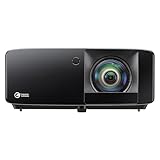
The GT2400HDR is a Full HD 1080p laser short throw projector listed at 4,200 lumens, with low input lag for gaming. The title also mentions golf simulation readiness, so it suits a dedicated game room or garage where a bright, responsive image matters more than built-in apps.
- Strength: laser light source and 4,200 lumens.
- Strength: low input lag gaming.
- Limit: it is 1080p rather than 4K.
Skip it if you want smart apps built in or ultra short throw placement.
Portable Smart Projector with Google TV Stick

This unbranded listing bundles a Google TV Stick and lists 4K support, Dolby, HDR10, WiFi and Bluetooth, with short throw and ceiling use. It reads as a mini movie projector for casual viewing, aimed at a bedroom or a ceiling rather than a brightly lit family room, so keep expectations modest on brightness and verify the native resolution.
- Strength: bundled Google TV Stick.
- Strength: short throw, ceiling and portable design.
- Limit: 4K is listed as support, not native.
Skip it if you want a laser home theater.
AWOL VISION LTV-3000 Pro
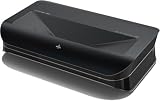
The LTV-3000 Pro is a 4K 3D ultra short throw triple laser projector with Dolby Vision, Dolby Atmos, HDR10+ and a 150-inch image. It targets large living rooms and open-plan spaces where a screen the size of a wall replaces a television, and the 3D mention makes it a candidate for buyers who still use that format.
- Strength: triple laser with Dolby Vision and Atmos.
- Strength: 150-inch UST laser TV class.
- Limit: it needs a big wall and a stable cabinet.
Skip it if your room is small.
Hisense PX3-PRO

Hisense lists an ultra short throw triple laser at 4K UHD, 80 to 150 inches, 3,000 lumens, 3000:1 contrast, Dolby Vision, Atmos and IMAX Enhanced. That feature list targets film fans who want a cinema look from a cabinet-height projector, with a stated image range that covers most living rooms.
- Strength: IMAX Enhanced with Dolby Vision and Atmos.
- Strength: 80 to 150-inch range.
- Limit: the lumens standard is not stated in the title.
Skip it if you prefer a plain 1080p model.
XGIMI MIRA 4K

MIRA 4K is a triple-laser ultra short throw at 2000 ISO lumens with 20,000:1 dynamic contrast, ISA 5.0, Google TV and Dolby Vision. The title alone does not show ports, noise level or speaker details, so those need a look at the listing.
- Strength: Google TV and ISA 5.0.
- Strength: 20,000:1 dynamic contrast.
- Limit: 2000 ISO lumens is a different standard from ANSI.
Skip it if you want the largest brightness figure.
Which One Fits Your Situation
Small apartment or dorm
Optoma ML1080UST Photon GO is portable and sits close to the wall, which helps when you cannot move furniture. The Portable Smart Projector with Google TV Stick suits casual ceiling viewing from a bed.
Living room theater
Choose between AWOL VISION Aetherion Pro, LTV-3000 Pro, Hisense PX3-PRO and XGIMI MIRA 4K. Start with the screen size range in each title and the wall you have, then compare the brightness figure, noting that ISO lumens and plain lumens are not the same measurement. The Hisense and the AWOL models list Dolby Vision and Atmos, while the XGIMI emphasizes contrast and Google TV.
Console and PC play
The Optoma GT2400HDR is built for low input lag and lists 4,200 lumens, which helps if your game room has windows. A console connects through HDMI, and a PC can connect the same way, so check the ports on the full spec sheet. If you want 4K gaming, the triple-laser models are the alternative, but confirm HDMI capability first.
Creator studio
Choose a triple laser unit, such as the AWOL VISION or XGIMI models, if you want a large, colorful wall for checking footage or screening edits. A bigger image helps in a studio, but color accuracy still depends on calibration and the screen, so use a neutral, flat surface.
Common Mistakes
- Confusing ISO lumens with ANSI lumens and comparing brightness numbers as if they used the same standard.
- Skipping the cabinet depth and distance-to-wall measurement before ordering an ultra short throw unit.
- Treating 4K support in a title as proof that the projector produces native 4K pixels.
- Aiming at a textured or uneven wall, which exaggerates flaws at the short distance.
- Forgetting sound, since a bright picture still needs speakers or a soundbar that match the room.
Frequently Asked Questions
Do I need a special screen?
Ultra short throw projectors work best with a flat screen made for them, because the light arrives at a steep angle and a normal screen or a bumpy wall can distort it. Check the screen type that the manufacturer suggests.
Is laser better than lamp?
A laser light source generally keeps its brightness longer than a lamp and starts quickly, with no bulb to replace. The trade-off is usually a higher upfront tier, so decide whether the longer life matters for how often you watch.
Can I game on these?
Yes, and the Optoma GT2400HDR lists low input lag for gaming. For other models, look for a game mode and confirm the HDMI version in the specs before connecting a console or PC.
What does ISA 5.0 mean?
The title does not explain it, so check the full spec sheet on the listing. Treat it as a manufacturer feature name for ultra short throw performance and look for details on what it adjusts.