A dorm room is one of the hardest places to game. Your desk is also your dining table, your roommate sleeps three metres away, and every charger you own fights for the same two wall outlets. A retro handheld solves most of that: no TV, no desk space, no fan noise at midnight. The catch is that not every handheld suits shared living — some are bulky, some click loudly, and some drain their battery before a study break ends.


Five handhelds pass the dorm tests, from a pocket-sized budget pick to a premium Android machine, and each earned its place on dorm criteria rather than raw power.
As an Amazon Associate, we earn from qualifying purchases.
Quick Answer
For dorm rooms, the Miyoo Mini Plus is the easiest recommendation: it is tiny, silent, and slips into a desk drawer between classes. The TrimUI Smart Pro adds a bigger widescreen for PSP games, while the Retroid Pocket 5 is the pick when you want GameCube and PS2 power with Bluetooth audio for late-night sessions.
What Dorm Life Demands From a Handheld
Before the picks themselves, it helps to define the criteria, because dorm gaming rewards different traits than gaming at home. Noise matters more than raw power: membrane buttons and passive cooling beat clicky switches and fans when someone sleeps nearby. Footprint matters too — a handheld that lives in a drawer actually gets played, while a bulky one gathers dust by mid-semester.
Fast sleep and resume is the third test: dorm sessions are short and interrupted, so a handheld that wakes instantly into a save state fits that rhythm, and one with a long boot does not. Finally, battery behaviour matters because outlets are contested, and a device that charges over USB-C from a laptop is easier to live with than one that monopolises a wall socket nightly.
Miyoo Mini Plus — The Drawer-Friendly Micro Console
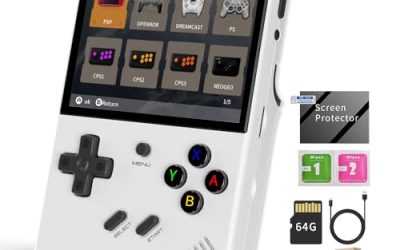
The Miyoo Mini Plus is the smallest serious retro handheld you can buy, and that size is its whole dorm argument. It is roughly the footprint of a deck of cards and disappears into a desk drawer, a backpack pocket, or the corner of a laundry bag. The membrane buttons and d-pad are soft and quiet, so late-night sessions stay silent.
Performance covers the 8-bit and 16-bit eras completely, plus PlayStation 1. The 3.5-inch screen is sharp for those systems, and the community Onion OS firmware turns the device into a save-state machine: close it mid-game and it bookmarks your place, then resumes in seconds — perfect for short sessions between classes. The trade-offs are dorm-appropriate ones: no Bluetooth, so audio is wired through the 3.5 mm jack, and no touchscreen, which matters for a small number of DS games.
Specs
- Display: 3.5-inch IPS, 640 x 480
- Processor: Allwinner A33 quad-core
- RAM: 128 MB
- Battery: 3000 mAh
- Storage: microSD card slot
- Connectivity: Wi-Fi, 3.5 mm headphone jack, no Bluetooth
- Touchscreen: No
- Weight: About 162 g
- Tier: Budget
TrimUI Smart Pro — The Slim Widescreen for Study Breaks
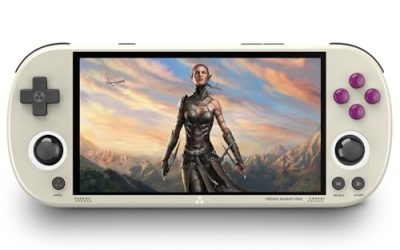
The TrimUI Smart Pro takes the opposite shape to the Miyoo: long, slim, and flat, like a phone. That profile slides into a laptop sleeve or a textbook stack without bulging, and the 4.96-inch widescreen suits PSP games in their native wide aspect. PS1 and everything below it is comfortable, and the controls stay quiet, with soft-press sticks and buttons.
Battery life is a genuine dorm advantage here. The 5000 mAh cell is large relative to the modest hardware it powers, so the Smart Pro stretches across days of short sessions instead of needing a nightly charge. Bluetooth is on board for wireless earbuds, which keeps audio private in the room. Two honest limits: no touchscreen, so stylus-heavy DS games are awkward, and the flat shape is less comfortable over very long sessions. For twenty-minute breaks, neither matters much.
Specs
- Display: 4.96-inch IPS, 1280 x 720
- Processor: Allwinner A133P quad-core
- RAM: 1 GB
- Battery: 5000 mAh
- Storage: microSD card slot
- Connectivity: Wi-Fi, Bluetooth, 3.5 mm headphone jack
- Touchscreen: No
- Weight: About 231 g
- Tier: Budget
Anbernic RG35XX Plus — The Vertical All-Rounder With TV Output
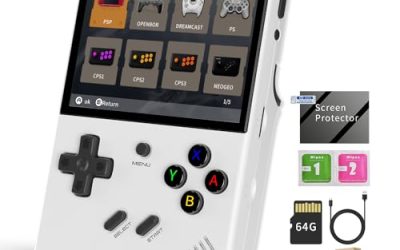
The RG35XX Plus keeps the classic vertical Game Boy silhouette but adds the two things dorm players actually use: Wi-Fi with Bluetooth, and a mini HDMI output. That output earns its place in a dorm, because most rooms have a shared TV or a roommate’s monitor, and the RG35XX Plus can drive a bigger screen for multiplayer sessions when the room turns social. Paired Bluetooth controllers complete the setup, then everything packs back into a handheld that fits a jacket pocket.
On its own screen it handles PS1, lighter Dreamcast titles, and some PSP, with a stronger processor than the two picks above. The 3300 mAh battery is the smallest here, which is the honest cost of the compact body — expect to charge it more often than the TrimUI. The buttons are a touch firmer than the Miyoo’s, though still far from loud. As one small device covering solo play and occasional TV multiplayer, it is the most flexible budget option here.
Specs
- Display: 3.5-inch IPS, 640 x 480
- Processor: Allwinner H700 quad-core
- RAM: 1 GB
- Battery: 3300 mAh
- Storage: microSD card slot
- Connectivity: Wi-Fi, Bluetooth 4.2, mini HDMI output, 3.5 mm headphone jack
- Touchscreen: No
- Weight: About 186 g
- Tier: Mid-range
Retroid Pocket Flip 2 — The Clamshell That Protects Itself

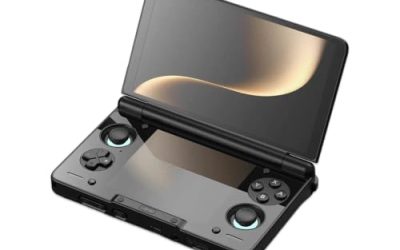
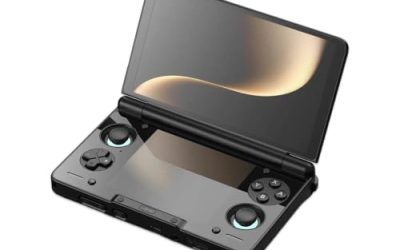
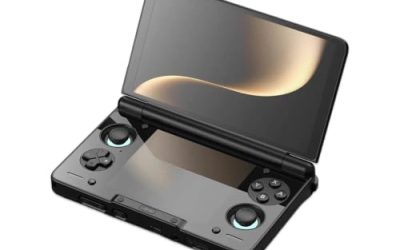
Dorm storage is hostile to screens: devices get buried under textbooks, knocked off desks, and carried loose in bags. The Retroid Pocket Flip 2 answers that with a clamshell shell — close it and the 5.5-inch AMOLED touchscreen is protected by the lid, no case routine required. Closed, it is also silent and inert, sleeping in a drawer without glowing or chiming.
Inside, this is a full Android handheld with a Snapdragon 865, so GameCube, PS2, and Dreamcast run properly rather than marginally, and the touchscreen makes DS and 3DS-style layouts workable. Hall effect sticks resist drift, which matters for a device that gets knocked around. The one dorm-relevant caveat is the active cooling fan: under heavy GameCube or PS2 loads it is audible in a quiet room, so for sleeping-roommate hours, lighter systems or earbuds are the sensible pairing. For everything else, the flip design is the most dorm-proof shape here.
Specs
- Display: 5.5-inch AMOLED, 1920 x 1080, touchscreen
- Processor: Qualcomm Snapdragon 865
- RAM: 8 GB
- Storage: 128 GB internal plus microSD card slot
- Battery: 5000 mAh
- Connectivity: Wi-Fi 6, Bluetooth 5.1, USB-C, 3.5 mm headphone jack
- Touchscreen: Yes
- Form factor: Clamshell with hall effect sticks and active cooling
- Tier: Premium
Retroid Pocket 5 — The Premium Pick for Heavier Systems
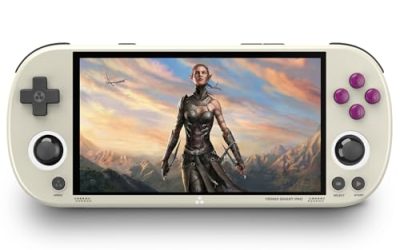
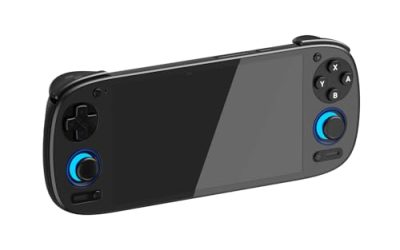
The Retroid Pocket 5 shares its processor and screen with the Flip 2 but in an open candybar shape, which makes it slimmer in a pocket and quicker to pick up for a short session. The AMOLED panel is bright enough for a sunlit library corner and dim enough for lights-out play, and the Snapdragon 865 handles GameCube and PS2 libraries that the cheaper picks cannot touch. Android also means proper Bluetooth audio with modern earbuds, so late sessions stay private.
For dorm life specifically, the USB-C video output is the sleeper feature: connect it to the room TV or a cheap monitor and it becomes a shared console for the floor, then unplugs back into a handheld. Battery capacity matches the Flip 2, and the same active-cooling note applies — heavy systems spin the fan, lighter retro systems stay near silent. If your budget stretches to one device covering NES to PS2 that also doubles as a TV console, this is the one.
Specs
- Display: 5.5-inch AMOLED, 1920 x 1080, touchscreen
- Processor: Qualcomm Snapdragon 865
- RAM: 8 GB
- Storage: 128 GB internal plus microSD card slot
- Battery: 5000 mAh
- Connectivity: Wi-Fi 6, Bluetooth 5.1, USB-C with video output, 3.5 mm headphone jack
- Touchscreen: Yes
- Form factor: Candybar with hall effect sticks and active cooling
- Tier: Premium
How to Choose
Start with the systems you actually play. If your library is NES, SNES, Game Boy, Genesis, and PS1, the Miyoo Mini Plus or TrimUI Smart Pro covers it completely — choose the Miyoo for pocketability and silence, the TrimUI for PSP and longer battery life. If you want one budget device that also drives a TV for multiplayer, the RG35XX Plus is the middle path.
Step up to the two Retroid Pocket models only if GameCube, PS2, or touchscreen DS play is on your list, because that is what the premium tier buys. Between them, pick the Flip 2 if your handheld will live in bags and drawers unprotected, and the Pocket 5 if you prefer the slimmer open shape. Whichever tier you land on, budget a microSD card and a pair of earbuds, because private audio is what makes a handheld dorm-friendly in the first place.
Who Should Skip These Picks
Skip this entire category if your dorm setup already includes a TV and a full console or gaming laptop you use daily — a handheld will duplicate what you own and sit unused. Skip the two budget Linux picks if DS and 3DS games are your priority, since neither has a touchscreen. Skip the Retroid Pocket models if fan noise at night is a hard dealbreaker and you mainly play heavy systems; the smaller passive-cooled picks are quieter, just weaker. And skip retro handhelds altogether if you need modern PC or current-console titles — a handheld gaming PC is a different product class.
Frequently Asked Questions
Which of these handhelds is quietest for a sleeping roommate?
The Miyoo Mini Plus. It has soft membrane buttons, no fan, and no Bluetooth speaker output to trigger by accident, so a late-night session produces almost no sound at all. The TrimUI Smart Pro is a close second for the same reasons.
Can I play multiplayer with friends in the dorm on one handheld?
Yes, on the picks with video output. The RG35XX Plus connects to a TV over mini HDMI and pairs Bluetooth controllers, and the Retroid Pocket 5 does the same over USB-C. The Miyoo Mini Plus and TrimUI Smart Pro are solo devices by design.
How long do these handhelds last between charges in short sessions?
The TrimUI Smart Pro and the two Retroid Pocket models carry 5000 mAh batteries and stretch across days of short retro sessions, while the RG35XX Plus, with the smallest battery here, needs charging most often. Heavy systems like PS2 drain any of them far faster than 16-bit games.
Do I need a touchscreen for dorm gaming?
Only for DS and some 3DS games that rely on stylus input. The Retroid Pocket Flip 2 and Pocket 5 have touchscreens; the three cheaper picks do not, and they still cover the NES through PS1 libraries completely, plus PSP on the TrimUI Smart Pro.
Final Verdict
For most students, the Miyoo Mini Plus is the dorm handheld to buy: the smallest, quietest, cheapest complete package for the classic libraries, and it vanishes into a drawer when space gets reclaimed. The TrimUI Smart Pro is the better budget pick if PSP widescreen and multi-day battery matter more than pocket size, and the RG35XX Plus adds TV multiplayer for a small step up. The Flip 2 and Pocket 5 are the premium answers when GameCube and PS2 are non-negotiable — Flip 2 for protection, Pocket 5 for slimness. Match the tier to your library, keep earbuds handy, and any of the five fits dorm life better than a console ever could.
Product and ASIN Reference
| Product | ASIN |
|---|---|
| Miyoo Mini Plus | B0DC6QHQ3Y |
| TrimUI Smart Pro (128GB) | B0CSK9B4G4 |
| Anbernic RG35XX Plus | B0CN3CJFZH |
| Retroid Pocket Flip 2 (Snapdragon 865) | B0FDQGNNS4 |
| Retroid Pocket 5 | B0DT4G4PD2 |