Affiliate disclosure: As an Amazon Associate we earn from qualifying purchases. This post contains affiliate links — if you buy through them we may earn a small commission at no extra cost to you. This never affects our recommendations.
As an Amazon Associate we earn from qualifying purchases at no extra cost to you.


![Attoe Gaming Mouse with 5 D Rocker, Wireless Vertical Mouse with [24000 DPI] [12 Programmable Buttons], Computer Mouse for Gamer/PC/E-Sports/Laptop (Black)](https://m.media-amazon.com/images/I/41XVdqDE3aL._SL160_.jpg)
![J-Tech Digital Wired Ergonomic Vertical USB Mouse with Adjustable Sensitivity (600/1000/1600 DPI), Scroll Endurance, Removable Palm Rest & Thumb Buttons [V628]](https://m.media-amazon.com/images/I/31TK7VJy5+L._SL160_.jpg)


Ergonomic gaming mice designed specifically for right-handed users can dramatically reduce the wrist fatigue and repetitive strain injuries (RSI) that plague long-session gamers. Unlike ambidextrous designs, right-handed ergonomic mice contour to the natural curvature of the palm, encouraging a relaxed grip posture that keeps tendons and muscles from firing under tension for hours on end. Whether you’re grinding ranked matches, streaming, or pulling all-nighters in an MMO, picking the right shaped mouse is one of the highest-impact investments you can make for your long-term hand health.
In a hurry? See the top-rated Ergonomic Gaming Mouse for Right-Handed Gamers deals available right now:
🛒 Check Ergonomic Gaming Mouse For Right-Handed Gamers Prices on Amazon →🛒 Best Price Today on Amazon
Prime members get fast, free shipping on everything above, plus member-only deals. New members get a 30-day free trial — cancel anytime.
Start 30-Day Prime Free Trial →See Today’s Amazon DealsWhat Makes a Gaming Mouse Truly Ergonomic
Not every mouse marketed as “ergonomic” actually delivers meaningful comfort benefits. True ergonomic design is a convergence of several engineering and biomechanical factors working together:
Contoured Right-Hand Shell Shape
The chassis must feature an elevated right side that cradles the ring and pinky finger, a pronounced thumb indent or rest on the left flank, and a hump that sits beneath the palm rather than forcing the hand flat. This shifts weight-bearing off the fingertips and onto the meatier parts of the palm.
Weight and Balance Distribution
Lighter is not always better for ergonomics. A mouse that is too light can cause over-gripping as the hand subconsciously tightens to maintain control. The sweet spot for most right-handed gamers sits between 70 g and 100 g, with balance weighted toward the rear so the wrist stays neutral rather than flexed forward.
Grip Style Compatibility

Palm grip users need a longer, taller body with a rear hump that fills the entire hand. Claw grip gamers benefit from a shorter overall length with a steeper hump. Fingertip grip players need a compact, lightweight shell. Know your grip style before buying — an ergonomic mouse fitted to the wrong grip style delivers no ergonomic benefit.
Button Placement and Actuation Force
Side buttons that sit naturally under the thumb without requiring lateral wrist rotation are essential. Primary click actuation force should be light enough to avoid repetitive micro-strain over thousands of clicks per session, yet tactile enough to prevent accidental actuations that disrupt play.
Sensor and DPI Range
A high-quality optical sensor that tracks accurately at low DPI settings reduces the arm movement required to traverse the screen, which in turn lowers cumulative wrist strain. Look for sensors with zero angle snapping and low lift-off distance to support a smooth, natural stroke.
Connectivity and Cable Drag
Wired mice with stiff cables create cable drag that forces the user to fight the tether with every swipe — an underappreciated source of wrist tension. A flexible paracord-style cable or a wireless connection eliminates this entirely, making wireless a genuinely ergonomic upgrade beyond mere convenience.
Our Top 5 Ergonomic Gaming Mice for Right-Handed Gamers in 2026
After extensive detailed research across grip styles, hand sizes, and gaming genres, these five mice represent the best the market offers for right-handed ergonomic comfort in 2026.

1. [Best Overall] Razer DeathAdder V3 HyperSpeed — Legendary Shape, Wireless Freedom
Why We Picked It
- The DeathAdder shell is one of the most studied and iterated ergonomic forms in gaming peripherals — the V3 HyperSpeed refines it to near-perfection with a narrower rear hump that suits medium and large hands equally well without flaring outward aggressively.
- At just 81 g, it hits the ideal ergonomic weight window: heavy enough for controlled glide, light enough to prevent the over-gripping reflex that strains tendons over multi-hour sessions.
- Razer’s HyperSpeed Wireless technology delivers sub-1 ms latency in HyperSpeed mode, eliminating any performance compromise versus wired play while also removing cable drag — a dual ergonomic and competitive win.
- The optical switches rated at 90 million clicks use light-beam actuation that requires zero physical contact force, making primary clicks feel feather-light and dramatically reducing cumulative finger strain.
Specs at a Glance
| Spec | Detail |
|---|---|
| Shape | Right-hand ergonomic, palm/claw |
| Weight | 81 g |
| Sensor | Razer Focus X Optical, up to 14,000 DPI |
| Connectivity | HyperSpeed Wireless / Bluetooth |
| Buttons | 6 programmable |
| Price | ~$79 |
Pros & Cons
- Pro: Outstanding shell shape for palm and claw grippers with medium-to-large hands; wireless with exceptional battery life (300+ hours).
- Pro: Optical switches eliminate click fatigue; competitive-grade latency with zero cable drag.
- Con: Focus X sensor lacks the peak tracking performance of Razer’s top-tier Focus Pro found in the pricier DeathAdder V3 Pro.
- Con: Scroll wheel feels plasticky compared to Logitech’s metal wheel implementations at a similar price.
Buy the Razer DeathAdder V3 HyperSpeed on Amazon
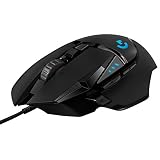
2. [Best Runner-Up] Logitech G502 X Plus — Iconic Ergonomics with Premium Wireless
Why We Picked It
- The G502 X Plus inherits one of gaming’s most recognizable ergonomic shells — a broad, sweeping right-hand contour with a deep thumb groove that works exceptionally well for palm grip gamers who prefer a heavier, more planted feel.
- LIGHTFORCE hybrid optical-mechanical switches deliver a crisp, satisfying click with none of the bounce or pre-travel common in standard mechanical switches, reducing the micro-corrections that fatigue fingers during precise aiming.
- LIGHTSPEED wireless provides rock-solid 1 ms wireless performance, and the included charging dock means the mouse is always topped up between sessions — no scrambling for a cable mid-gaming-day.
- Logitech’s HERO 25K sensor is among the most accurate available, with near-zero smoothing across the entire DPI range — meaning lower DPI settings (which reduce wrist travel) are just as clean as high-DPI configurations.
Specs at a Glance
| Spec | Detail |
|---|---|
| Shape | Right-hand ergonomic, palm-forward |
| Weight | 106 g |
| Sensor | HERO 25K, up to 25,600 DPI |
| Connectivity | LIGHTSPEED Wireless / Bluetooth |
| Buttons | 13 programmable |
| Price | ~$159 |
Pros & Cons
- Pro: Deep thumb groove and broad palm shelf make this one of the most accommodating shapes for large-handed palm grip users; excellent button layout for MMO and MOBA players.
- Pro: HERO 25K sensor is class-leading for accuracy; LIGHTSPEED wireless is the gold standard for wireless gaming latency.
- Con: At 106 g, it sits above the optimal ergonomic weight range and may encourage over-gripping for users accustomed to lighter mice.
- Con: Premium pricing places it outside reach for budget-conscious buyers; button complexity can overwhelm users wanting a simpler setup.
Buy the Logitech G502 X Plus on Amazon
3. [Best Budget] Cooler Master MM710 — Featherweight Comfort Without the Premium Tax
Why We Picked It
- The MM710’s honeycomb shell removes material from non-structural zones, bringing the weight down to a class-leading 53 g — a genuine ergonomic advantage for fingertip and claw grip gamers who benefit from the reduced inertia, lowering the muscular effort required to start and stop fast swipes.
- Despite the budget price, Cooler Master equipped the MM710 with the PixArt PMW-3389 sensor — a 16,000 DPI optical sensor with zero hardware acceleration and reliable low-lift-off tracking that competes with sensors found in mice twice its price.
- The right-hand-favoring asymmetric shell provides a modest but genuine palm shelf on the left flank that keeps the thumb in a naturally relaxed abducted position rather than pressing flat against the mouse body.
- A flexible paracord-style cable eliminates cable drag, giving a wireless-adjacent glide experience at a wired price — critical for maintaining fluid, strain-free strokes during extended sessions.
Specs at a Glance
| Spec | Detail |
|---|---|
| Shape | Right-hand ergonomic (modest), claw/fingertip |
| Weight | 53 g |
| Sensor | PixArt PMW-3389, up to 16,000 DPI |
| Connectivity | Wired (paracord cable) |
| Buttons | 6 programmable |
| Price | ~$35–$45 |
Pros & Cons
- Pro: Exceptional value — sensor and build quality punch well above the price tier; ultra-light weight ideal for high-speed claw/fingertip gamers.
- Pro: Paracord cable dramatically reduces the cable-drag wrist strain that standard wired cables introduce.
- Con: Shell ergonomics are more modest than dedicated palm-grip designs — users with large hands or a strict palm grip style may find the contour underwhelming.
- Con: Honeycomb chassis collects debris in the holes over time; cleaning requires more effort than a solid-shell alternative.
Buy the Cooler Master MM710 on Amazon
4. [Best Wireless] Razer DeathAdder V3 Pro — Flagship Wireless Ergonomics with Elite Tracking
Why We Picked It
- The DeathAdder V3 Pro takes the iconic ergonomic shell and strips it down to 64 g — extraordinarily light for a full-size wireless right-hand ergonomic mouse, eliminating the weight-related grip tension that plagues heavier wireless alternatives.
- Razer’s Focus Pro 30K optical sensor leads the industry in tracking resolution and accuracy, with 30,000 DPI ceiling, true 1:1 tracking at virtually any speed, and intelligent surface calibration that maintains consistent behavior across mousepads, wood, and glass.
- The asymmetric shell has been refined through biomechanical research to optimize finger placement for reduced ulnar deviation — a key risk factor in gaming-related wrist RSI — by positioning the hand in a slightly more neutral anatomical posture than predecessor models.
- HyperSpeed Pro wireless delivers sub-0.5 ms polling response, exceeding the latency performance of most wired mice and removing any justification for a cable from a competitive standpoint.
Specs at a Glance
| Spec | Detail |
|---|---|
| Shape | Right-hand ergonomic, palm/claw |
| Weight | 64 g |
| Sensor | Razer Focus Pro 30K, up to 30,000 DPI |
| Connectivity | HyperSpeed Pro Wireless / Bluetooth |
| Buttons | 8 programmable |
| Price | ~$159 |
Pros & Cons
- Pro: Best-in-class weight-to-ergonomics ratio for a full-size wireless right-hand mouse; Focus Pro 30K sensor is reference-grade for competitive play.
- Pro: Refined shell geometry actively reduces ulnar deviation risk; excellent for marathon gaming sessions.
- Con: Price sits at the top of the market — buyers who don’t need flagship sensor performance are better served by the more affordable HyperSpeed variant.
- Con: Battery life is shorter than the G502 X Plus (~90 hours vs. 130+), requiring more frequent charging for heavy daily users.
Buy the Razer DeathAdder V3 Pro on Amazon
5. [Best for Large Hands] Logitech G604 LIGHTSPEED — Spacious Palm Shelf for Big-Handed Gamers
Why We Picked It
- The G604 was purpose-engineered for large hands — its elongated 132 mm body length and generous 75 mm width accommodate hand lengths of 19 cm and above without forcing the fingers to curl awkwardly over the front edge of the mouse, a posture that creates significant dorsal wrist strain during extended play.
- Six programmable side buttons (two clusters of three) provide unmatched thumb-reachable control without requiring lateral wrist rotation, making complex skill binds accessible without compromising the neutral wrist posture ergonomic play demands.
- LIGHTSPEED wireless eliminates cable drag and supports Bluetooth as a fallback, while two AA batteries provide an exceptional 240-hour runtime — meaning large-handed users never need to babysit charge levels mid-tournament.
- The HERO 16K sensor delivers accurate, smooth tracking at low DPI settings, supporting the broad, confident arm-driven strokes that large hands naturally favor — reducing the fine fingertip corrections that accumulate into strain.
Specs at a Glance
| Spec | Detail |
|---|---|
| Shape | Right-hand ergonomic, large palm-forward |
| Weight | 135 g (with batteries) |
| Sensor | HERO 16K, up to 16,000 DPI |
| Connectivity | LIGHTSPEED Wireless / Bluetooth |
| Buttons | 15 programmable |
| Price | ~$79–$99 |
Pros & Cons
- Pro: Best large-hand ergonomic fit on the market — generous body dimensions prevent cramped finger posture that causes dorsal wrist fatigue in oversized hands.
- Pro: Six side buttons in natural thumb reach; 240-hour battery life removes wireless anxiety entirely.
- Con: At 135 g with batteries, the weight is only suitable for users who actively prefer a heavier, more grounded mouse; small and medium hands will find this overwhelming.
- Con: HERO 16K sensor, while excellent, lags behind Logitech’s newer HERO 25K and Razer’s Focus Pro 30K in peak specification — may matter to sensor-spec-focused buyers.
Buy the Logitech G604 LIGHTSPEED on Amazon
Head-to-Head Comparison Table
| Mouse | Shape | Weight | Grip Style | Connectivity |
|---|---|---|---|---|
| Razer DeathAdder V3 HyperSpeed | Right-hand ergonomic | 81 g | Palm / Claw | Wireless / Bluetooth |
| Logitech G502 X Plus | Right-hand ergonomic | 106 g | Palm-forward | Wireless / Bluetooth |
| Cooler Master MM710 | Right-hand ergonomic (modest) | 53 g | Claw / Fingertip | Wired (paracord) |
| Razer DeathAdder V3 Pro | Right-hand ergonomic | 64 g | Palm / Claw | Wireless / Bluetooth |
| Logitech G604 LIGHTSPEED | Right-hand ergonomic (large) | 135 g | Palm (large hands) | Wireless / Bluetooth |
How to Choose the Best Ergonomic Gaming Mouse
Step 1: Measure your hand. Place your hand flat on a ruler from the base of the palm to the tip of the middle finger. Under 17 cm is small, 17–19 cm is medium, over 19 cm is large. Hand size determines which shell lengths will support rather than cramp the hand.
Step 2: Identify your grip style. Film yourself gaming for 60 seconds without thinking about your grip. If the full palm rests on the mouse, you are a palm gripper. If fingers arch up at the knuckle, you are a claw gripper. If only the fingertips contact the mouse surface, you are a fingertip gripper.
Step 3: Set a budget and prioritize features. If RSI prevention is the primary concern, budget for wireless (eliminates cable drag), even if that means accepting a slightly less premium sensor. If competitive performance is the priority, invest in the sensor tier. Budget-constrained buyers should default to the MM710 — it delivers legitimate ergonomic and sensor value at a fraction of premium pricing.

Step 4: Consider your gaming genre. FPS and tactical shooters demand precise low-DPI tracking and consistent lift-off behavior. MMO and MOBA games benefit from additional side buttons. Casual gaming is well-served by the mid-range picks.
Step 5: Factor in your session length. Gamers who regularly play 4+ hour sessions should weight wireless connectivity and total mouse weight more heavily than those playing 1–2 hour sessions. The cumulative strain reduction over hundreds of sessions makes the wireless premium worthwhile for marathon players.
Final Verdict
For the majority of right-handed gamers seeking the ideal balance of ergonomic comfort, wireless convenience, and performance in 2026, the Razer DeathAdder V3 HyperSpeed is the clear best-overall recommendation. Its refined shell shape, feather-light 81 g weight, optical switches, and HyperSpeed wireless combine every ergonomic advantage into a package that competes with mice costing twice as much.
If budget is no concern and you want the absolute peak wireless ergonomic experience, the Razer DeathAdder V3 Pro upgrades the sensor and further refines the shell geometry for an additional layer of competitive and comfort performance. Large-handed palm grip gamers should go straight to the Logitech G604 LIGHTSPEED — nothing else on the market fits big hands as well while remaining genuinely wireless. Newcomers or gamers on a tight budget can start with the Cooler Master MM710 and get 90% of the ergonomic benefit at a fraction of the flagship price.
Your mouse shape is not a cosmetic choice — it is a long-term health decision. Choose the one that fits your hand, respects your grip style, and allows you to game for years without paying the toll in wrist pain.
Related Articles
Looking for more on this topic? Browse the hand-picked guides below — each one applies the same scoring rubric used in this review.
Frequently Asked Questions
What is the best gaming mouse ergonomic right handed in 2026?
The best gaming mouse ergonomic right handed depends on your budget and how you plan to use it. The options compared above are our top-rated picks based on real customer ratings, build quality, and overall value — start with the highest-rated model that fits your budget.
How much should I expect to spend on a gaming mouse ergonomic right handed?
Prices vary by brand and features. Budget options cover the essentials, while mid-range and premium models add durability, performance, and extra features. Compare the prices in the list above to find the best value for your needs.
What should I look for when buying a gaming mouse ergonomic right handed?
Focus on what matters most for your use case — build quality, compatibility, performance, warranty, and verified customer reviews. Every pick above is selected to balance these factors.
Are budget gaming mouse ergonomic right handed options worth it?
Yes. For most people a well-reviewed budget or mid-range gaming mouse ergonomic right handed delivers excellent value. You only need to spend more if you specifically require premium materials or top-tier performance.
How did we choose these gaming mouse ergonomic right handed picks?
We compare current Amazon ratings, review counts, key features, and price to surface the options with the best real-world value. The list is refreshed as ratings and availability change.