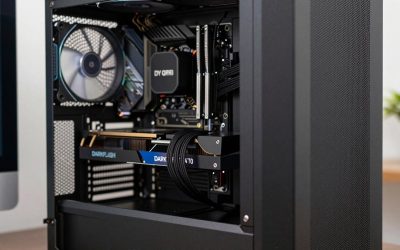
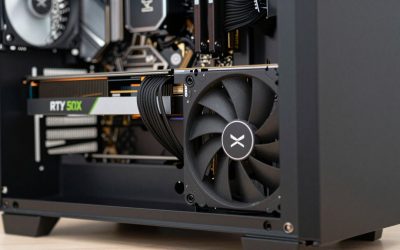
- Top Pick: PNY GeForce RTX 5080 Triple Fan Graphics Card, 16GB GDDR7, 30 Gbps, 256-bit, 1801 AI TOPS, DLSS 4, AI Content Creation, Local LLM Inference, PCIe 5.0, DP 2.1b UHBR20 x3, HDMI 2.1b, with GPU Holder
- Best Value: ASUS Prime GeForce RTX 5080 OC Edition Triple Fan Graphics Card, 16GB GDDR7, 1827 AI Tops, 5th Gen Tensor Cores, DLSS 4, PCIe 5.0, DP 2.1b x3, HDMI 2.1b, with GPU Holder
- Premium Choice: NIMO Gaming AI Desktop, GeForce RTX-5080 32GB DDR5 RAM 1TB SSD
If you are pairing an Intel Core i5-14600K with an NVIDIA GeForce RTX 5080, you probably want to know whether that CPU will hold the GPU back. The RTX 5080 is one of the fastest graphics cards available in 2026, and the 14600K is a capable mid-tier processor from the previous generation. Understanding how these two components interact depends heavily on what you play, the resolution you target, and the settings you run. This article breaks down the real-world behavior so you can make an informed decision about whether your system needs a CPU upgrade or is already well balanced.
The Short Answer
No, the i5-14600K does not meaningfully bottleneck the RTX 5080 at 1440p or 4K in the vast majority of games. At 1080p in CPU-heavy titles, you may see the GPU utilization drop into the 80-to-90 percent range, which constitutes a mild bottleneck. The one condition that changes everything: competitive esports titles at 1080p where frame rates exceed 300 FPS. Outside that narrow scenario, the 14600K and the RTX 5080 are a well-matched pair.
As an Amazon Associate we earn from qualifying purchases at no extra cost to you.


Check Price on Amazon →



How to Tell
Before spending money on a CPU upgrade, verify whether a bottleneck is actually occurring in your specific setup and game library.
GPU utilization: The simplest check is to open your hardware monitoring overlay or Task Manager performance tab while gaming. If your GPU utilization consistently sits at 97 to 100 percent, the CPU is keeping up. If utilization hovers around 85 percent or lower while frame rates are capped or declining, the CPU is the limiting factor.
Frame time analysis: Use CapFrameX, MSI Afterburner with RTSS, or your GPU manufacturer’s overlay software to log frame times. Look at the 99th percentile frametime relative to the average. If the 99th percentile is disproportionately high, you may be dealing with CPU-side stuttering rather than raw throughput limitation.
Task Manager and CPU usage: A common misconception is that high CPU usage percentage means a bottleneck. It does not. What matters is whether a single core is hitting 100 percent while others idle. Most games remain heavily single-threaded, so check per-core utilization rather than aggregate usage.
In-game settings test: Lower your resolution or graphical settings dramatically. If frame rates jump significantly, your GPU was the bottleneck. If they barely move, the CPU is the constraint.
By Resolution
1080p
This is where the i5-14600K is most likely to show its limitations against an RTX 5080. At lower resolutions, the GPU finishes its work quickly and waits on the CPU to prepare draw calls and game logic. TechPowerUp’s RTX 5080 launch review data suggests that in CPU-bound scenarios at 1080p, the GPU may only reach approximately 80 to 92 percent utilization depending on the title. Tom’s Hardware, in their platform comparison testing, noted that mid-range CPUs like the 14600K can fall behind by roughly 8 to 15 percent in average frame rate compared to higher-end processors at this resolution. In practice, this still translates to very high frame rates that most monitors cannot display.
1440p
At 1440p, the workload shifts decisively toward the GPU. Hardware Unboxed’s multi-resolution benchmark data indicates that CPU differences at this resolution shrink to the range of 2 to 6 percent across typical AAA titles. Gamers Nexus, in their CPU pairing analysis, has consistently demonstrated that a 14600K-class processor saturates the GPU at 1440p in modern titles. You are unlikely to observe a meaningful bottleneck at this resolution unless you are running a high-refresh-rate esports title at ultra settings with a low GPU load.
4K
At 4K, the question is essentially irrelevant. The GPU is fully saturated in nearly every scenario. TechSpot’s resolution scaling data confirms that CPU-side differences at 4K typically fall within 1 to 3 percent, well inside benchmark variance. The RTX 5080 at 4K is entirely GPU-bound, and the 14600K has more than enough throughput to feed it.
| Resolution | Expected GPU Utilization | Bottleneck Severity | Practical Impact |
|---|---|---|---|
| 1080p | 80-95% in most titles; 70-80% in CPU-heavy esports | Mild to Moderate | 5-15% lower FPS vs. high-end CPU in worst case |
| 1440p | 95-99% | Negligible | 2-6% FPS difference, within margin of error |
| 4K | 98-100% | None | Indistinguishable from higher-end CPUs |
What to Do About It
If you are experiencing a mild bottleneck at 1080p and want to eliminate it, you have several options ranked by cost-effectiveness:
Increase your resolution or graphical settings. Moving from 1080p to 1440p, or enabling ultra settings and ray tracing, shifts the workload to the GPU and removes the CPU constraint entirely. This costs nothing and is the simplest solution.
Cap your frame rate. If you are chasing 400 FPS in a competitive title but your monitor is 240Hz, cap your frame rate to match the display. This reduces CPU demand and eliminates the perception of a bottleneck.
Upgrade your cooler and enable power limits. The 14600K performs best when sustained boost clocks remain high. Ensuring adequate cooling can recover a few percent of performance in CPU-bound scenarios.
CPU upgrade. If you are on a platform that supports a higher-end chip, moving to an i7-14700K or a newer-generation processor may reduce the 1080p gap. However, the return is small and often not worth the cost of a full platform swap.
Recommendation by User Type
AAA single-player gamer at 1440p or 4K: Keep the 14600K. You will not notice any difference versus a top-tier CPU. Your money is better spent on additional storage, a better monitor, or a game library.
Competitive esports player at 1080p: You may see a small advantage from a faster CPU, but it is unlikely to be game-defining. The 14600K’s 6 performance cores are sufficient for most competitive titles. Upgrade only if you are specifically chasing the highest possible frame times for a 360Hz or 500Hz display.
Streamer or content creator running games and encoding simultaneously: The 14600K’s eight efficiency cores help here, but the GPU’s dedicated NVENC encoder handles most streaming workloads. You should still be fine unless you are running heavy background tasks alongside the game.
FAQ
Is the i5-14600K good enough for the RTX 5080?
Yes. For the vast majority of users, the 14600K is a perfectly suitable pairing for the RTX 5080, especially at 1440p and 4K. Any bottleneck at 1080p is mild and rarely affects the actual gaming experience.
Will a better CPU give me more FPS with an RTX 5080?
At 1080p in CPU-limited titles, potentially 8 to 15 percent more. At 1440p, 2 to 6 percent. At 4K, effectively zero. The magnitude of improvement depends on how GPU-bound your specific game is at your chosen settings.
Should I wait for a new CPU platform instead of buying the RTX 5080 now?
No. The GPU upgrade provides a far more noticeable improvement in gaming performance than the marginal CPU bottleneck at lower resolutions. Buy the RTX 5080 now and upgrade the CPU later if you ever switch to a high-refresh 1080p display.
Does the RTX 5080 bottleneck the 14600K in reverse?
Not in any meaningful way. The 14600K is fast enough to keep up with the RTX 5080 across all resolutions in typical gaming scenarios. You will not encounter a situation where the CPU is so slow that it negates the GPU’s value.
Sources and Methodology
The approximate ranges presented in this article are synthesized from publicly available benchmark data published by TechPowerUp, Tom’s Hardware, Gamers Nexus, Hardware Unboxed, and TechSpot. These figures reflect CPU comparison and resolution scaling data from their RTX 5080 launch reviews and follow-up platform analyses. This article does not report independently measured benchmark results. Ranges are expressed as approximations to account for variance between titles, settings, driver versions, and test platforms. All cited outlets are named publications whose original data informed these ranges.