Totally Reliable Delivery Service is We’re Five Games’ physics-driven delivery co-op game, released on Steam on 1 April 2021: up to four couriers wrestle packages across an open map, locally or online. Its store page presents it as a Windows and Mac game, and anyone scanning for a penguin icon will conclude there is nothing to install.


The game’s own record disagrees. Inside the same data sits a fully written Linux requirements tab, and behind it a full-size Linux depot inside the package a purchase delivers. One layer says no Linux build exists; three deeper layers say one was built, packaged and sold. This article walks them in order.
As an Amazon Associate, we earn from qualifying purchases.
Quick answer
Yes, with a paperwork catch. Steam’s store flag says Windows and Mac only, yet the same record carries a fully written Linux requirements tab, and the package a purchase delivers contains a real Linux depot alongside the Windows and Mac ones. The build is genuine but frozen since 2021, and Valve’s Deck badge was earned under Proton.
The flag layer: a flat no
Steam’s app record lists the platforms as Windows true, Mac true and Linux false — the false that draws the platform icons and feeds the search filters. Nor is it one slip: the store package a purchase delivers, sub 335006, repeats the same line on its own record. Two flag readings agree; on most games in this cluster that ends the enquiry. The record carries no DRM or external-account notice either. If the flags were the whole file, this would be an ordinary not-native article. They are not.
The requirements tab: written out in full
Beneath the flags, the Linux requirements field is neither the empty list nor the hollow shell this cluster usually finds on a Windows-only record. The minimum names Ubuntu 10.10 and SteamOS, an Intel Core i5 2500K, 4 GB of RAM, a GTX 560 or Radeon HD 5870 class card — with the period joke “or whatever” left in — and 4 GB of storage. The recommended tier steps up to an i7 3770K or Ryzen 5 1600, 8 GB of memory and a GTX 1060 or RX 480.
Text alone proves little here; copied blocks have decorated records that ship nothing. But this is not the Windows block pasted sideways — the system lines name Ubuntu and SteamOS. It reads like paperwork for a real build; the next layer decides whether it shipped.
The depot layer: the build is in the box
SteamDB’s depot table lists three content depots. Depot 1011671 holds the Windows build at 4.29 GiB, depot 1011672 the macOS build at 4.32 GiB, and depot 1011673, named “Totally Reliable Delivery Service Linux”, holds a Linux build at 4.06 GiB — the same order of size as its siblings, not a token placeholder.
Existence alone is not delivery — this cluster’s stranded-depot cases prove a depot no package grants might as well not exist — so the decisive check is the package. SteamDB’s record for sub 335006, the ordinary store package, lists all three depots inside it. A normal purchase grants the Linux build, on the very package whose platform line reads Linux false — the inverse of the usual trap.
One honest qualification: the Linux depot’s last update is dated 3 September 2021, while the Windows depot moved as recently as June 2026 and the macOS depot in January 2026. The build delivered today is the 2021 build — a real native version of the game as it then stood, not a port kept current.
The family sweep: five extras, no extra builds
The downloadable-content array holds five apps, each read on its own record. The three launch packs — Stunt Sets, Cyberfunk and Dress Code — all flag Linux true and repeat the game’s written Linux requirements text. Mascot Mayhem, the newest extra, also flags Linux true, but over empty lists on every platform: the bare-flag shape. Atari Attire dissents the other way, flagging Linux false with empty lists throughout.
None of it moves the verdict: SteamDB marks the extras’ depots as Unused, their content riding inside the base game’s depots. These packs inherit the base builds; none carries a Linux build of its own, and their flags are inherited paperwork, not evidence. A family scan trusting them would report this game’s status three different ways.
Anti-cheat and the online file
The game lists Online Co-op among its Steam categories, so the anti-cheat question matters, and the three sources stay separate. Steam’s record names no anti-cheat. SteamDB’s detected-technology list is engine and networking plumbing — Unity, the Epic Online Services SDK, the Photon SDK, SteamworksNET — middleware, not a verdict from anyone. The Are We Anti-Cheat Yet dataset carries no entry for this game, searched by name and app number. Nothing names a kernel-level blocker; equally, nothing here is a promise about servers or sessions, and the article makes none.
The Proton file: a thin pool that never went native
ProtonDB’s summary reads Gold as headline tier, Platinum as best-reported and Gold as trending, from just four reports at low confidence — one of the thinnest pools in this cluster. Every report runs the Windows build under a named Proton version: a Deck filing on Proton 7.0-4 describing out-of-the-box play, a recent GE-Proton filing reporting a flawless run, and one older report of slowdowns on an early Proton 6 build.
The game’s ProtonDB page heads its requirements block “Natively Supports:”, a label this cluster usually catches contradicting Steam outright. Here it is half right: it agrees with the field, the depot and the package, and disagrees only with the flag. The pool shows players reaching for Proton anyway — the route Valve certified, tracking the current build rather than the frozen 2021 one.
The Steam Deck sheet: Verified, under Proton
Valve’s compatibility record, read through SteamDB’s republication of Valve’s data, grades the game Verified, with SteamOS separately marked Compatible. All four Verified items pass: full functionality on the default configuration, Deck icons, legible text, and default graphics that perform well. The sheet was tested on 2 March 2022 against build 7302426; its recommended runtime is proton-7.0-1.
That runtime line is the sheet’s quiet surprise. With a native depot sitting in the package, Valve certified the Windows build through Proton, not the native build. The paperwork also predates the current branch build — a supplement candidate for the list of Deck sheets awaiting a fresher test. A badge earned in 2022 under Proton says nothing about the native depot.
The GOG ruling
There is no GOG edition to weigh: GOG’s search returns no product for the game, and its natural product address resolves to the general catalogue, not a verifiable product page. No wishlist page is treated as an edition here. The Steam copy — the one carrying the hidden Linux depot — is the only PC edition.
Gear that fits the record
The gear below follows the record’s shape: the badged handheld, two couch pads, a desktop mouse, and library storage.
Valve Steam Deck OLED 512GB
The handheld the Verified badge was written for — and the badge certifies the Windows build under Proton, against requirements far below the Deck’s APU.
Specs
- Display: 7.4-inch HDR OLED, 1280 by 800, up to 90 Hz
- Processor: AMD Zen 2 and RDNA 2 custom APU
- Memory: 16 GB LPDDR5
- Storage: 512 GB NVMe, plus a microSD slot
- Wireless: Wi-Fi 6E and Bluetooth
- Channel note: Valve sells the Deck mainly through its own store, so Amazon listings are third-party sellers
8BitDo Ultimate 2 Bluetooth Controller
The first couch pad, for a four-player co-op game: modern sticks and triggers plus back buttons for the grab and throw inputs a delivery run repeats.
Specs
- Connectivity: Bluetooth wireless and USB-C wired
- Joysticks: TMR electromagnetic, anti-drift design
- Triggers: Hall effect, with mode switching
- Extras: two remappable back buttons, motion control
- In the box: charging dock included
Xbox Wireless Controller, Carbon Black

The safest guest pad in PC gaming: universal Steam Input support, matching glyphs, and Bluetooth or its own wireless standard — what a rotating co-op cast needs.
- Connectivity: Xbox Wireless and Bluetooth
- Port: USB-C for wired play
- Controls: hybrid D-pad, dedicated Share button
- Power: AA batteries or optional rechargeable pack
Logitech G502 HERO

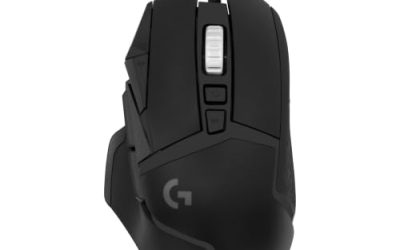
At a desk, the game’s menus and map screens are pointer work; a precise wired mouse turns loadout and route checks into single clicks, and eleven programmable buttons cover the repeated inputs.
Specs
- HERO optical sensor, up to 25,600 DPI
- 11 programmable buttons
- Adjustable weight system
- Wired USB connection
- On-board memory profiles
Samsung T9 Portable SSD 2TB

For moving a Linux game library between machines, or keeping an offline backup of installers, a fast USB-C drive is the simple answer. The headline figure needs a Gen 2×2 host port; on a lesser port the drive runs at that ceiling.
Specs
- Capacity: 2 TB portable SSD
- Interface: USB 3.2 Gen 2×2, USB-C connector
- Maker-rated speeds: up to 2,000 MB per second read, 1,950 MB per second write
- Features: Dynamic Thermal Guard, maker-rated drop resistance
How to choose
Choose your route by which fact matters more. The native route costs nothing extra: a normal purchase already includes the Linux depot, whatever the icons claim, so a Linux desktop can install the hidden build. But that build is the 2021 version, frozen while the other builds kept moving — for online co-op on current versions, the Proton route is the one the pool and Valve’s test describe, and its Gold headline says the Windows build behaves. On Deck, follow the badge: earned under Proton, on an older build, with the sheet’s configuration as the known-good start. Either way, ignore the extras’ flags; their paperwork points three ways at once.
Who should skip
Skip the native build if your crew plays online across platforms and versions: a 2021 build poorly matches a game whose other platforms are current, and nothing promises it a seat in a modern session. Skip it on Linux altogether if a four-report ProtonDB pool at low confidence is too thin a file — the evidence here is structural far more than communal. And skip it if a store page that denies its own contents puts you off; the contradiction is real, and the storefront will not resolve it.
FAQ
Does Totally Reliable Delivery Service run natively on Linux?
Yes. Beneath a store flag reading Linux false, the record holds a fully written Linux requirements tab and a Linux depot of about 4 GiB inside the ordinary store package. A normal purchase delivers the native build — in its 2021 form, not updated since.
Why does the Steam page show no Linux icon?
Because the platform flag on the game’s record and its store package reads false, and the icons follow the flag. The field, the depot table and the package contents were never aligned with it — a paperwork split inside one record, where the delivery layers decide what installs.
How does it run under Proton?
ProtonDB gives the Windows build a Gold headline tier, Platinum best-reported and Gold trending, from four reports at low confidence. The filings describe out-of-the-box play, including on Deck under Proton 7.0-4, with one older report of slowdowns on Proton 6.
What does the Steam Deck Verified badge actually cover?
The Windows build under Proton. Valve’s sheet, tested in March 2022 on an older build, sets its runtime to proton-7.0-1 and passes all four Verified items. It predates the current build and never mentions the native depot.
Final verdict
Totally Reliable Delivery Service is a native Linux game whose storefront says otherwise. The flag layer — repeated on the game and its package — is the only layer denying the port; the field is written in full, the depot is real and full-size, and the purchase package contains it. Set against that: the build is frozen in 2021, Valve certified the Proton route instead, and the community file is four reports deep. Buy it on Steam and the Linux build is yours — just know which vintage it is, and that the livelier evidence trail runs through Proton.
Product and ASIN Reference
| Product | ASIN |
|---|---|
| Valve Steam Deck OLED 512GB | B0CQ3RWQQZ |
| 8BitDo Ultimate 2 Bluetooth Controller | B0F194QFT2 |
| Xbox Wireless Controller, Carbon Black | B08DF248LD |
| Logitech G502 HERO | B07GBZ4Q68 |
| Samsung T9 Portable SSD 2TB | B0CHFS9K14 |