

- Top Pick: GIGABYTE AMD Radeon RX 6800 XT Gaming OC 16G Graphics Card, 16GB of GDDR6 Memory, Powered by AMD RDNA 2, HDMI 2.1, WINDFORCE 3X Cooling System, GV-R68XTGAMING OC-16GD (Renewed)
- Best Value: PowerColor AMD Radeon RX 6800 XT Gaming Graphics Card with 16GB GDDR6, Raytracing, PCIe 4.0, HDMI 2.1, AMD Infinity Cache (Renewed)
- Premium Choice: Sapphire Technology Pulse AMD Radeon RX 6700 XT Gaming Graphics Card with 12GB GDDR6, AMD RDNA 2 (11306-02-20G) (Renewed)
The newer RX 6700 XT is actually the slower card, trailing the RX 6800 XT by roughly 25-35% at 1440p, so the RX 6800 XT is the better buy for 1440p and entry-level 4K, while the RX 6700 XT only wins for 1080p builds with a smaller power supply or a tighter budget.
The release dates can be misleading. The RX 6800 XT launched in October 2020 as one of AMD’s RDNA 2 flagships, and the RX 6700 XT followed in March 2021 as the upper-midrange card. Being several months newer does not make the RX 6700 XT an upgrade; it is a step down in the same product family, built on the smaller Navi 22 chip.
As an Amazon Associate we earn from qualifying purchases at no extra cost to you.

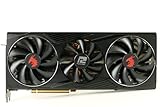
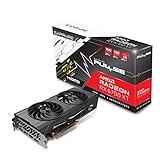

Navi 21 vs Navi 22: The Spec Picture
| Spec | RX 6800 XT | RX 6700 XT |
|---|---|---|
| Architecture | RDNA 2.0 (7 nm) | RDNA 2.0 (7 nm) |
| Release date | 28 October 2020 | 3 March 2021 |
| Launch MSRP | $649 | $479 |
| Stream processors | 4608 | 2560 |
| Boost clock | 2250 MHz | 2581 MHz |
| VRAM | 16 GB GDDR6 | 12 GB GDDR6 |
| Bus / bandwidth | 256-bit / 512.0 GB/s | 192-bit / 384.0 GB/s |
| Cache | 4 MB L2 + 128 MB L3 | 3 MB L2 + 96 MB L3 |
| TDP | 300 W | 230 W |
| Power connectors | 2x 8-pin | 1x 6-pin + 1x 8-pin |
| Length / width | 267 mm / 2-slot | 267 mm / 2-slot |
| Outputs | 1x HDMI, 2x DisplayPort, 1x USB-C | 1x HDMI, 3x DisplayPort |
The RX 6800 XT has 80% more stream processors, a wider bus, 33% more bandwidth and a larger Infinity Cache. The RX 6700 XT runs higher clocks to claw some of that back, but cannot close the gap.
How Far Apart Are They in Games?
TechPowerUp’s relative performance charts place the RX 6700 XT at roughly three quarters of the RX 6800 XT’s performance at 1440p. Aggregated benchmark data ranges from about a 14% gap on the low end to above 30% on the high end, depending on the game list and resolution. TechSpot’s launch review of the RX 6700 XT found it around 10-14% behind even the non-XT RX 6800 in several titles, which is itself slower than the 6800 XT.
- 1080p: RX 6800 XT roughly 20-25% faster; CPU limits narrow the gap in some games.
- 1440p: roughly 25-35% faster.
- 4K: roughly 35-45% faster, as the RX 6700 XT’s narrower bus and smaller cache run out of headroom.
As a rough example, a game averaging about 75 fps at 1440p high on the RX 6700 XT would often run around 95-100 fps on the RX 6800 XT. Results vary with CPU, settings and patch, but the order does not change.
Ray Tracing and Upscaling Support
Both cards use first-generation RDNA 2 ray accelerators, one per compute unit, so the RX 6800 XT’s larger chip also gives it proportionally more RT hardware. Ray-traced performance follows roughly the same gap as raster, and both cards fall well behind Nvidia’s Ampere and newer cards in heavy RT. Light RT effects are usable on the RX 6800 XT at 1440p; on the RX 6700 XT they are best kept to 1080p with upscaling.
Feature support is identical. Both use FSR 3.1 upscaling and frame generation in supported games, AMD Fluid Motion Frames at the driver level, and XeSS through its DP4a path. FSR 4 targets the RX 9000 series, so neither card gains the newer machine-learning upscaler as a standard feature.
VRAM: 16 GB vs 12 GB
Both cards have more memory than the 8 GB cards that struggle in many 2026 releases. Approximate needs:
- 1080p: 8-10 GB is enough; both are comfortable.
- 1440p: 12 GB is the comfortable target; the RX 6700 XT meets it, the RX 6800 XT exceeds it.
- 4K: 16 GB is the safer target; only the RX 6800 XT meets it.
In practice, the RX 6700 XT runs out of GPU horsepower at 4K before it runs out of memory, so its 12 GB is well balanced for what the chip can do.
Power, PSU and Physical Fit
The RX 6800 XT is rated at 300 W and the RX 6700 XT at 230 W, a 70 W difference.
PSU sizing worked example
- RX 6800 XT: 300 W + 125 W (typical gaming CPU) + 150 W headroom = about 575 W, so a quality 750 W unit is the comfortable choice and matches AMD’s guidance.
- RX 6700 XT: 230 W + 125 W + 150 W = about 505 W, so a quality 600-650 W unit is enough.
Anyone moving from an RX 6700 XT to an RX 6800 XT on a 550-650 W unit should check the PSU’s quality and 12 V rating, as RDNA 2’s top cards can spike briefly above their rated power.
Connectors and size
The RX 6800 XT needs two 8-pin connectors, while the RX 6700 XT uses a 6-pin plus 8-pin layout. Both reference cards measure 267 mm and two slots, but many partner RX 6800 XT models are longer than 300 mm with 2.5- or 3-slot coolers, while many RX 6700 XT models are compact dual-fan designs. Small form factor builders will find more fitting options on the RX 6700 XT side.
Cost per Frame
At launch MSRP
Setting the RX 6700 XT at 100 and the RX 6800 XT at about 130 at 1440p:
- RX 6700 XT: 100 / $479 = 0.209 performance points per dollar.
- RX 6800 XT: 130 / $649 = 0.200 performance points per dollar.
At MSRP they were nearly identical in value, which meant the RX 6800 XT’s extra speed came at a fair price.
On the used market
In 2026 the RX 6700 XT usually sells for around $200-$250 used, and the RX 6800 XT for around $300-$370. Using midpoints of $225 and $335, the RX 6700 XT gives about 0.444 points per dollar and the RX 6800 XT about 0.388. The RX 6700 XT is therefore the better pure value, while the RX 6800 XT is the better performance-per-build choice for 1440p high refresh. Mining-era used cards are common for both, so fan condition, hotspot temperature and repasting history are worth checking.
Pick the RX 6800 XT If / Pick the RX 6700 XT If
| Resolution and budget | Pick the RX 6800 XT if… | Pick the RX 6700 XT if… |
|---|---|---|
| 1080p, tight budget | You want 144 Hz+ in demanding games | You want the best value and lower power |
| 1440p, mid budget | You want high settings and high refresh | 60-90 fps targets with FSR are acceptable |
| 4K | You accept high settings plus FSR | Not recommended |
| 550-650 W PSU | Only with a quality unit and modest CPU | Fits comfortably |
| Small case | Choose a reference-length model | More compact models available |
Buyers considering new cards should also compare the RX 9060 XT 16 GB, which brings FSR 4 and stronger ray tracing at lower power, and the RX 9070 for anyone who wants RX 6800 XT-class performance or better with a warranty.
Tuning and Upgrade Notes
Both cards undervolt well in AMD’s Adrenalin software, which can trim power and noise without large performance losses. An RX 6700 XT owner looking for a meaningful upgrade should aim for RX 6800 XT-class performance or higher, rather than the small step to an RX 6750 XT.
Frequently Asked Questions
Is the RX 6700 XT an upgrade over the RX 6800 XT?
No. Despite launching a few months later, the RX 6700 XT is a lower-tier card and is roughly 25-35% slower at 1440p. Moving from an RX 6800 XT to an RX 6700 XT would be a downgrade in performance and memory.
Is the RX 6800 XT worth the extra over the RX 6700 XT?
For 1440p high refresh and 4K, yes, as the performance gap is large and the 16 GB of VRAM adds headroom. For 1080p gaming, the RX 6700 XT offers better value per dollar. The decision mostly comes down to resolution and power supply.
Can the RX 6700 XT run 1440p games?
Yes, it handles 1440p well in most games at high settings, with FSR helping in the most demanding releases. Its 12 GB of VRAM is enough for 1440p textures in nearly all current games. Ray tracing at 1440p is limited.
What PSU does the RX 6800 XT need?
A quality 750 W unit is the standard recommendation. The 300 W card plus a typical gaming CPU and headroom lands near 575 W. Two separate 8-pin PCIe cables are preferable to one daisy-chained cable.
How does the RX 6750 XT fit between these two?
The RX 6750 XT is a refreshed RX 6700 XT with higher clocks and faster memory, typically a few percent faster than the RX 6700 XT. It still sits well below the RX 6800 XT. It also draws more power than the RX 6700 XT.
Ready to decide? Our #1 pick for 2026 is the Architecture.
Live price & availability on Amazon.












