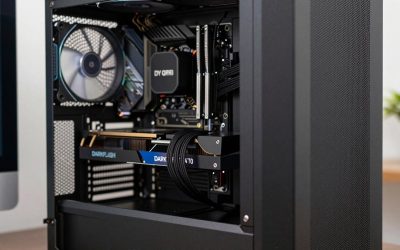
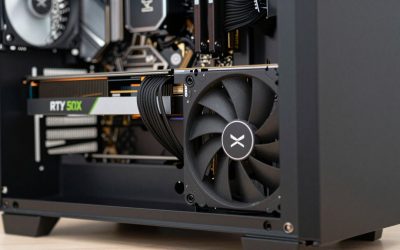
The question of whether to pick up an RTX 5070 or settle for a used RTX 3080 is one of the most practical cross-generation debates on the market in 2026. The RTX 5070 represents NVIDIA’s newest Blackwell architecture, arrives with 12 GB of GDDR7, and unlocks a suite of features that the aging RTX 3080 simply cannot replicate. Meanwhile, the RTX 3080 sits on the used market at a fraction of its original launch price, retains a wider memory bus, and still handles the vast majority of titles at high settings without breaking a sweat.
What makes this comparison genuinely difficult is that neither card is an obvious default. The RTX 5070 costs significantly more but brings multi-frame generation, a newer AV1 encoder, and architectural efficiency that matters if you are upgrading a small-form-factor build. The RTX 3080 costs less, has higher raw memory bandwidth on paper, and is still a very capable card in rasterization-heavy scenarios. Choosing between them requires weighing features against pure price-per-frame, and it depends heavily on your resolution target, whether you care about frame generation, and how much you are willing to spend upfront.
As an Amazon Associate we earn from qualifying purchases at no extra cost to you.

Quick Verdict
If you are buying today, the RTX 5070 is the better card for most people. It outperforms the RTX 3080 in the majority of rasterization benchmarks by a comfortable margin, and the DLSS 4 multi-frame generation support turns a modest performance advantage into a massive one in supported titles. The RTX 3080 only wins in one scenario: extreme budget constraints on the used market where every dollar counts and you do not intend to use any upscaling or frame-generation features.
Specs Side by Side
| Spec | RTX 5070 | RTX 3080 |
|---|---|---|
| Architecture | Blackwell (GB205) | Ampere (GA102) |
| CUDA Cores | 6144 | 8704 |
| RT Cores | 48 (4th gen) | 68 (2nd gen) |
| Tensor Cores | 192 (5th gen) | 272 (3rd gen) |
| Boost Clock | ~2520 MHz | ~1710 MHz |
| Memory | 12 GB GDDR7 | 10 GB GDDR6X / 12 GB GDDR6X |
| Memory Bus | 192-bit | 320-bit / 384-bit |
| Memory Bandwidth | ~672 GB/s | ~760 GB/s / ~912 GB/s |
| TDP | 250W | 320W / 350W |
| Interface | PCIe 5.0 x16 | PCIe 4.0 x16 |
| Display Outputs | 3x DP 2.1b, 1x HDMI 2.1b | 3x DP 1.4a, 1x HDMI 2.1 |
| MSRP | $549 | $699 (10 GB) / $719 (12 GB) |
Gaming Performance
1080p
At 1080p, the RTX 5070 holds a roughly 12-18% lead over the RTX 3080 in average rasterization frame rates, according to launch coverage from TechPowerUp and Hardware Unboxed. Tom’s Hardware reported a similar gap in their 1080p test suite. In practice, this means that if the RTX 3080 delivers 140 fps in a competitive shooter, the RTX 5070 pushes into the 155-165 fps range. Both cards are well above the threshold where the difference becomes perceptible at this resolution, but the RTX 5070 gives you extra headroom for pushing refresh rates closer to 240 Hz without dropping settings.
1440p
The gap at 1440p remains consistent with 1080p. Hardware Unboxed and TechSpot both placed the RTX 5070 approximately 10-17% ahead of the RTX 3080 in their 1440p gaming benchmarks across a range of titles. This is the sweet-spot resolution for both cards, and the performance difference is large enough to matter: in demanding open-world titles at high settings, the RTX 5070 comfortably maintains 80-100 fps while the RTX 3080 may dip toward the 70-85 fps range depending on the game. In titles that support DLSS 4 multi-frame generation, the advantage widens dramatically, potentially doubling or more the frame rate on the RTX 5070.
4K
This is the resolution where the RTX 3080’s wider memory bus and higher bandwidth partially offset the RTX 5070’s architectural advantage. TechPowerUp and Gamers Nexus noted that the performance gap narrows to approximately 5-12% at 4K in rasterization-heavy benchmarks. The 3080’s 320-bit bus and 760 GB/s bandwidth give it an edge in textures and settings that saturate memory bandwidth, while the 5070’s 192-bit bus and 672 GB/s can become a limitation in the most demanding 4K scenarios. That said, with DLSS quality mode and frame generation enabled, the RTX 5070 still pulls ahead significantly in supported titles.
Power, Heat and Noise
The RTX 5070 operates at a 250W TDP, which is 70 to 100 watts lower than the RTX 3080 depending on which variant you are comparing. Gamers Nexus measured the RTX 5070 drawing meaningfully less power in real-world gaming loads than the RTX 3080, and the thermal behavior reflects that. A mid-range AIB RTX 5070 typically runs 10-15°C cooler under sustained load than an equivalent RTX 3080, or it can maintain the same temperature with noticeably lower fan noise. If you are building in a compact case or want to keep your system quiet, the RTX 5070’s efficiency advantage is not trivial.
Features
This is the category where the RTX 5070 decisively separates itself from the RTX 3080. DLSS 4 with multi-frame generation is exclusive to the RTX 50 series. It can generate up to three additional frames for every one rendered natively, transforming frame rates in supported titles in a way that no previous feature has matched. The RTX 3080 supports DLSS 2 and DLSS 3 frame generation in a limited number of titles, but not multi-frame generation.
On the encoder front, the RTX 5070 includes dual 9th-generation NVENC units with hardware AV1 support at the same level as the 3080, but with improved efficiency and lower bitrate overhead. The RTX 5070 also supports DisplayPort 2.1b with 8K resolution at higher refresh rates, which is relevant for future-proofing. The RTX 3080 is capped at DP 1.4a, which limits it to 8K at lower refresh rates or 4K at 240 Hz without compression.
Platform-wise, the RTX 5070 requires a PCIe 5.0 interface for optimal bandwidth utilization, though it functions at PCIe 4.0 speeds with minimal loss. It also pairs best with newer CPU platforms that support the power delivery standards NVIDIA recommends for Blackwell cards.
Price and Value
The RTX 5070 carries a $549 MSRP. The RTX 3080 originally launched at $699 and, as a used card, typically sells for $320-$450 depending on condition, variant, and marketplace. On a strict cost-per-frame basis using rasterization numbers, the RTX 3080 at the lower end of its used price range offers better value. If you find a clean RTX 3080 for $340 and the RTX 5070 costs $549, the RTX 3080 is approximately 50% more cost-effective per frame of pure rasterization.
However, the math changes the moment you factor in DLSS 4 multi-frame generation. A frame rate that is 2-3x higher in supported titles means the cost-per-useful-frame for the RTX 5070 becomes competitive or even superior. The value question ultimately hinges on whether you will enable frame generation in your games. If you will, the RTX 5070 wins on value. If you will not, the used RTX 3080 is the cheaper path.
Who Should Buy Which
Competitive 1080p Players
The RTX 5070 is the better choice. The higher frame rate headroom, lower input latency from frame generation in supported competitive titles, and power efficiency (which can help maintain clocks under sustained load) all favor the newer card. A used RTX 3080 is only acceptable here if budget is absolutely fixed and you cannot stretch to the 5070’s price.
1440p High-Refresh Enthusiasts
RTX 5070, without reservation. At 1440p with a 165 Hz or 240 Hz monitor, the multi-frame generation support is the differentiator that makes the card feel like a generational leap rather than a modest upgrade. The RTX 3080 can deliver 100+ fps at high settings, but it cannot unlock the frame generation modes that will keep this resolution target feeling future-proof.
4K Gamers
The RTX 3080 remains a viable used option at 4K in titles that do not support frame generation, particularly the 12 GB variant with its wider bus. However, the RTX 5070 with DLSS quality mode and multi-frame generation will outperform it in most scenarios that matter. If you are buying for 4K, the RTX 5070 is the stronger choice unless the price gap is too wide to justify.
Creators and Streamers
The RTX 5070 is the clear winner. The improved AV1 encoder efficiency, DisplayPort 2.1b for external recording and capture workflows, and 12 GB of VRAM that is better suited to modern GPU-accelerated editing than the 10 GB variant of the 3080 all point to the newer card. If you are already using a 3080 for creative work, it is still capable, but upgrading to a 5070 will benefit your workflow.
Upgraders from Two Generations Back
If you are coming from an RTX 2070 Super or equivalent, the RTX 5070 is the upgrade that justifies its price. You will see roughly 2-2.5x the frame rate in native rasterization and significantly more with DLSS 4 MFG enabled. The jump from a two-generation-old card to the RTX 5070 is transformative in a way that the jump to a used RTX 3080, while still meaningful, does not match. The 3080 would leave you missing all of the Blackwell-era feature advantages that make the upgrade feel current.
FAQ
Is the RTX 5070 faster than the RTX 3080?
Yes, in most scenarios. The RTX 5070 leads by approximately 10-18% in rasterization benchmarks at 1080p and 1440p according to TechPowerUp and Hardware Unboxed. At 4K the gap narrows to 5-12%. With DLSS 4 multi-frame generation enabled, the advantage expands significantly further in supported titles.
Is 12 GB of VRAM enough on the RTX 5070?
For 1080p and most 1440p workloads, yes. At 4K in the most demanding titles at ultra settings, the 12 GB can become a limitation, which is why some outlets noted bandwidth-bound scenarios where the RTX 3080’s 10 GB with a wider bus still held up. The RTX 3080 12 GB variant avoids the VRAM limitation but carries the older architecture’s inefficiencies.
Should I buy a used RTX 3080 instead?
Only if your budget is strictly capped below the RTX 5070’s price and you will not use upscaling or frame generation. If you can find a clean RTX 3080 for under $400 and you are comfortable with DLSS 2/3 only, it is a reasonable value play. Otherwise, the feature gap between the two cards makes the RTX 5070 the better investment for anyone looking to stay current beyond the next year or two.
Does the RTX 3080 support DLSS 4?
No. DLSS 4 with multi-frame generation is exclusive to the RTX 50 series. The RTX 3080 supports DLSS 2 and DLSS 3 frame generation in select titles, but not the newer pipeline. This is one of the primary reasons NVIDIA recommends the RTX 5070 as a replacement for Ampere-era cards.
Sources and Methodology
Performance ranges cited in this article are approximations drawn from launch and follow-up reviews published by TechPowerUp, Tom’s Hardware, Hardware Unboxed, TechSpot, and Gamers Nexus. Rasterization benchmarks reflect averages across each outlet’s test suites rather than single-title figures. Feature support information is based on NVIDIA’s published specifications and confirmed software implementation status. All benchmark ranges should be treated as directional estimates, not precise measurements.