⚡ Key Takeaways
- What PCIe Version Numbers Actually Mean
- The GPU Verdict: It Barely Matters
- Where PCIe 5.0 Actually Helps: Storage (a Little)
- So Should You Care When Buying?
- How to Tell What PCIe Version You’re Running
- The Lane-Sharing Trap
- Future-Proofing Perspective
- What About PCIe and Multi-GPU or Capture Cards?
- Related Guides
- Frequently Asked Questions
- The Bottom Line
- Related Articles



- PCIe (Peripheral Component Interconnect Express) is the high-speed lane system connecting your GPU and SSDs to the CPU.
- Benchmarks consistently show that running even a flagship RTX 50-series card on PCIe 4.0 versus 5.0 produces differences within the margin of error—typically 0–3% in average FPS.
- PCIe 5.0 SSDs hit sequential read speeds around 12–14 GB/s versus roughly 7 GB/s for PCIe 4.0 drives.
- When choosing a motherboard, treat PCIe 5.0 as a nice future-proofing bonus, not a must-have for gaming.
Every new motherboard and GPU generation reignites the same debate: PCIe 5.0 vs 4.0—does it actually matter for gaming? With current platforms advertising PCIe 5.0 support across graphics and storage, it’s easy to assume you’re missing out if you’re still on 4.0. The short, evidence-based answer is that for gaming today, the difference is almost negligible. This comparison explains why, where PCIe 5.0 genuinely helps, and whether it should influence your buying decision.
As an Amazon Associate we earn from qualifying purchases at no extra cost to you.




Related: best portable SSDs for gaming.
Related: best GPU support brackets.
Related: best gaming SSDs with heatsink.
🛒 Best Price Today on Amazon
Prime members get fast, free shipping on everything above, plus member-only deals. New members get a 30-day free trial — cancel anytime.
What PCIe Version Numbers Actually Mean
PCIe (Peripheral Component Interconnect Express) is the high-speed lane system connecting your GPU and SSDs to the CPU. Each generation roughly doubles the bandwidth per lane. PCIe 4.0 delivers about 2 GB/s per lane; PCIe 5.0 delivers about 4 GB/s per lane. A graphics card uses a x16 slot, so it gets 16 of those lanes.
| Spec | PCIe 4.0 | PCIe 5.0 |
|---|---|---|
| Bandwidth per lane | ~2 GB/s | ~4 GB/s |
| x16 slot (GPU) total | ~32 GB/s | ~64 GB/s |
| x4 slot (NVMe SSD) total | ~8 GB/s | ~16 GB/s |
| Typical gaming GPU benefit | Baseline | 0–3% in most titles |
| Real-world SSD load-time benefit | Baseline | Marginal |
The GPU Verdict: It Barely Matters
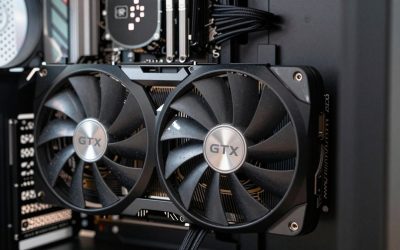
Here’s the crucial fact: no current gaming GPU comes close to saturating a PCIe 4.0 x16 connection. Benchmarks consistently show that running even a flagship RTX 50-series card on PCIe 4.0 versus 5.0 produces differences within the margin of error—typically 0–3% in average FPS. The GPU simply isn’t moving enough data per frame across the slot to need the extra bandwidth.
So if your motherboard is PCIe 4.0 and your new GPU is PCIe 5.0, you lose essentially nothing in gaming. The card will run at its full gaming potential. This is why upgrading a motherboard solely for PCIe 5.0 GPU support makes no sense for gamers.
The One Exception: Reduced Lane Counts
PCIe version matters more when you have fewer lanes. Some budget GPUs use only a x8 or even x4 connection instead of full x16. On those cards, the newer PCIe generation helps because the higher per-lane bandwidth compensates for the missing lanes. A x8 card on an older PCIe 3.0 board can lose meaningful performance—but on 4.0 or 5.0, it’s fine.
Where PCIe 5.0 Actually Helps: Storage (a Little)
PCIe 5.0 SSDs hit sequential read speeds around 12–14 GB/s versus roughly 7 GB/s for PCIe 4.0 drives. That sounds huge, but games rarely benefit. Game load times are gated by random access patterns and decompression, not raw sequential throughput, so a PCIe 5.0 SSD typically shaves only a fraction of a second off load screens compared to a good 4.0 drive—often not enough to notice.
PCIe 5.0 SSDs also run hot and frequently require beefy heatsinks. For most gamers, a quality PCIe 4.0 NVMe drive is the smarter, cooler, cheaper choice today. The exception is DirectStorage-heavy titles, where faster storage can help streaming—but that benefit is still emerging.
So Should You Care When Buying?
When choosing a motherboard, treat PCIe 5.0 as a nice future-proofing bonus, not a must-have for gaming. If two boards are similarly priced and one offers PCIe 5.0 slots, take it—but don’t pay a large premium for it. Spend that money on a better GPU, more VRAM, or faster RAM instead, all of which deliver real gaming gains. Our best gaming motherboard guide weighs these features in real-world terms.
Likewise, when picking a graphics card, the PCIe generation it supports should be near the bottom of your priority list. Focus on raw performance and memory—see our mid-range GPU roundup and best value GPU picks for what actually moves frame rates.
How to Tell What PCIe Version You’re Running
If you’re curious what link speed your hardware actually negotiated, you don’t have to take the spec sheet’s word for it. GPU-Z displays your current “Bus Interface”—for example, “PCIe x16 4.0 @ x16 4.0,” where the first figure is the maximum the slot supports and the second is what’s running right now. GPU-Z also has a render test button that loads the GPU so it ramps to full link speed, since many cards drop to a lower PCIe state at idle to save power. Seeing your slot downshift at idle is normal and not a problem.
This matters for diagnosing real issues. Occasionally a poorly seated GPU, a dirty slot, or a riser cable will negotiate down to x8 or even x4, or to an older PCIe generation, and that can cost performance. If GPU-Z shows your card running at fewer lanes than expected, re-seat the GPU and check that you’re using the primary x16 slot wired to the CPU rather than a secondary slot routed through the chipset.
The Lane-Sharing Trap
Here’s a real-world gotcha that catches builders off guard: on many motherboards, the primary GPU slot shares lanes with certain M.2 SSD slots. Populating a particular M.2 slot can drop your GPU from x16 to x8, or disable a SATA port. For a full-width gaming GPU on PCIe 4.0 or 5.0, going from x16 to x8 has minimal gaming impact—but it’s worth reading your motherboard manual’s lane-allocation table so you install your boot SSD in a slot that doesn’t steal GPU lanes unnecessarily. This is far more likely to affect your experience than the raw PCIe generation ever will.
Future-Proofing Perspective
PCIe generations are backward and forward compatible—a PCIe 5.0 card works in a 4.0 slot and vice versa, automatically negotiating the highest common speed. That compatibility is exactly why you don’t need to chase the latest version. As GPUs grow more powerful over the next several years, PCIe 5.0 bandwidth may eventually matter for gaming, but that crossover point is still on the horizon, not here today.
What About PCIe and Multi-GPU or Capture Cards?
A handful of niche use cases do care about PCIe bandwidth and lane allocation. If you run a high-end capture card alongside your GPU, or use multiple expansion cards that each demand lanes, you’ll want a platform and board with enough total PCIe lanes to feed everything at full speed. Consumer platforms have a limited lane budget shared between the GPU, M.2 SSDs, and expansion slots, so heavy expansion users sometimes benefit from a higher-end chipset. For the typical single-GPU gaming build, though, none of this applies—you have far more lanes than a lone graphics card and a couple of SSDs will ever use.
Multi-GPU gaming (SLI/CrossFire) is effectively dead and no longer worth planning around, so don’t pick a board for dual-x16 gaming slots. If you see marketing emphasizing two full-speed GPU slots, treat it as irrelevant to gaming unless you have a specific professional or compute workload in mind.
Frequently Asked Questions
Will a PCIe 5.0 GPU work in a PCIe 4.0 motherboard?
Yes, fully. PCIe is backward compatible; the card simply runs at PCIe 4.0 speeds, which for gaming is indistinguishable from 5.0. You lose essentially no frame rate.
Is a PCIe 5.0 SSD worth it for gaming?
Not really. Game load times barely improve over a good PCIe 4.0 drive, and 5.0 SSDs cost more and run hotter. Save your money unless you have a specific high-throughput workload.
Does PCIe 5.0 improve FPS?
For full x16 gaming GPUs, no measurable difference in most titles—typically within 0–3%. The bandwidth simply isn’t the bottleneck for current cards at full lane width.
When will PCIe 5.0 actually matter for gaming?
Likely a few GPU generations from now, when cards become powerful enough to saturate PCIe 4.0 x16. For 2026 builds, it’s a future-proofing checkbox, not a performance requirement.
Should I upgrade my motherboard just for PCIe 5.0?
No. There’s no gaming reason to upgrade a working PCIe 4.0 board solely for PCIe 5.0. Put that budget toward a better GPU or RAM where it delivers tangible gains.
The Bottom Line
For gaming in 2026, PCIe 5.0 versus 4.0 is a non-issue: full-width GPUs see only 0–3% difference, and PCIe 5.0 SSDs barely improve load times while running hotter and costing more. Treat PCIe 5.0 as a welcome bonus if it comes at no premium, but never pay extra or upgrade specifically for it—your money does far more good on the GPU itself.