⚡ Key Takeaways
- First, Understand What Stutter Actually Is
- 9 Causes and Their Fixes
- Quick Diagnosis Cheat Sheet
- A Practical Troubleshooting Order
- When It’s a Hardware Limitation
- Stutter vs. Low FPS vs. Lag: Know the Difference
- Game-Specific and Online Stutter
- Don’t Overlook the Power Supply
- Preventing Stutter Before It Starts
- Related Guides
- Frequently Asked Questions
- The Bottom Line
- Related Articles


- Frame rate (FPS) is an average over a second; frame time is how long each individual frame takes.
- Use this table to jump straight from the symptom you're seeing to the most likely cause and first fix.
- Work top-down: first confirm EXPO/XMP is on, then check temperatures, then monitor VRAM and CPU/GPU usage during a stutter.
- Sometimes the honest answer is that a part is the bottleneck.
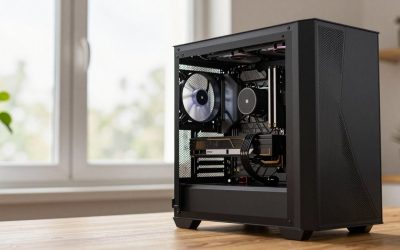
Few things ruin a gaming session like a PC stuttering in games—those jarring micro-freezes that hit right as the action peaks, even when your average FPS looks fine. Stutter is almost always a frame-time problem, not a frame-rate one, which is why “just buy a faster GPU” rarely fixes it. This guide walks through the nine most common causes in rough order of likelihood, with the proven fix for each, so you can diagnose your stutter methodically instead of guessing.
As an Amazon Associate we earn from qualifying purchases at no extra cost to you.



![arVin Mobile Gaming Controller for Tablet/iPad[Within 5-10"] Wireless Gamepad for iPhone/Android/PC/Switch/PS4, with RGB Hall Effect Joystick/Turbo/6-Axis Gyro/Vibration/Support Streaming/Cloud Gaming](https://m.media-amazon.com/images/I/51oN2KofosL._SL160_.jpg)


Related: best portable SSDs for gaming.
Related: best X3D gaming CPUs.
Related: best GPU support brackets.
Related: best budget gaming monitors.
Related: best Ryzen 5 CPUs for gaming.
Related: best DDR5 RAM for gaming.
🛒 Best Price Today on Amazon
Prime members get fast, free shipping on everything above, plus member-only deals. New members get a 30-day free trial — cancel anytime.
First, Understand What Stutter Actually Is
Frame rate (FPS) is an average over a second; frame time is how long each individual frame takes. A game can average 120 FPS but still feel choppy if a few frames take 40ms instead of 8ms. Those spikes are stutter. Use an overlay like MSI Afterburner or your GPU software to watch the frame-time graph—a flat line is smooth, jagged spikes are your problem. Diagnose by symptom, not by average FPS.
9 Causes and Their Fixes
- Memory running at default speed (no EXPO/XMP). This is the #1 hidden cause. If you never enabled your RAM’s EXPO (AMD) or XMP (Intel) profile in BIOS, your DDR5 is likely running at a slow 4800 MHz instead of its rated 6000 MHz. Fix: Enter BIOS and enable the memory profile. This single change resolves a huge share of stutter complaints.
- VRAM overflow. When a game needs more video memory than your GPU has, it swaps data over PCIe and stutters badly, especially during fast movement. Fix: Lower texture quality one notch, drop the resolution, or enable upscaling. An 8GB card at 1440p ultra is a classic offender.
- Background processes and bloatware. Overlays, browsers with dozens of tabs, RGB software, and auto-updaters steal CPU time and cause hitches. Fix: Close unnecessary apps before gaming, disable startup bloat in Task Manager, and turn off overlays you don’t use.
- Outdated or corrupt GPU drivers. A bad driver version can introduce stutter that wasn’t there before. Fix: Do a clean driver install—use DDU (Display Driver Uninstaller) in safe mode, then install the latest driver from NVIDIA, AMD, or Intel.
- Shader compilation stutter. Many modern games compile shaders on the fly the first time you see an effect, causing a one-time hitch. Fix: Let the game finish its initial shader pre-compilation step if offered, and play through an area once—the stutter usually vanishes on the second pass.
- Thermal throttling. An overheating CPU or GPU clocks itself down mid-game, causing performance to lurch. Fix: Check temperatures with HWiNFO; if your CPU hits 95°C or your GPU exceeds the mid-80s, improve cooling. A better CPU cooler or improved case airflow solves it.
- Storage bottleneck. Games installed on a slow HDD or a full, throttling SSD stutter while streaming assets. Fix: Install games on an NVMe SSD and keep at least 15–20% free space so the drive doesn’t choke.
- CPU bottleneck. If your GPU usage drops below 95–99% during stutters while CPU sits pegged, the processor can’t feed the GPU fast enough. Fix: Lower CPU-heavy settings (draw distance, crowd density, ray tracing), or upgrade to a CPU with stronger single-thread performance like a Ryzen X3D chip.
- Windows power and game settings. Power-saving plans, mismatched V-Sync, or an uncapped frame rate fighting your refresh rate all cause hitches. Fix: Set Windows to the “High Performance” or “Balanced” plan, cap your FPS a few frames below your monitor’s refresh, and try enabling G-Sync/FreeSync.
Quick Diagnosis Cheat Sheet
Use this table to jump straight from the symptom you’re seeing to the most likely cause and first fix.
| Symptom | Most Likely Cause | First Fix |
|---|---|---|
| Stutter in many games right after building | EXPO/XMP disabled | Enable memory profile in BIOS |
| Texture pop-in, hitches on fast movement | VRAM overflow | Lower textures / resolution |
| Hitches while moving through new areas | Slow or full storage | Install game on NVMe SSD, free space |
| Performance lurches after a few minutes | Thermal throttling | Check temps, improve cooling |
| GPU usage dips below 95% during stutter | CPU bottleneck | Lower CPU-heavy settings |
| One-time hitch on first encounter | Shader compilation | Replay the area; let pre-compile finish |
A Practical Troubleshooting Order
Don’t change ten things at once. Work top-down: first confirm EXPO/XMP is on, then check temperatures, then monitor VRAM and CPU/GPU usage during a stutter. Change one variable at a time and re-test. This isolates the real cause instead of leaving you wondering which “fix” actually worked.
When It’s a Hardware Limitation
Sometimes the honest answer is that a part is the bottleneck. If you’ve exhausted the software fixes and your GPU usage pins at 99% while frame times stay spiky at acceptable settings, the GPU is simply maxed out. If the CPU is the limiter, a platform upgrade helps. Our best value GPU guide and mid-range GPU roundup can point you toward a sensible upgrade once you’ve confirmed the bottleneck.
Stutter vs. Low FPS vs. Lag: Know the Difference
These three problems feel similar but have different causes and fixes, and conflating them sends you chasing the wrong solution. Low FPS is a sustained low average—every frame is slow, and the fix is usually lower settings or a faster GPU. Stutter is inconsistency: a good average punctuated by sharp frame-time spikes, which points to the software and configuration issues covered above. Input lag is delay between your action and the on-screen response, often caused by V-Sync, frame generation, or a high render-queue setting, and it’s unrelated to either FPS or stutter.
Diagnosing correctly saves hours. If your average FPS is high but the game feels choppy, you have stutter, not a performance deficit—so buying a faster GPU won’t help. If everything is uniformly slow, that’s an FPS problem. And if the image is smooth but feels delayed, you’re dealing with latency. Match the symptom to the right category before changing anything.
Game-Specific and Online Stutter
Sometimes the stutter isn’t your hardware at all. Multiplayer titles can hitch due to network problems—high ping, packet loss, or an overloaded server—producing a stutter that looks like a local issue but vanishes on a better connection or a different server. Individual games also ship with known stutter bugs that patches later fix, so it’s worth checking whether other players report the same behavior in a specific title before tearing your system apart. A quick test is to run a different, well-optimized game: if that one is perfectly smooth, your hardware is fine and the problem is specific to the troublesome title or its servers.
Don’t Overlook the Power Supply
An undersized or failing PSU can cause stutters and crashes under load that look exactly like a GPU problem. If your system hitches or shuts off during demanding scenes and nothing else explains it, a quality power supply with adequate wattage and headroom is worth ruling in.
Preventing Stutter Before It Starts
Once you’ve fixed an existing stutter problem, a few habits keep it from coming back. Enable your memory profile the moment you finish a build so it’s never a lingering issue. Keep your GPU drivers reasonably current but don’t blindly install every release the day it drops—occasionally a new driver introduces regressions, so it’s fine to wait a few days and check for problem reports. Keep at least 15–20% of your game SSD free, run periodic dust cleanings to keep temperatures in check, and avoid loading your system with unnecessary background overlays and startup apps.
It also pays to set sensible default in-game options. Cap your frame rate a few frames below your monitor’s refresh and enable G-Sync or FreeSync if your display supports it; this pairing produces the smoothest, tear-free experience and sidesteps a whole category of pacing problems. With these basics in place, the vast majority of stutter never gets a chance to appear.
Frequently Asked Questions
Why does my PC stutter even with high FPS?
Because stutter is a frame-time problem, not a frame-rate one. A handful of slow frames among many fast ones still feels choppy. Watch the frame-time graph, not just the FPS counter.
Does more RAM fix stuttering?
It can if you’re running out—16GB is tight for some modern games, and 32GB gives breathing room. But making sure your existing RAM runs at its rated speed via EXPO/XMP usually matters more than adding capacity.
Can a bad SSD cause stutter?
Yes. A nearly full or slow drive can’t stream game assets fast enough, causing hitches as you move through a level. Use an NVMe SSD and keep free space available.
Is stutter caused by my GPU or CPU?
Check usage during the stutter. GPU pinned at 99% points to a GPU limit; CPU pinned while GPU dips below 95% points to a CPU bottleneck. The fix differs depending on which one it is.
Will overclocking reduce stutter?
Rarely, and it can introduce instability that makes things worse. Enabling your rated memory profile (EXPO/XMP) is the one “overclock” almost everyone should do; pushing further is for tinkerers, not stutter fixes.
The Bottom Line
Game stutter is a frame-time issue with a short list of usual suspects: disabled memory profiles, VRAM overflow, background bloat, bad drivers, shader compilation, thermal throttling, slow storage, and CPU bottlenecks. Diagnose with a frame-time overlay, change one variable at a time, and start with enabling EXPO/XMP—it fixes more stutter than any other single step.