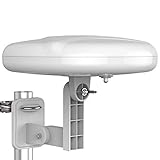
- Top Pick: HIDB TV Antenna for Smart TV Indoor, Digital TV Antenna for Local Channels | OTA Digital HD Signal Antenna with Magnetic Base and 10ft Cable for Easy Setup
- Best Value: TV Antenna for Smart TV Indoor, Digital TV Antenna for Local Channels | HD Digital Antenna with Amplifier Signal Booster for Local Channels Supports 4K 1080p-16.5 ft Long Cables
- Premium Choice: DAANT TV Antenna Indoor Long Range | Supports 4K 1080p Smart TV Signal Reception with 16ft HDTV Coax Cable
An antenna is the one piece of home theater gear where the box cannot tell you whether it will work. Over-the-air television depends on how far you live from the broadcast towers, what stands between you and them, and which floor your TV is on. A listing can promise “long range” and “4K” all it likes, but an antenna only receives radio waves; the picture quality comes from the broadcaster, not from the cable. So the real question is how to match a flat indoor panel, an amplified model or a portable antenna to your address.
This guide is for cord-cutters picking up local channels, apartment dwellers, RV and tailgate crowds, and anyone adding a second TV. It covers nine antennas, from a simple magnetic-base panel with a 10 ft lead to a 33 ft amplified model, and a flat panel that mentions NextGen TV. The notes below are drawn only from each listing’s wording for 2026, and several lofty claims are called out instead of repeated, since a title is advertising and not a measurement.
Quick Picks
As an Amazon Associate we earn from qualifying purchases at no extra cost to you.



| Product | Best for | Key spec from the title |
|---|---|---|
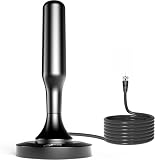
| HIDB Indoor Antenna | Simple setups near a window | Magnetic base, 10 ft cable |
| intelbras Amplified Antenna | Mid-distance reception | Amplifier booster, 16.5 ft cable |
| DAANT Indoor Long Range | Standard living rooms | 16 ft HDTV coax cable |
| BEIMQN Indoor/Outdoor | Flexible placement | Indoor/outdoor use, amplifier |
| URIIU Long-Range Antenna | Long cable runs | 33 ft coax, amplifier, older TV support |
| Bwxsyws 360 Antenna | Towers in different directions | 360 degree signal reception |
| NEOSIGN Antenna | Tidy wall mounting | 16.5 ft cable, signal booster |
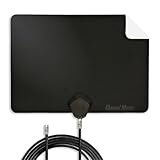
| Channel Master FLATenna | Newer broadcast formats | 12 ft coax, NextGen TV support |
| GE Portable HD Antenna (81843) | RV, camping, tailgating | VHF/UHF, magnetic base, compact |
How to Choose
Distance to the towers
Start with where your local stations broadcast from. An online reception map that uses your address will show tower direction and distance. Within roughly 25 miles, a plain flat antenna usually works; at 40 miles or more, you may need an amplified or outdoor model. Distance claims in listings, especially figures in the thousands of miles, are not physically meaningful, so ignore them. Hills, dense trees and steel-framed buildings cut range more than any product feature adds, which is why two neighbors can get different results with the same antenna.
Amplified or passive
An amplifier boosts weak signals and helps when you run a long cable, but it also boosts noise, and it can overload a receiver sitting close to a tower. If you are near the towers, passive is often cleaner. If the cable is 30 ft or more, or you have several splits, an amplifier makes more sense. Four of the listings here mention an amplifier or booster, and three of them pair it with a lead of 16 ft or longer, which is the case where it earns its place. If your signal is already strong, a booster adds nothing but the chance of overload, and some people end up unplugging the power injector to get a cleaner picture. Think of the amplifier as a tool for long runs and weak signals, not a default upgrade.
Indoor, outdoor or portable
An indoor flat panel is easy but sees walls, appliances and your neighbor’s building. An indoor/outdoor model can go on a balcony or attic. A compact magnetic-base design, like the portable GE, targets travel. Placement matters more than product: higher, near a window and facing the towers beats any spec. Try two or three spots and run a channel scan at each, because a move of a few feet can add or drop whole stations. Windows that face the broadcast direction are the best candidates, and glass is far kinder to signals than brick, stucco or metal siding. In a tall building, upper floors usually have a clearer line to the towers than a ground-floor unit.
Cable length, VHF/UHF and formats
Lengths in these listings range from 10 ft to 33 ft; pick one that reaches the best window without extra splices. Check that the antenna lists both VHF and UHF, since many stations still transmit on VHF. Resolution words like 4K and 8K do not apply to antennas. NextGen TV support matters only if your local stations broadcast ATSC 3.0 and your TV can decode it, so look up your market before making it a deciding factor. Finally, remember that all of these antennas feed the same tuner in your TV. If channels still break up after you have tried several placements, the cause may be a long, shared or damaged coax run, so check the connectors and any splitters on the line before blaming the antenna.
The 9 Best Options
HIDB Indoor Antenna
A plain indoor digital antenna with a magnetic base and a 10 ft cable, described for smart TVs and local channels. It is a no-frills starting point for someone finding out whether over-the-air reception works at their address, and the magnetic base makes it easy to move between a window, a shelf and a wall until the channel scan turns up the most stations.
- Strength: a magnetic base for quick placement on metal surfaces.
- Strength: no amplifier means fewer noise sources.
- Trade-off: a 10 ft lead limits placement to near the TV.
Skip it if your best signal is across the room.
intelbras Amplified Antenna
An indoor digital antenna with an amplifier signal booster and 16.5 ft cables, listed for local channels and 4K and 1080p TVs. It suits a home that is some distance from the towers and needs a little extra gain.
- Strength: the amplifier helps with weaker signals.
- Strength: 16.5 ft reaches a nearby window.
- Trade-off: boosters can overload receivers close to towers.
Skip it if you live near the transmitters.
DAANT Indoor Long Range
An indoor model with a 16 ft HDTV coax cable aimed at smart TV reception. The title is short on details, which keeps the shopping decision simple and puts the burden on placement.
- Strength: 16 ft of cable gives placement choice.
- Strength: no amplifier mentioned, so fewer complications.
- Trade-off: the title does not name VHF or UHF bands.
Skip it if you need amplification.
BEIMQN Indoor/Outdoor Antenna
An indoor and outdoor antenna with an amplifier and a headline claim of 200 percent wider signal reach, plus 4K and 8K labels. It is the pick for a household that might move the antenna outside later.
- Strength: indoor/outdoor use opens up balcony or attic mounting.
- Strength: an amplifier is included.
- Trade-off: the wider reach claim has no stated baseline, and the 8K label means nothing for an antenna.
Skip it if you want measurable range specs.
URIIU Long-Range Antenna
An indoor antenna with an amplifier, 33 ft coaxial cable and support for older TVs, with a 5000-plus-mile claim in the title. The cable length is the useful part, because it lets you reach a distant window.
- Strength: the 33 ft cable reaches far windows.
- Strength: older TV support is mentioned.
- Trade-off: the mileage figure is not credible.
Skip it if inflated claims put you off.
Bwxsyws 360 Antenna
An indoor HD digital antenna advertising 360 degree signal reception for all types of HDTV. The wording suggests it is meant to handle stations that sit in different compass directions.
- Strength: omnidirectional wording suits towers in several directions.
- Strength: broad TV compatibility.
- Trade-off: the title gives no cable length or amplifier detail.
Skip it if you need to know the lead length.
NEOSIGN Antenna
A black indoor antenna with a 16.5 ft cable and signal booster, listed for local channels and long-range reception. The dark finish blends in against a dark wall or window frame.
- Strength: a booster and a lead long enough for a window.
- Strength: a black finish is low-profile.
- Trade-off: reach is stated only as long range.
Skip it if you want a name with a longer track record.
Channel Master FLATenna
A flat indoor HDTV antenna with a 12 ft coaxial cable, built for OTA broadcasts and NextGen TV, and aimed at 4K smart TVs. Channel Master is a long-standing antenna brand, and the title leans on reception reliability.
- Strength: NextGen TV support is named.
- Strength: a flat shape suits window mounting.
- Trade-off: the cable is shorter than several rivals.
Skip it if you need 30 ft or more of cable.
GE Portable HD Antenna (81843)
A compact travel antenna with VHF/UHF, a magnetic base and a design for RVs, camping and tailgating. Its small size is the point: it packs easily and sticks to a metal roof or frame.
- Strength: VHF and UHF are both named.
- Strength: small enough to pack.
- Trade-off: portable designs trade size for range.
Skip it if it will be your only home antenna in a fringe area.
Which One Fits Your Situation
You live in an apartment close to the towers
Start with the HIDB or DAANT. A passive flat panel avoids the overload that amplifiers can cause nearby, and a window sill is often enough. The HIDB has the shorter lead, so choose it if the TV sits near the glass and the DAANT if you need a few extra feet to reach a better spot.
Your TV is far from a window
The URIIU with its 33 ft cable reaches farther than the rest, and its amplifier makes up for some of the loss along the run.
You camp or tailgate
The GE Portable (81843) lists VHF/UHF in a magnetic-base design made for travel. Stick it on a metal surface, aim it toward the nearest town and rescan whenever you park somewhere new.
You want to prepare for newer broadcasts
The Channel Master FLATenna names NextGen TV, which is relevant if your market is adopting it. If you are still unsure which channels you can reach, the Bwxsyws 360 or the BEIMQN indoor/outdoor model give you more flexibility in placement.
Common Mistakes
- Buying on a mile or percentage claim instead of checking tower distance.
- Skipping a channel rescan after moving the antenna.
- Putting an amplified antenna right beside a tower.
- Hiding the antenna behind the TV or low on the floor.
- Believing 4K or 8K labels improve the picture.
Related guides
- Combination Smoke And Carbon Monoxide Detectors
- Aio Liquid Coolers For High Performance Gaming
- How To Lower Input Delay In Competitive Shooters
Frequently Asked Questions
Do I need a different antenna for each TV?
One antenna can feed several TVs with a splitter, though splitting weakens the signal, so an amplifier may help. A second antenna is simpler if the rooms face different directions.
Why do some channels pixelate?
Weak or interrupted signals cause it. Moving the antenna higher or closer to a window often fixes it, and so does a fresh channel scan.
Is an outdoor antenna better?
Usually yes for fringe areas, since it sits higher with fewer obstacles. For homes close to the towers, an indoor panel is typically enough.
Do antennas need power?
Passive ones do not. Amplified ones need a USB or inline power source, so check where the power supply will plug in before you mount the antenna.