

- Top Pick: Bambu Lab P1S Combo, P1S 3D Printer and AMS, Multi-Color 3D Printing | MakerWorld Model Library, Multi-Color 3D Printing,High Speed & Precision CoreXY 3D Printer,Auto Bed Leveling, Ready-to-Use
- Best Value: Bambu Lab P2S Combo, P2S 3D Printer & AMS 2 Pro, Multi-Color 3D Printing | MakerWorld Model Library, Multi-Color 3D Printing, High-Speed CoreXY 3D Printer,AI Error Detection
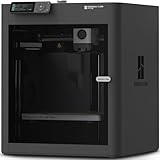
- Premium Choice: Bambu Lab P1S 3D Printer, Ready-to-Use FDM 3D Printer | Beginner-Friendly Ecosystem with MakerWorld Model Library, Enclosed CoreXY, High Speed & Precision Printing
If you need size, the Creality K2 Plus Combo (350 mm cube, enclosed) and the Prusa Core One L (300 x 300 x 330 mm, heated chamber) are the main enclosed large-format choices; the Bambu Lab A2L offers a large open-frame bed at a lower tier; and if you mainly want an enclosure rather than size, the Bambu Lab P1S or P2S, Elegoo Centauri Carbon and Prusa Core One cover most needs. For two-material jobs, the Bambu Lab X2D and H2D use dual nozzles, while the Snapmaker U1 uses four swappable toolheads.
- Large and Enclosed 3D Printers at a Glance
- Why Size and Enclosure Matter
- Best Large 3D Printers
- Best Enclosed 3D Printers
- Best ABS and Engineering Material Printers
- CoreXY and Why It Matters
- Best Dual-Extruder and Multi-Tool Printers
- Running Costs for Big Machines
- Setup and Compatibility Notes
- Pick X If… (Decision Table)
- Alternatives
- Frequently Asked Questions
As an Amazon Associate we earn from qualifying purchases at no extra cost to you.



Large and Enclosed 3D Printers at a Glance
| Printer | Enclosure | Build volume | Other stated specs | Best for |
|---|---|---|---|---|
| Creality K2 Plus Combo | Fully enclosed CoreXY | 350 x 350 x 350 mm | 600 mm/s; nozzle to 350 C; bed to 120 C; chamber to 60 C; CFS multi-material, up to 16 spools | Very large parts, multi-colour |
| Prusa Core One L | Enclosed, heated chamber | 300 x 300 x 330 mm | Chamber to 60 C; nozzle to 290 C; bed to 120 C (maker) | Large engineering parts |
| Prusa Core One | Enclosed, heated chamber | 250 x 220 x 270 mm | Chamber to about 55 C per reviewers; steel frame | Repairable, open ecosystem |
| Bambu Lab H2D | Enclosed, active chamber | 325 x 320 x 325 mm single nozzle; 350 x 320 x 325 mm total | Dual nozzles; 350 C nozzle; 65 C chamber; 1000 mm/s toolhead | Dual-material and support jobs |
| Bambu Lab X2D | Enclosed, active chamber | 256 x 256 x 260 mm (maker) | Dual nozzle; 65 C chamber; three-stage filtration | Fast dual-nozzle work |
| Bambu Lab P2S / P1S | Enclosed (passive) | 256 x 256 x 256 mm | P2S: 300 C nozzle, 110 C bed, 600 mm/s | Mainstream enclosed use |
| Elegoo Centauri Carbon | Enclosed (passive) | 256 x 256 x 256 mm | 320 C nozzle; 110 C bed; 500 mm/s | Value enclosed CoreXY |
| Bambu Lab A2L | Open frame | 330 x 320 x 325 mm | Up to 19 colours with AMS units | Large prints without an enclosure |
| Snapmaker U1 | Semi-enclosed, open top | 270 x 270 x 270 mm | Four toolheads; Klipper; 500 mm/s | Multi-colour with little waste |
Why Size and Enclosure Matter
A larger build volume lets you print a single piece instead of gluing sections, which saves time and avoids weak joints. An enclosure matters for a different reason: warm, draft-free air keeps ABS, ASA and nylon from warping or splitting between layers. Large flat parts amplify the effect, because the bigger the footprint, the more it pulls on the bed as it cools. This is why the biggest machines tend to add an enclosure and, in the best cases, an actively heated chamber.
Passive enclosures trap the heat of the bed. Active chamber heaters add a dedicated element or circulating airflow. The Prusa Core One and Core One L, the Creality K2 Plus, the Bambu Lab H2D and X2D list active chamber heating; the P1S, P2S and Centauri Carbon do not.
Best Large 3D Printers
Creality K2 Plus Combo
Creality lists a fully enclosed CoreXY frame with a 350 mm cube, 600 mm/s speed, 30,000 mm/s squared acceleration, a 350 C nozzle and a 60 C chamber. It ships with the CFS filament system, and up to four CFS units can be chained for 16 spools. TechRadar reports outstanding speed, build quality and print results for the K2 Plus. The compromise is the footprint and weight: plan a sturdy table and good ventilation.
Prusa Core One L
Prusa’s larger CoreXY offers 300 x 300 x 330 mm, roughly double the standard Core One’s volume, with an actively heated chamber to 60 C, an AC convection-heated aluminum bed with low temperature variance, a 290 C nozzle and a 120 C bed per the maker. Tom’s Hardware reviewed it under the headline of a bigger and better printer. One independent review disputed the chamber heater claim, which conflicts with Prusa and other sources, so read the specifications from the maker for your unit.
Bambu Lab A2L
Announced in June 2026, the A2L is an open-frame large-bed printer with a 330 x 320 x 325 mm volume. Bambu describes it as an extra-large bed-slinger with CoreXY-grade stability, and it supports up to 19 colours when combined with AMS units. It does not have an enclosure, so skip it for ABS or ASA.
Best Enclosed 3D Printers
Many buyers want an enclosure but not a giant machine. The Bambu Lab P1S is widely described as a plug-and-play benchmark, and the P2S adds a 5-inch touchscreen, a quick-swap nozzle and a 110 C bed. The Elegoo Centauri Carbon has the same 256 mm cube and a 320 C hardened nozzle at a lower tier. Tom’s Hardware reports that it printed PLA, PETG, TPU, ABS and ASA without issue. The Prusa Core One adds active chamber heating, which makes a visible difference with nylon and ASA.
Best ABS and Engineering Material Printers
ABS and ASA need an enclosure and benefit from a warm chamber. Pair them with:
- a hardened nozzle if you print carbon-fibre or glass-fibre filled materials;
- good ventilation, since ABS gives off fumes and odours while printing;
- a filter if the printer offers one; the Bambu Lab X2D lists a G3 pre-filter, H12 HEPA filter and activated carbon layer, and the Creality K1C lists a carbon filter;
- a printer with a bed of 100 C or higher.
Heat-resistant materials above roughly 300 C need a nozzle rated for them, which the K2 Plus (350 C) and H2D (350 C) provide. Always follow the manufacturer’s manual and the filament maker’s guidance.
CoreXY and Why It Matters
In a CoreXY machine the bed moves only up and down while the toolhead moves in X and Y. Because the heavy bed is not whipping back and forth, large machines can print fast without shaking. Bed-slingers can still print large objects, but heavy parts on a moving bed limit acceleration. Most models in this guide are CoreXY, except the A2L, which uses an open bed-slinger layout.
Best Dual-Extruder and Multi-Tool Printers
Two basic designs address multi-material work.
- Dual nozzle: the Bambu Lab H2D puts two nozzles on one hotend; only the left moves up and down. Build volume depends on mode: 325 x 320 x 325 mm single-nozzle, 300 x 320 x 325 mm dual-nozzle. The X2D uses a direct-drive left nozzle and a Bowden-fed right nozzle capped at 200 mm/s.
- Toolchanger: the Snapmaker U1 swaps among four toolheads, which cuts purge waste. The maker claims 5 second swaps; one reviewer measured roughly 10 to 12 seconds. The base unit has no heated chamber, but an optional top cover helps with higher-temperature materials.
Dual extruders are especially useful for soluble supports and for pairing a rigid and a flexible material in one part.
Running Costs for Big Machines
Large prints consume large amounts of filament: a single big part can use most of a spool, so filament is the dominant ongoing cost. Premium engineering filaments, hardened nozzles and replacement build plates raise it further. Multi-colour systems that purge on every swap waste material; toolchangers reduce this. Heated chambers draw more power, though still modest for home use.
Setup and Compatibility Notes
- Space: measure the table, including clearance for the lid and for opening the front door. Large machines weigh enough that a weak shelf is a hazard.
- Power: use a properly rated outlet; ask an electrician if you are unsure about circuits, especially with heated chambers.
- Slicers: Bambu Studio, PrusaSlicer, Creality Print and Orca-based software support these models.
- Filament storage: big parts take hours; keep the spool dry.
Pick X If… (Decision Table)
| If you need… | Pick | Why |
|---|---|---|
| The largest enclosed volume | Creality K2 Plus Combo | 350 mm cube |
| Large plus heated chamber, repairable | Prusa Core One L | 300 x 300 x 330 mm, 60 C chamber |
| Large and open-frame at a lower tier | Bambu Lab A2L | 330 x 320 x 325 mm |
| Enclosed at a value tier | Elegoo Centauri Carbon | Handles ABS and ASA |
| Mainstream enclosed | Bambu Lab P1S or P2S | Reliable and widely recommended |
| Dual material | Bambu Lab H2D or X2D | Dual nozzles, active chamber |
| Multi-colour, low waste | Snapmaker U1 | Four toolheads |
Alternatives
- Creality K1C: a 220 x 220 x 250 mm enclosed CoreXY with a tri-metal nozzle at a lower tier.
- Bambu Lab A1: a 256 mm open-frame machine for PLA and PETG.
- Splitting parts: a mid-size enclosed printer plus careful part splitting may be more economical than a giant machine.
Frequently Asked Questions
Do I need an enclosed printer for large prints?
For PLA you can often print large parts on an open frame, though drafts can still cause warping. ABS, ASA and nylon strongly benefit from an enclosure, and large footprints make the effect stronger.
What is the difference between a passive and an active heated chamber?
A passive chamber retains heat from the bed, while an active chamber has its own heating or circulation. Active chambers reach and hold higher temperatures, which helps with engineering materials. Check the maker’s spec sheet to see which applies.
Is a bigger build volume always better?
No. Larger machines cost more, take more space, and use more filament per print. If most of your parts fit within 250 mm, a mid-size printer is usually enough.
Are enclosed printers safe to use indoors?
Enclosures keep hands away from hot parts but do not remove fumes. Print ABS and ASA in a ventilated room and use the filter if your printer has one. Follow the manual.
Which is better, a dual-nozzle printer or a toolchanger?
Dual-nozzle machines are simpler and good for two materials, such as a main plastic plus soluble support. Toolchangers handle four or more colours with less waste but add mechanical complexity.
Can I print ABS on an open-frame printer?
It is possible for small parts, but warping and splitting are common and fumes are harder to manage. An enclosed machine is the better choice.







