- Top Pick: GMWD Air Rowing Machines for Home, 10-Level Adjustable Resistance Professional Rower Machine with Performance Monitor, Ergonomic Comfort Seat, Device Holder & Easy Storage, Lava Flow Series
- Best Value: Merach R50 Pro Rowing Machine Indoor, Professional Monitor, Easy Storage
- Premium Choice: YOSUDA R2 Professional Air Rowing Machine Indoor, Self-Powered Monitor
Best Air Rowing Machines for Home Gyms and Cardio
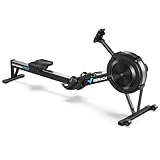
The best air rowing machine for most home gyms is the Concept2 RowErg with the standard-height legs, while the AssaultRower Pro and Xebex Air Rower 2.0 are better alternatives when you want a different monitor, a more substantial frame, or a more commercial-style build.
- Best Air Rowing Machines for Home Gyms and Cardio
- Quick comparison: the leading air rowers
- Head-to-head: which air rower fits your situation?
- How to match flywheel feel to workout intensity
- Room-size decision matrix
- Measure the real footprint, not just the product dimensions
- Noise: what to expect from an air flywheel
- Buying checklist
- Verdict
Air rowers use a flywheel that speeds up as you pull harder. That makes resistance responsive rather than fixed: an easy stroke produces light resistance, while a powerful stroke creates more drag. This feels natural for intervals and lets beginners and experienced athletes use the same machine. The trade-off is sound, a long operating footprint, and the need to choose a frame and rail length that suit your room.
As an Amazon Associate we earn from qualifying purchases at no extra cost to you.


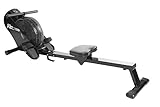
Quick comparison: the leading air rowers
| Model | Resistance and adjustment | Approximate footprint in use | Rail and fit notes | Noise profile | Typical market range |
|---|---|---|---|---|---|
| Concept2 RowErg, standard height | Air flywheel; damper positions 1–10 | 96 × 24 in | About 54 in of monorail travel; separates into two pieces | Moderate-to-loud fan noise | Usually $1,000–$1,200 |
| Concept2 RowErg, elevated height | Air flywheel; damper positions 1–10 | 96 × 24 in | Higher seat helps users who prefer easier access | Moderate-to-loud fan noise | Usually $1,100–$1,300 |
| AssaultRower Pro | Air resistance with adjustable damper | Roughly 93 × 20 in | Long commercial-style rail; check clearance for full leg extension | Moderate-to-loud at high stroke rates | Usually $900–$1,300 |
| Xebex Air Rower 2.0 | Air resistance with adjustable airflow | Roughly 95 × 20 in | Long rail intended for broad user-height coverage | Moderate-to-loud | Usually $1,000–$1,400 |
Dimensions and prices can vary by production revision, console package, and retailer. The space figures describe the machine laid out for use, not the extra room needed to climb on, store it, or perform a full stroke.
Head-to-head: which air rower fits your situation?
Choose the Concept2 RowErg for the safest all-round decision
The RowErg is the benchmark because its flywheel feel, performance data, replacement parts, folding design, and training ecosystem are well established. Its PM5 monitor records pace, watts, stroke rate, distance, intervals, and heart-rate data, and it can connect to compatible apps and sensors.
The damper is often misunderstood. Setting 10 does not create ten fixed resistance levels. It changes how much air reaches the flywheel, which changes the feel and the rate at which the fan slows between strokes. A low setting generally feels quicker and easier to cycle; a high setting feels heavier and places more demand on the legs and back. For most general workouts, starting around damper 3–5 is more useful than automatically selecting 10.
Its main weakness is noise. The fan produces a distinct rushing sound, especially during sprints, so it is less suitable beside a sleeping area or a shared wall. The 96-inch length also requires more floor planning than many people expect.
Choose the AssaultRower Pro for a sturdy, gym-like platform
The AssaultRower Pro suits users who want a robust machine for frequent intervals, group training, or heavier use. It has a substantial frame and an air-resistance feel that rewards a strong drive. Its narrower listed width than the RowErg can help in a tight room, although the difference is not enough to compensate for poor front-to-back clearance.
It is a better choice than a compact magnetic rower when your priority is repeatable hard efforts and immediate resistance changes. It is less compelling if quiet operation, small storage dimensions, or the most widely supported training monitor matters more than frame heft.
Choose the Xebex Air Rower 2.0 when rail length and commercial durability matter
The Xebex Air Rower 2.0 is aimed at users who want a long, sturdy air rower for taller athletes and demanding conditioning sessions. Before buying, verify the current console and connectivity package: Xebex configurations can differ, and the monitor experience is a more important part of daily use than many buyers expect.
Its air fan is not a quiet-workout solution. It belongs in a garage gym, dedicated exercise room, or space where fan noise will not disturb other people. Measure the rail and handle path rather than relying only on the published footprint.
How to match flywheel feel to workout intensity
- Steady cardio: Use a lower-to-mid damper setting and row at a sustainable pace. The lower flywheel load makes it easier to maintain smooth rhythm for 20–45 minutes.
- Short intervals: Use a mid setting and concentrate on a powerful leg drive followed by a controlled recovery. Air resistance rises with effort, so sprinting automatically creates more load.
- Strength-biased rowing: A higher damper creates a heavier initial feel, but it is not a substitute for weight training. It can also make poor technique more fatiguing.
- Technique practice: Keep the stroke rate moderate, commonly around 18–24 strokes per minute, and prioritize the sequence of legs, torso, then arms on the drive.
A useful starting workout is 10 minutes easy, then six rounds of one minute at a challenging pace and two minutes easy. If the last two hard rounds collapse in pace or technique, lower the intensity or extend the recovery rather than increasing the damper.
Room-size decision matrix
| Your situation | Recommended direction | Why | What to check before purchase |
|---|---|---|---|
| Dedicated room, frequent intervals | Concept2 RowErg or AssaultRower Pro | Both provide responsive air resistance and suit repeated hard sessions | At least 8 ft of usable length and a stable floor |
| Tall user or long legs | Long-rail model such as Xebex Air Rower 2.0 | More rail travel reduces the chance of crowding the seat at the front | Test or confirm seat travel, handle clearance, and maximum user height |
| Small apartment | Concept2 RowErg, only if it can be separated and stored | Its two-piece separation is practical, but air noise remains a limitation | Storage height, doorway width, neighbor sensitivity, and floor protection |
| Shared wall or early-morning workouts | Consider a magnetic or water rower instead | Air fans are inherently audible during fast work | Whether the quieter alternative meets your resistance and data needs |
| Older user or difficult knee access | Elevated-height Concept2 RowErg | The taller seat reduces the depth of the squat-like movement when mounting | Seat height, handle reach, and ability to step around the frame safely |
Measure the real footprint, not just the product dimensions
Start with the machine’s length, then add room behind the foot stretchers and in front of the handle path. A practical minimum is roughly 12 inches of free space at each end, but 18–24 inches makes mounting and dismounting more comfortable. You also need lateral clearance to step around the frame.
For example, a 96-inch RowErg placed with 18 inches at both ends needs about 132 inches, or 11 feet, of clear front-to-back space. If the room is only 10 feet long, you may need to place one end near a wall and move the rower for use, or choose a different cardio machine. A machine that technically fits but blocks a door or forces the handle into furniture will quickly become inconvenient.
When stored upright or separated, check the ceiling, wall, and doorway dimensions. Also measure the path from the delivery entrance to the workout room; a rower can be long even when its frame is relatively narrow.
Noise: what to expect from an air flywheel
Air noise increases with flywheel speed, so a gentle warm-up is much quieter than a 30-stroke-per-minute sprint. The chain, seat rollers, and foot straps add mechanical sounds, but the fan is usually the dominant source.
Place the rower on a dense rubber mat to reduce vibration transmitted into hard flooring. Keep it away from a shared wall where possible, and use headphones that do not require you to raise the volume excessively. If other household members sleep nearby, a magnetic rower is usually the better compromise; changing from one air model to another will reduce, but not eliminate, the fan sound.
Buying checklist
- Rail travel: Confirm that your leg length does not push the seat into its front stop before you reach a comfortable catch position.
- Flywheel adjustment: Look for a real damper or airflow adjustment, not just a vague “multiple resistance levels” claim.
- Monitor data: Decide whether you need watts, pace, stroke rate, interval programming, Bluetooth, or heart-rate compatibility.
- Storage: Check whether the frame separates, folds, or can stand vertically without becoming unstable.
- Maintenance: Inspect chain lubrication guidance, seat rollers, handle grip, and availability of replacement parts.
- Noise tolerance: If quiet training is a firm requirement, do not choose an air rower merely because its frame is compact.
Verdict
For the broadest combination of performance data, proven durability, adjustable air resistance, and practical storage, the Concept2 RowErg is the best air rowing machine for most home gyms. Choose the elevated version if seat height matters. Pick the AssaultRower Pro for a heavier commercial-style build and hard conditioning, o
Ready to decide? Our #1 pick for 2026 is the Concept2 RowErg, standard height.
Live price & availability on Amazon.