- Top Pick: Water Bath Canning & Preserving Cookbook for Beginners: 2100 Days of Quick & Easy Homemade Recipes | A Step-by-Step Guide to Healthy and High-Quality Food + 5 Bonus for Preppers
- Best Value: Canning & Preserving for Beginners: The Essential Canning Recipes & Canning Supplies Guide
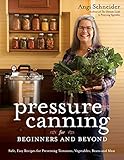
- Premium Choice: Pressure Canning for Beginners and Beyond: Safe, Easy Recipes for Preserving Tomatoes, Vegetables, Beans and Meat
The best home canning pressure cookers for canning and preserving are the Presto 23-Quart Pressure Canner for most households, the All American 921 for maximum durability, and the Presto 16-Quart Pressure Canner for smaller batches and easier storage.
- Best pressure canners at a glance
- 1. Presto 23-Quart Pressure Canner: best overall
- 2. All American 921: best for durability
- 3. Presto 16-Quart: best for smaller kitchens
- 4. All American 930 and 941: best for large harvests
- Decision matrix: match the canner to your situation
- Pressure controls and altitude: the detail that affects safety
- Safety features worth paying for
- Material durability and maintenance
- Bottom line
For low-acid foods such as meat, poultry, seafood, beans, corn, and most vegetables, choose a genuine pressure canner—not a small electric pressure cooker. Pressure canning reaches the temperature needed to control botulism risk when used with tested recipes, correct processing times, and the right altitude adjustment. High-acid foods such as fruits, pickles, jams, and properly acidified tomatoes can usually be processed in a boiling-water canner instead.
As an Amazon Associate we earn from qualifying purchases at no extra cost to you.



Best pressure canners at a glance
| Model | Approx. capacity | Typical jar load | Pressure control | Best for | Typical market range |
|---|---|---|---|---|---|
| Presto 16-Quart Pressure Canner | 16 qt | 9 pint jars or 7 quart jars | Dial gauge and regulator, depending on version | Small kitchens and occasional canning | Usually $100–$160 |
| Presto 23-Quart Pressure Canner | 23 qt | 18 pint jars or 7 quart jars | Dial gauge with three-piece weighted regulator on common versions | Best overall batch capacity and value | Usually $120–$200 |
| All American 921 | 21 qt | 19 pint jars or 7 quart jars | Weighted pressure regulator and dial gauge | Long-term durability and frequent use | Usually $350–$500 |
| All American 930 | 30 qt | 19 pint jars or 14 quart jars | Weighted pressure regulator and dial gauge | Large harvests and serious preserving | Usually $450–$650 |
| All American 941 | 41 qt | 32 pint jars or 19 quart jars | Weighted pressure regulator and dial gauge | Very large batches and community-scale preserving | Usually $500–$750 |
Jar counts are approximate manufacturer capacities and depend on jar shape, rack configuration, and whether the canner is being used for pints or quarts. A large advertised quart capacity does not always mean it can hold the same number of quart jars in every arrangement.
1. Presto 23-Quart Pressure Canner: best overall
The Presto 23-Quart Pressure Canner is the strongest all-around choice for most home preservers. It offers enough room for meaningful batches without the weight, height, and storage demands of a 30- or 41-quart unit. It commonly handles up to 18 pint jars in a single layer arrangement or seven quart jars, making it practical for beans, stock, salsa ingredients, meat, and garden vegetables.
Its aluminum construction keeps the purchase price and lifting weight lower than heavy cast-aluminum canners. Common versions use a pressure dial plus a three-piece weighted regulator that can indicate 5, 10, and 15 pounds per square inch. The regulator is useful because it lets you maintain the target pressure without continuously interpreting small dial movements.
Why choose it
- Good pint capacity for processing several meals’ worth of food at once.
- Usually compatible with gas, electric coil, and smooth-top ranges when the cooktop manufacturer permits the weight.
- Replacement sealing rings, overpressure plugs, and gauges are generally easier to find than parts for obscure brands.
- Some versions are designed for induction, but the exact model must say induction-compatible; ordinary aluminum cookware will not work on induction.
The main compromise is material thickness. Aluminum transfers heat quickly and is durable when treated carefully, but it is more susceptible to staining, dents, and abrasive damage than the heavier cast-aluminum body of an All American.
2. All American 921: best for durability
The All American 921 is a premium 21-quart pressure canner built from heavy cast aluminum. Its distinctive metal-to-metal lid system does not use a disposable rubber gasket in the usual sealing arrangement. That reduces one recurring replacement part and makes the canner attractive to people who preserve every season.
The 921 accommodates approximately 19 pint jars or seven quart jars, so its usable batch size is comparable to the Presto 23-Quart despite the smaller nominal capacity. It includes a weighted regulator and dial gauge. The regulator helps maintain the selected pressure, while the dial gives a visual reading that can be checked against the regulator.
Trade-offs
- It is substantially heavier when empty and more awkward to move after adding water and jars.
- The metal lid requires correct alignment and tightening of the wing nuts; it is not as quick to close as a gasketed lid.
- The large footprint may be inconvenient on a compact range.
- The higher cost makes less sense for someone who cans only a few pints each year.
Choose the 921 if long service life, a gasket-free lid design, and robust construction matter more than low weight or purchase price.
3. Presto 16-Quart: best for smaller kitchens
The Presto 16-Quart Pressure Canner is a sensible fit when storage space is limited or most batches are modest. It typically holds nine pint jars or seven quart jars. The seven-quart limit means it may not save much processing time for quart-heavy recipes, but its narrower body can be easier to store and lift.
Before buying, check the exact version’s gauge and stovetop compatibility. Some 16-quart models use a dial gauge, while others may have different regulator arrangements. A dial gauge should be checked for accuracy periodically, especially if it is dropped or begins behaving inconsistently.
4. All American 930 and 941: best for large harvests
The All American 930 and 941 are designed for people who routinely process large harvests, bulk meat, or food for a large household. The 930 can hold approximately 19 pints or 14 quarts, while the 941 can hold approximately 32 pints or 19 quarts.
Large canners save time only when the batch is large enough to fill them. They also require more water, more stove power, more counter clearance, and more strength to load safely. A very large canner may be a poor match for a lightweight glass cooktop, and some range manufacturers specify maximum cookware diameter or weight limits.
Decision matrix: match the canner to your situation
| Your situation | Recommended class | Why | Check before purchase |
|---|---|---|---|
| Apartment kitchen, occasional pints | 16-quart aluminum canner | Lower storage and lifting burden | Cooktop diameter and cabinet clearance |
| Weekly preserving, mixed pints and quarts | 23-quart aluminum canner | Strong capacity-to-cost balance | Induction compatibility if needed |
| Frequent seasonal preserving for years | 21-quart heavy cast-aluminum canner | Durable gasket-free lid design | Empty weight and lifting space |
| Large garden or bulk meat processing | 30- or 41-quart heavy canner | Fewer batches for high-volume work | Range weight rating and ventilation |
| Induction cooktop | Induction-rated pressure canner | Standard aluminum will not activate induction | Exact model, base diameter, and manufacturer approval |
Pressure controls and altitude: the detail that affects safety
Pressure canners commonly use either a dial gauge, a weighted gauge, or both. A dial gauge displays pressure continuously but should be checked for accuracy according to local extension-service guidance. A weighted regulator signals that pressure is being maintained by rocking or jiggling at the specified setting, depending on the model’s instructions.
At sea level, many tested recipes use 10 pounds per square inch with a weighted gauge, or 11 pounds with a dial gauge. Some foods and recipes require 15 pounds. At higher elevations, pressure settings or processing instructions change because atmospheric pressure is lower. Do not substitute a higher pressure casually: pressure and processing time are recipe-specific.
A practical pressure calculation
Suppose a recipe calls for 10 pounds of pressure at sea level, but your location is 3,500 feet above sea level. The correct adjustment depends on the gauge type and the tested recipe. A common dial-gauge schedule may require 12 pounds at 2,001–4,000 feet and 13 pounds at 4,001–6,000 feet, while a weighted-gauge schedule may use 15 pounds above a specified elevation. The important point is that the same food can require a different setting solely because elevation changes the relationship between gauge pressure and boiling temperature. Use the altitude table supplied by the recipe source or your local extension service rather than estimating.
Safety features worth paying for
- Overpressure plug or vent: provides a relief path if the main vent becomes blocked.
- Locking lid mechanism: prevents the lid from being opened while internal pressure remains.
- Accurate pressure indicator: helps maintain the tested processing pressure.
- Metal rack: keeps jars off the bottom and permits hot water or steam to circulate.
- Replaceable seals and gauges: make long-term maintenance practical.
Never force a lid open, cool a pressurized canner under cold water, or use a recipe that has not been tested for pressure canning. After the pressure returns to zero, wait for the manufacturer’s recommended additional cooling period before opening.
Material durability and maintenance
Aluminum is lightweight, responsive, and usually the best value. Avoid harsh abrasives, dishwasher cleaning unless explicitly permitted, and storing the lid locked in place, which can compress or damage sealing components. Cast aluminum is thicker and more resistant to warping, but its weight is a real operating factor rather than a minor inconvenience.
After each use, inspect the vent, overpressure plug, rack, handles, and sealing surfaces. Clear the vent only as directed by the manufacturer. Replace damaged seals or plugs with parts intended for the exact model. A replacement part that looks similar may not provide the correct fit or pressure behavior.
Bottom line
Buy the Presto 23-Quart Pressure Canner if you want the best balance of capacity, cost, manageable weight, and commonly available replacement parts. Choose the All American 921 for frequent long-term use and heavy-duty construction. Select the Presto 16-Quart when storage and lifting are the priority, or move to the All American 930 or 941 only when your harvests justify the extra size. Whichever model you choose, let the tested recipe, altitude, jar size, and gauge instructions determine the processing setting—not the canner’s maximum pressure rating.
Ready to decide? Our #1 pick for 2026 is the Presto 16-Quart Pressure Canner.
Live price & availability on Amazon.