

- Top Pick: AQUANEAT LED Aquarium Light Full Spectrum for 48 Inch to 54 Inch Fish Tank Light Fresh Water
- Best Value: AQUANEAT LED Aquarium Light Full Spectrum for 18 Inch to 24 Inch Fish Tank Light Fresh Water
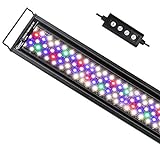
- Premium Choice: hygger Advanced LED Aquarium Light with Timer, 24/7 Lighting Cycle & DIY Mode, Full Spectrum Fish Tank Light for 48-54 in Freshwater Planted Tank
The best aquarium LED lights are the ones that match your tank’s length, plant demand, desired spectrum, mounting space, and timer needs—not simply the fixture with the highest wattage.
- Best Aquarium LED Lights by Tank Situation
- How to Choose the Right Spectrum
- Match Brightness to Plants and Tank Depth
- Choose the Correct Length and Coverage
- Mounting Style: Rim, Legs, or Suspended
- Timer Controls and Daily Light Settings
- Heat Output and Electrical Cost
- Freshwater, Planted, and Special-Tank Requirements
- Quick Buying Checklist
- Related Guides
Best Aquarium LED Lights by Tank Situation
| Tank situation | Recommended light class | Useful starting intensity | What to prioritize |
|---|---|---|---|
| Fish-only freshwater tank | Dimmable full-spectrum LED | 10–25 lumens per litre | Low heat, adjustable brightness, simple timer |
| Low-light planted tank | Full-spectrum planted-tank LED | 20–40 lumens per litre | Even coverage and a reliable 6–8 hour schedule |
| Medium-light planted tank | RGB or WRGB planted LED | 40–70 lumens per litre | Dimming, sunrise/sunset control, red and blue output |
| High-light or demanding plants | High-output WRGB or white/RGB fixture | 70+ lumens per litre | PAR data, cooling, height adjustment, CO2 compatibility |
| Long tank over 90 cm | Tank-length bar or two shorter fixtures | Set by plant position, not total wattage | End-to-end coverage and independent dimming |
Lumens are only a rough comparison because aquarium plants respond to usable light at the substrate, commonly measured as PAR. Still, the table provides a practical starting point when a manufacturer does not publish PAR maps. Start below the suggested range and increase gradually; excessive light is a common cause of algae.
As an Amazon Associate we earn from qualifying purchases at no extra cost to you.

How to Choose the Right Spectrum
For freshwater fish-only tanks, a neutral white or full-spectrum LED around 6,000–7,000K usually produces natural-looking water and accurate fish colors. You do not need a strong red or blue channel unless you prefer that appearance.
For planted aquariums, choose a fixture described as full-spectrum, RGB, or WRGB. Plants use several wavelength ranges for photosynthesis, while red LEDs can improve the appearance of green and red foliage. A red-heavy setting can make fish and plants look attractive, but it does not automatically mean better growth.
- White-heavy spectrum: Natural appearance and useful general-purpose growth.
- RGB spectrum: Stronger color rendering, especially for red plants and colorful fish.
- WRGB spectrum: Dedicated white, red, green, and blue emitters for a balanced appearance and flexible color control.
- Blue-heavy spectrum: Often visually dramatic but usually unnecessary for freshwater tanks and more likely to expose algae problems.
A good planted-tank setting usually begins with white at 60–80%, red at 20–40%, green at 20–40%, and blue at 20–35%. These are starting values, not universal targets. If algae appears before new leaves develop, reduce total intensity or photoperiod instead of adding more color channels.
Match Brightness to Plants and Tank Depth
Tank depth matters more than the aquarium’s water volume. A small, deep aquarium can need more powerful lighting than a long, shallow aquarium of the same capacity because light loses intensity as it travels through the water.
Low-light plants such as Anubias, Java fern, and many Cryptocoryne varieties can grow under modest output. Carpeting plants, red-stem plants, and compact plants placed far from the surface usually need more PAR. In a high-light planted tank, CO2 and adequate nutrients become increasingly important; adding a powerful light without those resources commonly produces algae rather than faster growth.
A practical brightness calculation
Suppose a tank holds 120 litres and you want moderate planted growth. Using a starting target of 45 lumens per litre gives:
120 litres × 45 lumens = 5,400 lumens at the tank
That figure is not a demand for a 5,400-lumen fixture because published lumens are measured at the LEDs, while the aquarium receives less after lens, height, and water losses. Treat it as a comparison point. A dimmable fixture rated around 4,000–6,000 LED lumens, mounted close to the water, may provide useful adjustment range; use PAR readings or plant response to refine the setting.
For a beginner, buying more output than necessary but using a dimmer is safer than buying a weak, non-adjustable light. The extra capacity also helps if you later add taller plants or raise the fixture.
Choose the Correct Length and Coverage
A light should cover the areas where plants actually grow. A fixture that is much shorter than the aquarium leaves dark ends, while an excessively long bar can waste light on the cabinet or create bright spots.
- 60 cm tank: Choose a fixture designed for approximately 45–60 cm, depending on its adjustable legs.
- 90 cm tank: Use a 75–90 cm bar or two shorter lights for more even coverage.
- 120 cm tank: A full-length 120 cm fixture is simplest; two 60 cm fixtures allow separate brightness zones.
- Very deep or densely planted tanks: Consider two parallel bars rather than one extremely bright bar. This reduces shadows and spreads light across the substrate.
Two fixtures can also solve a plant-layout problem. Place the brighter unit over demanding plants and the dimmer unit over Anubias or shade-tolerant plants. This is often more useful than increasing the output of one central fixture.
Mounting Style: Rim, Legs, or Suspended
Adjustable legs
Extendable legs are the easiest option for standard rimmed aquariums. They are stable, simple to remove, and keep the light close to the water. Confirm the fixture’s minimum and maximum span before buying, especially for curved or unusually wide tanks.
Rim-mounted brackets
Bracket-mounted lights work well with open-top aquariums and can leave more room for feeding. They are less suitable when the aquarium has a thick rim, rear equipment chamber, or large hang-on-back filter that occupies the mounting area.
Suspended fixtures
Suspension is useful for deep tanks, aquascapes, and lights that produce a wide spread. Raising a fixture by 10–20 cm softens hot spots and improves coverage, but it also reduces intensity at the substrate. Use a dimmer or PAR meter after changing the height.
Leave ventilation around the fixture and keep splash protection in mind. A light rated for humid environments is not necessarily safe to submerge, and condensation can damage power supplies or controllers.
Timer Controls and Daily Light Settings
The best aquarium LED lights for planted tanks should offer a dependable timer, not just manual brightness buttons. A consistent schedule is more important than elaborate effects.
Start with a total photoperiod of 6 hours per day for a new planted aquarium. After two weeks without significant algae, increase to 7 hours. Mature low-to-medium-light tanks often perform well at 7–8 hours. High-light tanks may need only 6–7 hours because their intensity is greater.
For a gradual schedule, use this example:
- 10:00–10:30: ramp from 0% to 60% brightness
- 10:30–16:30: hold at 60%
- 16:30–17:00: ramp down to 0%
- 17:00–10:00: lights off
Moonlight is optional and should be very dim. Blue light left on all night is not required by freshwater fish and can encourage algae. If the light has a built-in clock, check whether it retains the schedule after a power cut; a model that resets to full brightness can cause an unwanted algae spike.
Heat Output and Electrical Cost
LEDs produce less heat than fluorescent tubes or metal-halide lamps, but powerful aquarium LEDs still warm the water and the air above it. A sealed lid, poor ventilation, and a high-output fixture can raise temperature noticeably in a small tank.
As a rough example, a 45-watt light used for 8 hours daily consumes:
45 watts × 8 hours × 365 days ÷ 1,000 = 131.4 kWh per year
At an electricity rate of around $0 per kWh, that is about $26 per year. Actual power use depends on the dimmer setting; a fixture rated at 45 watts may draw substantially less when operated at 60%.
Choose a ventilated fixture with an external power supply when possible. Keep the light several centimeters above the water if the manufacturer permits it, and monitor tank temperature during the first week. If water temperature rises more than about 1–2°C, reduce intensity, improve room ventilation, or use a fan designed for aquarium use.
Freshwater, Planted, and Special-Tank Requirements
Freshwater fish-only tanks need visibility and a stable day-night rhythm, not maximum plant-growing output. A modest dimmable bar is usually the most economical choice.
Low-tech planted tanks without injected CO2 benefit from moderate light and conservative schedules. Choose easy plants first, then increase brightness only if growth is slow and algae remains controlled.
High-tech planted tanks with CO2 injection can use stronger WRGB or high-output full-spectrum fixtures. Look for published PAR measurements at the intended mounting height, active cooling, a robust timer, and enough dimming range to tune the light to your plant layout.
Do not select a freshwater fixture solely because it advertises reef or marine-spectrum output. Marine lights are designed around different visual and biological priorities and may be unnecessarily intense or blue for a freshwater planted aquarium.
Quick Buying Checklist
- Measure the tank’s actual length, width, and water depth.
- Identify whether the tank is fish-only, low-tech planted, or high-tech planted.
- Choose a fixture that spans the planted area, not merely the glass length.
- Prefer adjustable brightness over maximum fixed output.
- Choose full-spectrum, RGB, or WRGB output for planted tanks.
- Verify the mounting range and compatibility with the rim, lid, or filter.
- Check whether the timer resumes correctly after power loss.
- Allow for ventilation and monitor water temperature.
- Begin at moderate intensity and adjust after observing plants and algae for two weeks.
The right choice in 2026 is therefore a controllable, appropriately sized LED with enough output for the plants at the bottom of the tank, rather than the brightest model available. Match spectrum to appearance and plant type, match length to coverage, then tune brightness and hours gradually.







