- Top Pick: Incbruce Outdoor Swing Glider Rocking Chair Patio Bench for 2 Person, Garden Loveseat Seating Patio Steel Frame Chair Set with Cushion, Peacock Blue
- Best Value: Outsunny 2-Person Outdoor Glider Bench with Steel Frame, Black
- Premium Choice: VINGLI Outdoor Glider Wood Patio Chair with Cup Holders, Outdoor Bench Glider Loveseat with Smooth Rocking Mechanism, Heavy Duty 800 LBS
Best Porch Gliders: Choose the Right Frame and Size
The best porch gliders match your available space and climate first: choose a powder-coated metal frame for low-maintenance durability, solid wood for a classic look you’re willing to care for, or all-weather resin wicker for a softer appearance without natural-fiber upkeep. Then check the seat width, weight capacity, and glide mechanism—not just the style.
Wood vs. Metal vs. Wicker
Frame material affects more than appearance. It changes how much maintenance a glider needs, how it responds to rain and sun, and whether it feels sturdy in everyday use. “Wicker” describes a woven construction, so look for synthetic, UV-resistant resin wicker over an outdoor-rated frame rather than assuming every woven glider is weatherproof.
As an Amazon Associate we earn from qualifying purchases at no extra cost to you.


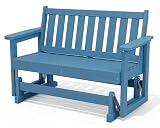
| Frame type | Best suited to | Weather and care | What to check |
|---|---|---|---|
| Solid wood | Traditional porches and buyers who value a natural finish | Needs periodic cleaning and, depending on the wood and finish, sealing or repainting | Wood species, joinery, finish, and whether hardware resists corrosion |
| Powder-coated metal | Frequent use and buyers seeking a sturdy, relatively low-care frame | Coating helps protect the frame; chipped areas and exposed hardware may still rust | Coating coverage, welds, drainage, and corrosion-resistant fasteners |
| Resin wicker on a metal frame | A woven look with less upkeep than natural wicker | UV-resistant resin tolerates outdoor exposure better than natural fiber; cushions still need care | Wicker material, frame underneath, weave security, and cushion storage guidance |
When wood makes sense
Wood can feel substantial and suits porches where the glider is part of a coordinated traditional design. The trade-off is upkeep: uncovered rain, strong sun, and repeated wet-dry cycles can wear finishes and stress wood over time. A covered porch helps, but does not eliminate maintenance. Ask whether the finish is intended for outdoor exposure and follow its care instructions.
When metal is the practical pick
Metal gliders often offer a rigid frame and a simple cleaning routine. Powder coating is a protective finish, not a guarantee against rust: scratches, poorly protected joints, and water trapped in hollow sections can become weak points. If your porch is exposed to salt air or persistent damp, prioritize corrosion-resistant hardware and inspect the frame regularly.
When to choose wicker
Resin wicker adds texture and can feel less visually industrial than metal. Its long-term performance depends on both the weave and the supporting frame. Natural wicker is generally a poor fit for an uncovered, wet location. For synthetic wicker, check that the product specifies outdoor use and UV resistance; cushions may need to come indoors even when the frame can remain outside.
Match Seating Capacity to Real Use
Product labels such as “two-person” are only a starting point. Measure the actual seat width and compare it with the space people need to sit comfortably. A narrow loveseat can technically seat two while feeling cramped, especially with wide armrests or thick cushions.
- One person: A single-seat glider suits a small porch or a reading spot. Check that the seat depth supports your posture without forcing your feet off the ground.
- Two people: A loveseat is a good fit for couples or occasional shared seating. Compare usable seat width—not the full outside width—to your household’s comfort needs.
- Three people: Choose a longer bench only if the porch has room for the frame and its full travel. A three-seat label does not mean three adults will have generous elbow room.
Check the stated maximum weight capacity and whether it applies to the whole seat or each seating position. Treat that figure as a limit, not a comfort rating. Also account for the combined weight of occupants, cushions, and anything else placed on the seat.
Measure the Porch Before Choosing a Glider
A glider moves forward and backward, so its footprint is larger in use than it appears in a static product photo. Measure the frame’s width, depth, and height, then confirm the manufacturer’s required clearance. If that information is not listed, leave extra room both in front and behind rather than placing the glider close to a wall or railing.
Here’s a useful planning calculation: if a glider is 30 inches deep and needs 12 inches of clearance at each end, reserve at least 54 inches of front-to-back space (30 + 12 + 12). This is a planning allowance, not a universal safety standard; the actual travel and clearance depend on the design. Mark the space on the floor with tape and check nearby doors, steps, and walking paths before ordering.
| Your situation | A sensible starting point | Why |
|---|---|---|
| Small covered porch, one regular user | Compact single-seat metal or wood glider | Preserves walkway space while keeping the seating footprint modest |
| Covered porch, two regular users | Two-seat glider sized by usable seat width | Balances shared seating with room for the glide path |
| Sunny or damp porch, minimal upkeep desired | Outdoor-rated metal or resin wicker with a corrosion-resistant frame | Reduces exposure-related maintenance; cushions may still need shelter |
| Traditional sheltered porch, natural materials preferred | Outdoor-finished solid-wood glider | Provides a classic appearance if you’re prepared to maintain the finish |
| Uncovered area with strong sun or frequent rain | Weather-rated frame plus a plan to cover or store cushions | Frame durability and cushion weather resistance are separate concerns |
How to Judge Glide Smoothness
A smooth glide comes from the mechanism, the frame’s alignment, and stable placement. Many gliders use metal linkages or bearings, but a product description may not reveal how well those parts are fitted. Look for a mechanism that moves evenly without scraping, looseness, or sharp changes in resistance, and check whether replacement hardware or assembly guidance is available.
When assembling a new glider, place it on a level, firm surface and tighten fasteners in the sequence given by the manufacturer. Uneven flooring or a twisted frame can cause rocking, binding, or squeaking that may be mistaken for a faulty mechanism. Recheck the fasteners after the initial period of use, following the care instructions. Do not lubricate a mechanism unless its manufacturer permits it; some components may need a particular lubricant or none at all.
Quick checks for noise or uneven movement
- Squeaking: Check for loose fasteners or contact between moving parts. Tighten only as instructed, and use lubricant only if the manual recommends it.
- Jerky travel: Confirm the glider is level and that the frame was assembled squarely. Check for a cushion, rug, or other object interfering with the mechanism.
- Side-to-side wobble: Inspect the floor and fasteners, then verify that the frame is not damaged. Stop using the glider if a linkage is bent or a joint is cracked.
- Changing resistance: Look for debris or an obstruction around the moving parts. Avoid forcing the seat through its travel.
Buying Checklist
- Measure the porch, including clearance for the full glide path.
- Compare usable seat width, seat depth, and stated weight capacity with how the glider will be used.
- Choose a frame material suited to your exposure and willingness to maintain it.
- Check the finish, joints, welds, fasteners, and mechanism—not just the visible seat surface.
- Confirm whether cushions are included, outdoor-rated, removable, or intended to be stored indoors.
- Read the assembly and maintenance instructions before purchase so you know what upkeep the design requires.
The right choice is the glider that fits the porch with its full movement, accommodates the people who will use it, and suits the local weather without demanding more care than you’re willing to give. For many households, a well-finished metal frame is the practical starting point; wood and resin wicker are strong alternatives when their appearance and maintenance trade-offs better match the space.
Ready to decide? Our #1 pick for 2026 is the Solid wood.
Live price & availability on Amazon.