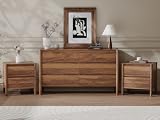
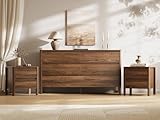
- Top Pick: CHUWELL Walnut Dresser Bedroom Set, 6 Drawer Dresser & 2 Drawer Nightstands
- Best Value: Walnut 3-Piece Bedroom Set, 6-Drawer Dresser & 2-Drawer Nightstands
- Premium Choice: Joaxswe 24" Wide Farmhouse Night Stand Set of 2,Large End Table with 3 Drawers & Metal Handle,Wood Dresser for Bedroom,Bed Side Table Chest of Drawers Cabinet,Natural Nightstand for Living Room,Closet
The best high end solid wood bedroom sets with dresser and nightstands are built around kiln-dried hardwood, dovetail drawers, durable low-VOC finishes, and a piece count that fits your room without forcing oversized furniture into narrow walkways.
- Quick Comparison: Which Set Fits Your Bedroom?
- What “High-End Solid Wood” Should Mean
- Wood Species: Head-to-Head
- Joinery and Drawer Construction Matter More Than Ornament
- Finish Durability: Match the Surface to Real Bedroom Use
- Included Pieces: Do Not Assume “Bedroom Set” Means a Complete Room
- Bedroom Size Fit: Calculate Before Ordering
- Delivery and Assembly Can Change the Value
- Best Buying Decision by Priority
- Final Buying Checklist
As an Amazon Associate we earn from qualifying purchases at no extra cost to you.


Quick Comparison: Which Set Fits Your Bedroom?
| Best for | Recommended wood | Useful set configuration | Typical market range | Main trade-off |
|---|---|---|---|---|
| Maximum durability and traditional styling | Hard maple or white oak | Dresser, mirror, two nightstands, bed | $3,000–$7,000+ | Heavy and often expensive |
| Warm appearance and visible grain | Black walnut | Dresser and two nightstands, optional bed | $4,000–$9,000+ | Higher price and softer surface than maple |
| Classic bedroom furniture at a lower premium | Cherry or rubberwood with solid-wood fronts | Dresser, two nightstands, optional mirror | $2,000–$5,000 | Cherry darkens over time; construction details vary |
| Small bedroom or apartment | Oak, maple, or painted poplar components | Six-drawer dresser and narrow nightstands | $1,800–$4,500 | May exclude the bed or mirror |
| Rustic, farmhouse, or industrial design | White oak, hickory, or reclaimed solid wood | Wide dresser, two nightstands, optional bed | $2,500–$6,500 | More variation in color, knots, and board movement |
What “High-End Solid Wood” Should Mean
A premium set should use solid wood for the structural rails, legs, drawer boxes, tops, and fronts—not merely a thin solid-wood veneer over engineered panels. Veneer is not automatically inferior; it can resist splitting and make large panels more stable. However, a product described as a solid-wood set should clearly identify where plywood, MDF, or veneer is used.
Look for kiln-dried lumber, stable frame construction, replaceable hardware, and a written care policy. Small knots and color variation are normal in natural wood. Widespread gaps, rough end grain, cloudy finish patches, or drawers that rack from side to side are not premium-level details.
Wood Species: Head-to-Head
Hard maple
Hard maple is one of the strongest choices for a heavily used bedroom. Its close grain handles repeated contact well, and its pale color suits modern, Scandinavian, and transitional rooms. It is usually less visually dramatic than walnut and can show dents less readily than softer woods. Because maple has a relatively tight grain, uneven staining can be noticeable, so clear or lightly pigmented finishes are often preferable.
White oak
White oak offers a strong balance of hardness, stability, and grain character. It works especially well with clear, natural, smoked, or wire-brushed finishes. Its pronounced grain hides minor marks better than very smooth, pale woods. Quarter-sawn oak can display distinctive ray patterns and is typically positioned at the premium end of the market.
Black walnut
Walnut is prized for its deep brown color and refined grain. It gives a bedroom a furniture-grade appearance without requiring ornate detailing. It is durable enough for normal bedroom use, but its darker surface can make dust and light scratches more visible. Walnut sets also command higher prices because of material cost and the amount of usable lumber required.
Cherry
Cherry has a smooth texture and warm reddish-brown tones that become deeper with light exposure. It suits traditional and transitional interiors. Expect the color to change during the first several years; placing one piece in direct sunlight while another remains shaded can create uneven aging.
Rubberwood, poplar, and mixed hardwoods
These woods can be sensible when used in the right places. Rubberwood is common in stable, value-oriented furniture, while poplar is frequently painted because its grain is less decorative. A premium set may combine a hardwood top and drawer fronts with a different solid wood for internal rails. That is acceptable if the specifications disclose the combination and the structural parts are properly joined.
Joinery and Drawer Construction Matter More Than Ornament
For a dresser, the critical stress points are the drawer joints, cabinet corners, stretcher rails, and leg-to-frame connections. Look for English or French dovetails at the drawer front and back. Dovetails mechanically resist the drawer front pulling away from the box. A glued-and-stapled butt joint can function adequately in light use, but it is not the same durability class.
- Best drawer bottoms: captured or fitted solid wood, or thick plywood seated in a groove.
- Acceptable drawer slides: full-extension, ball-bearing or concealed soft-close slides with a stated load rating.
- Useful load target: about 75–100 pounds per full-size clothing drawer, including the drawer itself.
- Strong case construction: mortise-and-tenon, pinned mortise joints, dowels, or carefully fitted corner blocks.
- Warning signs: thin stapled drawer boxes, bottom-mounted plastic rollers, visible case twisting, and drawers that open unevenly.
Soft-close hardware is convenient, but it does not compensate for a weak drawer box. Give priority to joinery, slide alignment, and a drawer bottom that will not sag under folded clothing.
Finish Durability: Match the Surface to Real Bedroom Use
Conversion varnish and catalyzed lacquer generally provide stronger resistance to moisture, cosmetics, and abrasion than basic oil-only finishes. A quality waterborne finish can also be durable while producing fewer odors during delivery and installation. Oil and wax finishes create a natural tactile surface and are easier to refresh, but they usually need more care and offer less protection from standing liquids.
For a nightstand, finish durability is particularly important because the top may encounter water glasses, charging devices, hand lotion, and cleaning products. Use coasters and wipe spills promptly regardless of the finish. Do not place hot mugs, damp towels, or alcohol-based products directly on the surface.
Included Pieces: Do Not Assume “Bedroom Set” Means a Complete Room
Manufacturers use “set” inconsistently. One package may include only a dresser and two nightstands, while another adds a bed, mirror, chest, and hardware. Before comparing prices, make a checklist:
- Dresser, chest, or both
- One or two nightstands
- Bed frame, headboard, and slat system
- Mirror and mounting hardware
- Center support legs for queen or king beds
- Anti-tip brackets
- Soft-close or full-extension slides
- Assembly tools and written instructions
A six-drawer dresser is often enough for one adult with a separate closet. A nine-drawer dresser or added chest makes more sense for shared storage, but it also increases wall length, weight, and delivery complexity.
Bedroom Size Fit: Calculate Before Ordering
Measure the room, not just the wall where the dresser will sit. A practical planning allowance is 30–36 inches for a normal walking path, 36–42 inches at the foot of a bed when possible, and the dresser’s full open-drawer depth plus at least 30 inches for standing space.
Here is a worked example. Suppose a dresser is 72 inches wide and 20 inches deep, and its drawers extend 18 inches. The wall needs at least 72 inches of uninterrupted width, while the operating zone needs approximately 20 + 18 + 30 = 68 inches of clear depth. If the opposite wall is only 60 inches away, the dresser may physically fit but will be uncomfortable to use.
| Room situation | Dresser width | Nightstand width | Best configuration |
|---|---|---|---|
| Small room or guest room | 48–60 inches | 18–24 inches | Six-drawer dresser and two narrow nightstands |
| Average primary bedroom | 60–72 inches | 22–28 inches | Six- or nine-drawer dresser with two nightstands |
| Large primary bedroom | 72–84 inches | 26–32 inches | Wide dresser, two substantial nightstands, and optional chest |
Delivery and Assembly Can Change the Value
Solid wood furniture is heavy. A tall dresser may weigh roughly 150–250 pounds, while a solid-wood bed can exceed 200 pounds once packaged. Confirm whether delivery is threshold, room-of-choice, or white-glove service. Check door, elevator, stairwell, and hallway dimensions, including corners where a boxed dresser cannot rotate upright.
Many premium sets arrive with the case assembled but require installation of legs, mirrors, handles, bed rails, or anti-tip hardware. Budget one to three hours for a dresser-and-nightstand group if the pieces are mostly assembled, and longer for a bed. Two adults are normally needed for safely moving large cases and aligning bed rails.
Do not skip wall anchoring on tall storage pieces. A dresser can tip when multiple drawers are open, especially on uneven flooring. Use the supplied restraint or a correctly rated replacement, and locate a wall stud whenever possible.
Best Buying Decision by Priority
- Choose white oak if you want visible grain, strong everyday durability, and a finish that suits both modern and traditional rooms.
- Choose hard maple if dent resistance and a clean, light appearance matter most.
- Choose walnut if visual richness is more important than minimizing cost.
- Choose cherry if you appreciate warm traditional furniture and are comfortable with gradual color changes.
- Choose a compact six-drawer configuration when a full set would reduce walking clearance below about 30 inches.
- Choose a modular dresser-and-nightstand package when you already own a bed or need to stage purchases around delivery access.
Final Buying Checklist
The strongest high-end set is not necessarily the largest or most decorative. Confirm the wood species for every major component, inspect drawer joinery and slide specifications, identify the finish type, calculate open-drawer clearance, verify exactly which pieces are included, and obtain the delivery and assembly terms in writing. Those checks reveal more about long-term value than a polished product photograph or a large advertised discount.
Ready to decide? Our #1 pick for 2026 is the Maximum durability and traditional styling.
Live price & availability on Amazon.