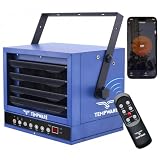
- Top Pick: Comfort Zone Hard-Wired Ceiling Mount Garage Space Heater with Remote, 7,500 Watt, 240 Volt, Fan-Forced, Overheat Protection, Digital Thermostat, 12-Hour Timer, Ideal for Garage & Workshop, CZ230ERBK
- Best Value: COMFORT ZONE 5000-Watt Fan-Forced Ceiling Mount Garage Heater – Grey
- Premium Choice: InoKraft 7500W Electric Garage Heater, 240V with NEMA 14-50P Plug
The best electric garage heaters for safe winter heating are hardwired 240V forced-air units between 5000W and 7500W for 2-car garages, and 1500W portable infrared units for insulated single-car spaces or supplemental heat, because they balance heating coverage, electrical safety, and operating cost without the combustion risks of gas heaters.
Choosing the right wattage and heater type depends entirely on your garage size, insulation, and available electrical circuit. An undersized heater will run constantly without reaching temperature, while an oversized heater on the wrong circuit will trip breakers and create a fire hazard.
As an Amazon Associate we earn from qualifying purchases at no extra cost to you.


How Much Wattage Do You Actually Need?
Electric heater output is directly tied to wattage. The common rule for garages is 10 watts per square foot for a well-insulated garage with finished walls and ceiling, and 12-15 watts per square foot for an uninsulated or drafty garage with bare studs and a non-insulated door.
| Garage Size | Insulated (10W/sq ft) | Uninsulated (15W/sq ft) | Ideal Heater Class |
|---|---|---|---|
| 240 sq ft (12×20 Single-Car) | 2,400W | 3,600W | 3000W – 4000W fan-forced |
| 400 sq ft (20×20 2-Car) | 4,000W | 6,000W | 5000W – 6000W ceiling mount |
| 576 sq ft (24×24 2.5-Car) | 5,760W | 8,640W | 7500W hardwired unit |
| 800+ sq ft (Workshop) | 8,000W+ | 12,000W+ | 7500W + supplemental 1500W infrared |
Voltage matters as much as wattage. 120V portable heaters max out at 1500W on a standard 15-amp household circuit due to electrical code limits. Anything above 1500W requires a dedicated 240V circuit, similar to an electric dryer or welder outlet. The most common safe garage heater classes in 2026 are:
- 120V 1500W Portable Fan-Forced / Infrared: Plug-and-play, heats 150-250 sq ft. Good for insulated single garages or as spot heating near a workbench.
- 240V 4000W-5000W Ceiling-Mounted Fan-Forced: The standard for 2-car garages. Requires a 30-amp double-pole breaker and 10-gauge wire.
- 240V 7500W Heavy-Duty Forced-Air: For large, poorly insulated workshops up to 600 sq ft. Requires a 40-amp double-pole breaker and hardwired installation.
Comparison: The Main Types of Electric Garage Heaters
| Heater Type | Typical Wattage / Voltage | Heating Coverage | Thermostat Control | Installation | Noise Level |
|---|---|---|---|---|---|
| Ceiling-Mounted Forced-Air (e.g., Fahrenheat FUH54, King Electric KB series) | 5000W-7500W / 240V | 400-600 sq ft | Built-in single or double-pole, adjustable 40-90F | Hardwired, ceiling bracket | Moderate (fan noise ~55-65 dB) |
| Wall-Mounted Fan-Forced (e.g., NewAir G73, Heat Storm HS-1500) | 4000W-6000W / 240V | 300-500 sq ft | Digital thermostat, often with remote or WiFi | Hardwired or plug-in 240V | Moderate-Low |
| Portable Infrared Radiant (e.g., Dr. Infrared Heater DR-988) | 1500W / 120V or 3000W / 240V | 150-300 sq ft (directional) | Digital thermostat with ECO mode | Portable, plug-in, no install | Very Low (nearly silent) |
| Portable Ceramic Fan-Forced | 1500W / 120V | 150-200 sq ft | Mechanical dial or digital | Portable, plug-in | Moderate |
1. Thermostat Control and Temperature Accuracy
This is where cheap and quality heaters diverge most. A mechanical bi-metal thermostat simply turns the heater fully on or off with a wide swing of 5-10 degrees, causing temperature overshoot and inefficient cycling.
Look for a digital thermostat with an accurate thermistor sensor and ECO or energy-saving mode. Models with a remote thermostat or WiFi control, like those in the Heat Storm and King Electric ECO2S lines, allow you to mount the temperature sensor away from the heater itself, which prevents short-cycling where the heater shuts off because hot air is trapped at the ceiling while the floor is still cold. For a garage you use as a workshop, set the thermostat to 50-55F for freeze protection when not in use, and 60-65F for working. Every degree above 65F increases energy use by roughly 3-5%.
2. Installation Requirements
Do not buy a 5000W+ heater until you confirm your electrical panel can support it. A 5000W heater at 240V draws 20.8 amps and requires a 30-amp breaker (125% of continuous load per NEC code). A 7500W heater draws 31.25 amps and requires a 40-amp breaker and 8-gauge wire.
Ceiling-mounted forced-air heaters are the safest for garages because they are out of the way of vehicles, flammable liquids, and floor clutter, and they distribute heat downward with a louvers-adjustable fan. They must be mounted at least 6 feet above the floor, 3 feet from any combustible material, and angled to not blow directly onto a vehicle. Wall-mounted units are easier to wire but should not be placed behind shelving that blocks airflow. All hardwired installations should be done by a licensed electrician and usually cost in the general market range of $200-$500 for wiring and breaker installation if your panel has capacity.
3. Safety Features You Should Not Skip
Garages contain gasoline, paint, sawdust, and chemicals, so safety certifications are non-negotiable. Only consider heaters that are UL or ETL listed for garage or workshop use.
- Overheat Protection: An automatic thermal cutoff that shuts the unit down if internal temperatures exceed safe limits, usually due to blocked airflow.
- Tip-Over Switch: Essential for any portable heater. It instantly cuts power if the unit is knocked over.
- Cool-Touch Housing and Grille: Prevents burns, important if children or pets access the garage.
- Single vs. Double-Pole Thermostat: A double-pole thermostat completely disconnects both hot legs of the 240V power when off, which is safer than a single-pole that leaves one leg energized.
Avoid using any portable heater with an extension cord or power strip. Plug it directly into a properly rated outlet. Forced-air garage heaters are designed for hardwired connections for this exact reason.
4. Noise and Heating Comfort
Fan-forced heaters heat the air quickly but the fan is audible. In a 2-car garage, a ceiling-mounted fan-forced unit will raise the temperature from 35F to 60F in about 15-25 minutes. Radiant infrared heaters are nearly silent and heat objects and people directly rather than the air, similar to sunlight. They do not stir up dust, which makes them better for woodworking shops or for someone working in one spot, but they will not uniformly heat a large, drafty garage. If you need silent operation for a garage gym or office, a wall-mounted infrared panel or low-noise ceramic unit is the better trade-off, even if it heats more slowly.
Worked Calculation: What Will It Cost to Run?
Operating cost is simple to calculate and often surprises buyers. Use this formula:
Cost per Hour = (Wattage / 1000) x Electricity Rate per kWh
Example for a typical 2-car garage in winter: You install a 5000W (5 kW) ceiling heater. Your utility rate is $0.155 per kWh, the 2026 US average residential rate. You work in the garage 4 hours per evening, 5 days a week, and the heater cycles on about 50% of the time once the space is warm due to the thermostat.
- Full-power cost: 5 kW x $0.155 = $0.775 per hour
- Effective cost with 50% duty cycle: $0.775 x 0.50 = $0.387 per hour
- Daily cost (4 hours): $0.387 x 4 = around $1 per day
- Monthly cost (20 workdays): around $1 x 20 = around $31 per month
Compare that to a 1500W portable heater running continuously to try to heat the same space and failing to reach temperature: 1.5 kW x $0.155 = $0.232 per hour, but because it never satisfies the thermostat it runs 100% of the time, costing around $0 for 4 hours with poor results. An undersized heater is not cheaper; it just runs longer and never makes the space comfortable.
For freeze protection only, setting a 5000W heater to 45F may only cycle 15-20 minutes per hour, dropping the hourly cost to under around $0.
Decision Matrix: Which Heater Class Fits Your Situation?
| Your Situation | Recommended Choice | Why |
|---|---|---|
| Insulated 1-car garage, standard 120V outlets only, occasional use | 1500W portable infrared or ceramic with digital thermostat | No electrical work needed, safe and quiet for small sealed space |
| 2-car attached garage, 240V access, daily workshop use | 5000W-6000W ceiling-mounted forced-air with double-pole thermostat | Fast, even heating; keeps floor space clear; safest for vehicles |
| Large detached, uninsulated workshop 500+ sq ft | 7500W hardwired forced-air + 1500W radiant for workbench | High output to overcome heat loss, radiant provides spot comfort |
| Garage gym or office conversion, noise-sensitive | Wall-mounted low-noise fan-forced or infrared panel with WiFi thermostat | Silent operation and precise temperature control for occupied space |
| Rental or no permission for electrical work | 120V 1500W portable, ETL listed for garages | Only plug-and-play option that does not violate lease or code |
Final Buying Checklist
Before you buy, confirm these four points in order: 1) Measure your garage square footage and check insulation level to determine required wattage, 2) Check your breaker panel for available 240V capacity or budget for an electrician, 3) Choose ceiling-mount forced-air for whole-garage heating or infrared for silent spot heating, and 4) Verify UL/ETL listing, overheat shutoff, and a double-pole or digital thermostat with an ECO mode. A heater that is correctly sized and safely installed will heat faster, cycle less, and cost less per month than a cheaper, undersized portable unit running at its limit.
Frequently Asked Questions
Can I run a 5000W garage heater on a dryer outlet?
Only if the outlet is correctly rated and the heater is designed for plug-in use. Most 5000W heaters are intended to be hardwired directly to a dedicated 30-amp breaker. Using a dryer outlet with an adapter or extension cord is not code-compliant and can overheat wiring. Have an electrician install a dedicated circuit.
Is it safe to leave an electric garage heater on overnight?
Only hardwired, thermostatically controlled, UL/ETL-listed garage heaters designed for unattended operation should be left on for freeze protection, typically set to 40-45F. Never leave a portable fan heater running unattended or overnight, and keep all combustibles at least 3 feet away from any heater.
Do I need to insulate my garage door before buying a heater?
You do not need to, but insulation dramatically lowers wattage needs and operating cost. An uninsulated garage door can account for 30-40% of heat loss. Adding an R-8 garage door insulation kit, usually $150-$350 in materials, can allow a 4000W heater to do the work of a 6000W heater.
Ready to decide? Our #1 pick for 2026 is the 240 sq ft (12×20 Single-Car).
Live price & availability on Amazon.