

- Top Pick: RocRow InkSonic R1390 13" DTF Printer with Oven for Custom Apparel | Easy-start T-shirt printing with an included laptop, white ink circulation, auto cleaning and 7/24 assistance.
- Best Value: A3 DTG Printer with Dual XP600 Printheads, 1440 DPI Direct to Garment Printer for Cotton T-Shirts, Hoodies and Canvas Bags, White Ink Circulation, Height Adjustable Platform, Complete Starter Kit
- Premium Choice: Generic Sublimation Heat Transfer Image Printing for T-shirts Ceramic Mugs Bags Heat Press Printer Bundle
For a small shop printing cotton shirts one at a time, the Epson SureColor F1070 is the entry-level machine reviewers cite most, while shops with steady volume look at the Epson SureColor F2270, the Brother GTX pro or the Ricoh Ri 1000; people who only want a few polyester shirts for personal use can skip direct-to-garment entirely and use a sublimation printer or heat transfer paper with an ordinary inkjet. The right pick depends on fabric, volume and how much you can spend on equipment and space.
As an Amazon Associate we earn from qualifying purchases at no extra cost to you.


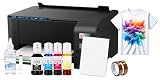

Three ways to print a shirt
Search phrases such as shirt printers, DTG printers and printers for t-shirt transfers describe three different methods, and the hardware is not interchangeable:
- Direct to garment (DTG): a specialized inkjet prints water-based ink straight into the fabric, usually with white ink so designs show on dark cotton. It is the high-end route.
- Direct to film (DTF): a printer prints onto a film, powder is applied, and a heat press transfers the design. It works on many fabrics and is covered by hybrid machines like the Epson F1070 and F2270.
- Sublimation and transfer paper: a desktop printer prints a transfer that a heat press bonds to the shirt. Sublimation only works on white or light polyester, while inkjet transfer paper works on cotton with a different look and feel.
T-shirt printers at a glance
| Model | Best for | Key stated specs | Limits |
|---|---|---|---|
| Epson SureColor F1070 | Startups and small shops | Retailers describe a 10 x 12 inch platen, CMYK plus two white inks in 250 mL packs, PrecisionCore Micro TFP printhead, UltraChrome DG2 ink, up to 2400 x 1200 dpi, DTG and DTF modes | About 10 shirts an hour with white ink per Epson’s FAQ; Epson ink packs only; weighs about 152 lb |
| Epson SureColor F2270 | Higher volume hybrid DTG/DTF | Reviewers describe CMYK plus white ink and platens up to 16 x 20 inches, sharing the printhead and ink family of the F1070 | Larger investment; needs workshop space |
| Brother GTX pro | Production DTG shops | Brother lists a 14 x 16 inch adult platen included, a maximum print size of 16 x 21 inches, 1200 x 1200 dpi, two print heads | Larger platens may be optional; production-sized machine |
| Ricoh Ri 1000 | Mid-volume custom shops | Reviewers cite up to about 16 x 19.6 inches | Commercial-class pricing and service needs |
| Sublimation printer (Epson F170, Sawgrass SG500) | Polyester shirts and gifts | Letter to legal size transfers with a heat press | White or light polyester only |
Best direct to garment printers
The F1070 is the usual starting point in 2026 roundups. Retail listings describe a 10 x 12 inch platen, CMYK plus two white ink channels, a PrecisionCore Micro TFP printhead and Epson UltraChrome DG2 ink supplied in cartridge-free ink packs. Epson’s FAQ, as reported by dealers, gives roughly 10 shirts an hour with white ink and 20 to 25 per hour without a white underbase, and positions the machine for about 100 to 200 shirts a month. The ink is Epson-only. Reviewers also stress the weight and size, about 35 by 28 by 17 inches and 152 pounds, so a sturdy table and a dedicated spot matter.
The F2270 is the production sibling. Dealers and reviewers describe it as a hybrid DTG and DTF machine with platens up to 16 x 20 inches, using the same printhead and ink family as the F1070, which makes it a natural upgrade. The cost is a much larger investment and a bigger footprint.
The Brother GTX pro is a DTG-only production machine from a maker with a long history in garment printing. Brother lists a 14 x 16 inch adult platen included, a maximum print size of 16 x 21 inches, 1200 x 1200 dpi and eight ink channels across two print heads. Youth and baby platens are optional extras. Ricoh’s Ri 1000 sits in the same bracket, with reviewers citing a print area of about 16 x 19.6 inches. Roundups suggest comparing these on support and service availability in your region, since downtime is expensive for a shop.
Best printers for t-shirt transfers and polyester shirts
If you do not want the cost and maintenance of a DTG machine, transfers are the practical alternative. Sublimation printers such as the Epson SureColor F170 or Sawgrass SG500 print mirrored designs that a heat press bonds into white or light polyester. Epson lists the F170 at an 8.5 inch maximum width, so it suits pocket prints and smaller graphics; larger front prints need the Sawgrass SG1000 or a wide-format printer. Reviewers point out that cotton shirts will not take sublimation dye, so you must buy polyester blanks.
For cotton, inkjet transfer paper is a hobby route. You print on special paper with an ordinary inkjet, then iron or press it on. The result usually feels thicker and is less durable than DTG, but it requires no special printer. Check the paper’s instructions for temperature and washing guidance, and use the heat press safely, since it can burn skin.
Running costs and maintenance
- DTG ink: white ink is the main expense and needs regular circulation or maintenance; follow the maker’s schedule or the print heads can clog.
- Pretreatment: dark garments generally need a pretreatment solution applied and cured before printing.
- Heat press: required for curing DTG, applying DTF and pressing sublimation.
- Sublimation consumables: ink, transfer paper and polyester blanks; the blank usually costs more than the ink.
- Space and power: production machines are heavy and may need a dedicated work area and an appropriate electrical supply; consult an electrician if unsure.
Setup and compatibility
The Epson F1070 lists support for Windows 8.1 64-bit or later and macOS 10.12 or later, USB 3.0 and Gigabit Ethernet, with Epson Garment Creator 2 software and cloud monitoring. DTG machines usually require a RIP or the maker’s software to manage white ink layers. Sublimation printers such as the F170 include print software for Mac and Windows. Whatever you buy, practice on inexpensive shirts first, because pretreatment amount, print settings and cure time all affect wash durability.
Fabric and durability notes
Garment color and fiber drive the choice of method. DTG with white ink suits 100 percent cotton and high-cotton blends, and pretreatment helps the ink sit on the surface of dark garments. DTF is more forgiving of fabric type, which makes it popular for blends, polyester and bags. Sublimation is limited to white or light polyester. Washing instructions matter too: reviewers recommend turning garments inside out and following the ink maker’s cure and wash guidance so the print lasts.
Because every method relies on heat, a good heat press is part of the budget. Even-pressure clamshell and swing-away designs are common, and the right size depends on the platen or transfer size. Treat the press as a hot appliance, keep it on a stable surface and read the manual before use.
Pick X if you…
| Pick | If you… |
|---|---|
| Epson SureColor F1070 | want an entry-level DTG and DTF machine for small batches |
| Epson SureColor F2270 | plan to grow to production volumes and want larger platens |
| Brother GTX pro | run a dedicated DTG shop with high daily output |
| Ricoh Ri 1000 | want a commercial DTG option with Ricoh service |
| Epson F170 or Sawgrass SG500 | only print light polyester shirts and gifts |
| Inkjet with transfer paper | want a few cotton shirts without special equipment |
Alternatives
- Dedicated DTF printers: machines built only for film transfers can be cheaper than hybrids and print on many fabrics.
- Screen printing: better for large runs of the same design.
- Outsourced print-on-demand: no equipment or maintenance, at a per-shirt cost.
Frequently Asked Questions
What is the best t-shirt printer for beginners?
For cotton and dark shirts, reviewers most often name the Epson SureColor F1070 as the entry-level DTG and DTF machine. For light polyester shirts only, a sublimation printer such as the Epson F170 is a smaller and simpler start.
Can a normal printer print t-shirts?
An ordinary inkjet can print on transfer paper, which you then press or iron onto a shirt. It will not print directly on fabric, and the results are usually less durable than DTG.
What is the difference between DTG and DTF?
DTG prints ink directly into the fabric, while DTF prints onto film that is transferred with powder and heat. DTF works on more fabric types, and hybrid machines like the Epson F1070 and F2270 offer both modes.
Do DTG printers need white ink maintenance?
Yes. White ink settles, so these printers have circulation and cleaning routines, and the maker’s manual specifies how often to use or maintain the machine. Neglect can clog the printheads.
Can I use sublimation on cotton shirts?
No. Sublimation dye bonds with polyester, so it needs white or light polyester shirts. Cotton and dark shirts need DTG, DTF or transfer paper.
How many shirts can an entry-level DTG make?
Epson’s FAQ, as reported by dealers, gives about 10 shirts an hour with white ink for the F1070, and the machine is positioned for roughly 100 to 200 shirts a month. Actual output depends on design, pretreatment and curing.







