
Best High-End 16-Channel PoE Camera Systems With NVR: The Short Answer
The best high-end 16-channel PoE camera system with an NVR is one whose recorder can power and record your intended cameras simultaneously, not simply one with “16 channels” on the box. For a demanding installation, look for 16 PoE ports, at least 200–250 W of PoE capacity, 4K recording support, room for multiple surveillance hard drives, useful person-and-vehicle detection, and a clear path to add cameras or storage.
- Best High-End 16-Channel PoE Camera Systems With NVR: The Short Answer
- What to Compare Before Choosing a System
- Head-to-Head: Bundled Kit or Modular System?
- Calculate PoE Headroom Before You Connect 16 Cameras
- Estimate Storage Instead of Guessing
- Match Features to the Property
- Night Vision, AI Detection, and Remote Access
- Expansion: Avoid a 16-Channel Dead End
- Bottom Line
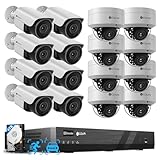
There is no single ideal kit for every property. A bundled system is easier to deploy; a separate NVR and camera lineup gives you more control over optics, analytics, and future upgrades. The key comparison is the complete recording chain: camera resolution and frame rate, NVR decoding and recording bandwidth, PoE power, storage retention, and access to footage when you are away.
As an Amazon Associate we earn from qualifying purchases at no extra cost to you.



What to Compare Before Choosing a System
| Requirement | High-end target | Why it matters |
|---|---|---|
| Camera channels | 16 PoE ports, or 16 supported channels with a separate PoE switch | Channel count and built-in port count are not always the same. |
| Camera resolution | 4K for critical views; 4–8 MP for general coverage | Higher resolution helps identify details but increases bandwidth and storage use. |
| PoE capacity | About 200–250 W for a 16-camera installation | High-power cameras with heaters, PTZ movement, or illuminators draw more than basic models. |
| Recording bandwidth | At least 160 Mbps for a robust 16-camera, 4K setup | The recorder must accept the combined camera bit rate, not just display live feeds. |
| Storage | Multiple drive bays and support for surveillance-rated HDDs | More bays extend retention without forcing a compromise on recording quality. |
| Outdoor rating | IP66 or IP67 for exposed cameras | Weather resistance depends on the camera enclosure and installation, not the NVR. |
Head-to-Head: Bundled Kit or Modular System?
Choose a bundled 16-channel kit for a simpler installation
A kit typically pairs a 16-channel recorder with matching cameras, cables, and a shared app. This reduces configuration work and makes it easier to confirm basic compatibility. It is a good fit when the cameras will cover similar areas and the included resolution, field of view, and analytics meet your needs.
Check the kit’s actual NVR specifications before buying: “16 channel” may mean 16 supported IP cameras while the chassis has fewer than 16 built-in PoE ports. Some recorders also limit the number of simultaneous 4K streams or have a lower total recording bitrate than the channel count suggests. A kit can be a poor choice if cameras cannot be mixed with other brands or if the recorder has only one drive bay.
Choose a modular system for mixed distances and more control
A separate NVR, PoE switch, and camera selection makes it easier to use a narrow-angle camera on a driveway, a wide-angle model in a yard, and a varifocal camera at a gate. Systems based on established IP-camera standards can offer broader choices, but compatibility is not automatic: features such as motion zones, audio, smart events, and camera configuration may work differently across manufacturers.
For example, the Synology DVA series is an NVR platform with video analytics capabilities, while Reolink sells NVRs and PoE cameras as part of its own ecosystem. These are different approaches, not interchangeable 16-camera kits; verify the exact model’s channel limit, PoE provision, supported resolution, and feature compatibility before planning around it.
Calculate PoE Headroom Before You Connect 16 Cameras
PoE budgets are a practical limit, not a marketing detail. Add the maximum power draw listed for each camera, then leave roughly 20% headroom for startup spikes, cold-weather operation, and future additions.
Worked example: Suppose 12 fixed cameras draw up to 9 W each and four cameras with stronger illuminators draw up to 15 W each. The total is (12 × 9) + (4 × 15) = 168 W. With 20% headroom, plan for at least 202 W of available PoE power. A 200 W recorder would be marginal; a 240 W unit or a separate PoE switch with sufficient capacity is the safer choice.
Use each camera’s maximum specified draw, not its average daytime consumption. Also check whether the NVR’s published PoE budget is shared across all ports, and whether a high-power port supports the PoE standard required by a PTZ or heater-equipped camera.
Estimate Storage Instead of Guessing
Resolution alone does not determine storage use. Frame rate, scene movement, codec, and bitrate matter too. For a quick estimate, divide the total recording bitrate in megabits per second by eight to get megabytes per second, then multiply by the number of seconds in a day.
Suppose 16 cameras each average 6 Mbps while recording continuously. That is 96 Mbps total, or 12 MB/s. Over 24 hours, this is about 1.04 TB per day before formatting and filesystem overhead. A nominal 16 TB drive therefore holds roughly 15 days at that rate in ideal conditions; actual retention will be lower. Motion-based recording can extend retention, but busy roads, rain, moving foliage, and insects can trigger frequent recording.
Use the NVR manufacturer’s storage calculator when available, and select drives intended for surveillance workloads. If retention is important, verify the recorder’s supported drive size, number of bays, RAID options, and whether RAID reduces usable capacity.
Match Features to the Property
| Your situation | Prioritize | Trade-off to watch |
|---|---|---|
| Long driveway or gate | Varifocal optics, adequate night illumination, and a focused detection zone | A wide-angle 4K image may still leave a distant face too small to identify. |
| Large yard or building perimeter | Weather-rated cameras, low-light performance, and person/vehicle filtering | More cameras improve coverage but raise power and retention requirements. |
| Retail or office entrances | Higher frame rates at key entrances, clear facial views, and event search | Analytics may require compatible cameras or a specific NVR model. |
| Existing mixed-brand cameras | Documented ONVIF support and confirmed event compatibility | Basic video may work while smart detections or audio do not. |
Night Vision, AI Detection, and Remote Access
Infrared night vision is common, but range claims do not guarantee useful identification at that distance. Trees, walls, glass, and reflective surfaces can create glare or wash out a nearby subject. For a critical entrance, place the camera close enough for detail, avoid aiming infrared directly at a wall, and consider separate lighting if color footage at night is important.
AI detection is most useful when it reduces irrelevant alerts. Look for person and vehicle classification, configurable zones, and sensitivity controls. Set zones to exclude roads or swaying branches, then test alerts at different times of day. Analytics can vary by camera and recorder, so confirm whether events are processed on the camera, on the NVR, or in the cloud.
For remote access, favor a system with a maintained mobile app, multi-user permissions, and secure account controls. Enable two-factor authentication where offered, use unique passwords, update firmware, and avoid exposing the recorder’s management interface directly to the internet. A VPN is a more controlled option for remote viewing when you can configure one safely.
Expansion: Avoid a 16-Channel Dead End
If you expect to add cameras, check both the NVR’s maximum supported channels and its available ports. A 16-channel NVR may support only 16 cameras total, even if you connect an external switch; another model may support more channels but require that switch from the start. Also check incoming bandwidth, maximum resolution per channel, drive bays, and whether the recorder can record and play back all streams at once.
For a new installation, leave spare PoE capacity and at least one free storage or expansion option if practical. If you need more than 16 views later, it may be cheaper to buy a recorder with a higher channel limit now than to replace the entire NVR.
Bottom Line
For a straightforward installation, choose a reputable matched kit whose NVR has enough recording bandwidth, at least 200 W of PoE for a typical high-end 16-camera build, and expandable storage. For mixed camera positions, specialized optics, or a likely expansion beyond 16 cameras, a modular NVR and PoE-switch setup offers more flexibility. In either case, size the system around your required identification distance and retention period—not just the camera count or headline resolution.